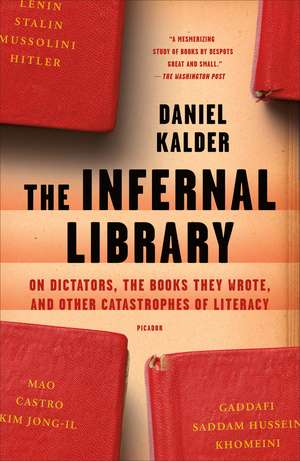
Infernal Library
Autor Daniel Kalderen Limba Engleză Paperback – 2 apr 2019
-The Washington Post
A darkly humorous tour of "dictator literature" in the twentieth century, featuring the soul-killing prose and poetry of Hitler, Mao, and many more, which shows how books have sometimes shaped the world for the worse
Since the days of the Roman Empire dictators have written books. But in the twentieth-century despots enjoyed unprecedented print runs to (literally) captive audiences. The titans of the genre-Stalin, Mussolini, and Khomeini among them-produced theoretical works, spiritual manifestos, poetry, memoirs, and even the occasional romance novel and established a literary tradition of boundless tedium that continues to this day.
How did the production of literature become central to the running of regimes? What do these books reveal about the dictatorial soul? And how can books and literacy, most often viewed as inherently positive, cause immense and lasting harm? Putting daunting research to revelatory use, Daniel Kalder asks and brilliantly answers these questions.
Marshalled upon the beleaguered shelves of The Infernal Library are the books and commissioned works of the century's most notorious figures. Their words led to the deaths of millions. Their conviction in the significance of their own thoughts brooked no argument. It is perhaps no wonder then, as Kalder argues, that many dictators began their careers as writers.
Preț: 157.73 lei
Puncte Express: 237
Carte disponibilă
Livrare economică 03-17 noiembrie
Livrare prin curier în România Termenul estimat este afișat lângă disponibilitate.
Transport gratuit de la 400.00 lei Plată online sau ramburs, în funcție de opțiunile comenzii.
Retur gratuit în 14 zile Comandă securizată și suport în română.
Specificații
ISBN-13: 9781250181602
ISBN-10: 1250181607
Pagini: 398
Ilustrații: Includes 13 black-and-white photographs throughout
Dimensiuni: 152 x 229 x 24 mm
Greutate: 0.41 kg
Editura: St. Martins Press-3pl
ISBN-10: 1250181607
Pagini: 398
Ilustrații: Includes 13 black-and-white photographs throughout
Dimensiuni: 152 x 229 x 24 mm
Greutate: 0.41 kg
Editura: St. Martins Press-3pl
Notă biografică
Daniel Kalder was born in Fife, Scotland in 1974. He studied English Literature at Edinburgh University. In 1994 he was selected as one of the BBCs Young Poets of the Year. Kalder moved to Russia in 1997, where he found himself living in Smolensk, the only foreigner in the city, totally alone, unable to speak the language or read the alphabet. He loved it. He discovered an alternate universe of names, scientists, architecture, books, art, and music. And so Kalders obsession with anti-tourism began. In 2001, he published his first short story inChapman, Scotlands top literary magazine, but he subsequently abandoned short story writing and set about writingLost Cosmonaut. He has produced articles on various themes ranging from CIA-approved torture techniques to how to swallow swords to the history of Lenins corpse for a number of magazines in the UK and Moscow under a myriad of pseudonyms. And, so, for the last ten years Kalder has lived in the former Soviet Union applying himself to several different trades, though he has never sold arms or human organs.
Cuprins
Introduction: Tradition and the Individual Tyrant
Phase I: The Dictator's Canon
1. Lenin
2. Stalin
3. Mussolini
4. Hitler
5. Mao
Phase II: Tyranny and Mutation
1. Small Demons
2. Catholic Action
3. Disembraining Machines
4. Eastern Approaches
5. Dead Letters
6. Another Green World
Phase III: Dissolution and Madness
1. Midnight in the Garden of Ultraboredom
2. North Korea: The Metafictions of Kim Jong-il
3. Cuba: Castro's Maximum Verbiage
4. Iraq: The Historical Romances of Saddam Hussein
5. Post-Soviet: Comrade Zoroaster
6. Turkmenistan: Post-everything
Phase IV: Death Is Not the End
Conclusion
Selected Bibliography
Index
Phase I: The Dictator's Canon
1. Lenin
2. Stalin
3. Mussolini
4. Hitler
5. Mao
Phase II: Tyranny and Mutation
1. Small Demons
2. Catholic Action
3. Disembraining Machines
4. Eastern Approaches
5. Dead Letters
6. Another Green World
Phase III: Dissolution and Madness
1. Midnight in the Garden of Ultraboredom
2. North Korea: The Metafictions of Kim Jong-il
3. Cuba: Castro's Maximum Verbiage
4. Iraq: The Historical Romances of Saddam Hussein
5. Post-Soviet: Comrade Zoroaster
6. Turkmenistan: Post-everything
Phase IV: Death Is Not the End
Conclusion
Selected Bibliography
Index