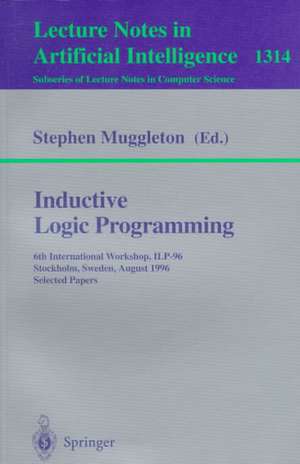
Inductive Logic Programming
Editat de Stephen Muggletonen Limba Engleză Paperback – 3 sep 1997
The 21 full papers were carefully reviewed and selected for inclusion in the book in revised version. Also included is the invited contribution "Inductive logic programming for natural language processing" by Raymond J. Mooney. Among the topics covered are natural language learning, drug design, NMR and ECG analysis, glaucoma diagnosis, efficiency measures for implementations and database interaction, program synthesis, proof encoding and learning in the absence of negative data, and least generalizations under implication ordering.
Preț: 327.92 lei
Preț vechi: 409.89 lei
-20%
Puncte Express: 492
Carte tipărită la comandă
Livrare economică 30 noiembrie-14 decembrie
Livrare prin curier în România Termenul estimat este afișat lângă disponibilitate.
Transport gratuit de la 400.00 lei Plată online sau ramburs, în funcție de opțiunile comenzii.
Retur gratuit în 14 zile Comandă securizată și suport în română.
Specificații
ISBN-13: 9783540634942
ISBN-10: 3540634940
Pagini: 412
Ilustrații: X, 402 p.
Dimensiuni: 155 x 235 x 23 mm
Greutate: 0.62 kg
Ediția:1997
Editura: Springer
Locul publicării:Berlin, Heidelberg, Germany
ISBN-10: 3540634940
Pagini: 412
Ilustrații: X, 402 p.
Dimensiuni: 155 x 235 x 23 mm
Greutate: 0.62 kg
Ediția:1997
Editura: Springer
Locul publicării:Berlin, Heidelberg, Germany
V-ar putea interesa
-
 -28%Preț: 428.82 lei597.47 lei
 -
 Machine Intelligence 15Koichi Furukawa-37%Preț: 773.51 lei1236.37 lei
 -
 The ZX Spectrum UlaChristopher David Smith-20%Preț: 246.85 lei308.57 lei
 -
 Digital Logic DesignGuy Even-20%Preț: 426.99 lei533.74 lei
 -
 Comp Arch Security CWang-9%Preț: 806.13 lei885.86 lei
 -
 Vision Architectures CJeong-20%Preț: 870.22 lei1087.78 lei
 -
 Enterprise Content and Search Management for Building Digital PlatformsShailesh Kumar Shivakumar-20%Preț: 528.34 lei660.43 lei
 -
 -20%Preț: 315.34 lei394.17 lei
 -
 CoCo: The Colorful History of Tandy’s Underdog ComputerBoisy G Pitre-20%Preț: 383.02 lei478.78 lei
 -
 Reconfigurable Multipipeline Computing StructuresIgor A Kalyaev-35%Preț: 1171.03 lei1811.74 lei
 -
 Latest Advances in Inductive Logic ProgrammingStephen Muggleton-20%Preț: 583.66 lei729.57 lei
 -
 -20%Preț: 927.73 lei1159.66 lei
 -
 System ArchitectureWolfgang J. Paul-20%Preț: 362.83 lei453.53 lei
 -
 -20%Preț: 400.33 lei500.42 lei
 -
 Logischer Entwurf digitaler SystemeHans Liebig-20%Preț: 546.11 lei682.64 lei
 -
 -20%Preț: 345.19 lei431.49 lei
 -
 -20%Preț: 407.50 lei509.38 lei
 -
 Inductive Logic ProgrammingStephen Muggleton-20%Preț: 334.21 lei417.76 lei
 -
 Anwendungsorientierte MikroprozessorenHelmut Bähring-20%Preț: 317.79 lei397.24 lei
 -
 Inductive Logic ProgrammingStephen Muggleton-20%Preț: 341.41 lei426.76 lei
 -
 Facing the Multicore-Challenge IIIRainer Keller-20%Preț: 298.82 lei373.53 lei
 -
 Computer Engineering and TechnologyWeixia Xu-20%Preț: 326.86 lei408.58 lei
 -
 Decision Theory with Imperfect InformationRafik A. Aliev-20%Preț: 992.33 lei1240.41 lei
Public țintă
ResearchCuprins
Inductive logic programming for natural language processing.- An initial experiment into stereochemistry-based drug design using inductive logic programming.- Applying ILP to diterpene structure elucidation from 13C NMR spectra.- Analysis and prediction of piano performances using inductive logic programming.- Noise detection and elimination applied to noise handling in a KRK chess endgame.- Feature construction with inductive logic programming: A study of quantitative predictions of biological activity by structural attributes.- Polynomial-time learning in logic programming and constraint logic programming.- Analyzing and learning ECG waveforms.- Learning rules that classify ocular fundus images for glaucoma diagnosis.- A new design and implementation of progol by bottom-up computation.- Inductive logic program synthesis with DIALOGS.- Relational knowledge discovery in databases.- Efficient ?-subsumption based on graph algorithms.- Integrity constraints in ILP using a Monte Carlo approach.- Restructuring chain datalog programs.- Top-down induction of logic programs from incomplete samples.- Least generalizations under implication.- Efficient proof encoding.- Learning Logic programs with random classification noise.- Handling Quantifiers in ILP.- Learning from positive data.- ?-Subsumption and its application to learning from positive-only examples.