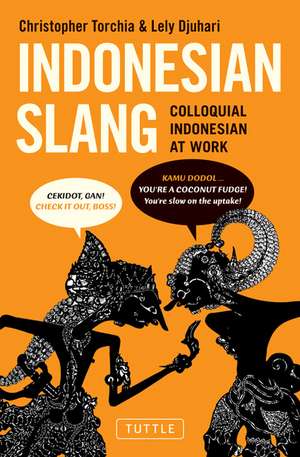
Indonesian Slang: Colloquial Indonesian at Work
Autor Christopher Torchia, Lely Djuharien Limba Engleză Paperback – 10 sep 2011
Cekidot, gan! — "Check it out, Boss!"
Kamu Dodol — "You're a coconut fudge!" (You're slow on the uptake.)
More than a phrasebook, Indonesian Slang explores the colorful informal language that reveals the humor, history and character of modern Indonesia. Covering slang, proverbs, quotations, acronyms, nicknames and regional expressions, it offers fascinating insights into Indonesian culture while helping readers understand how the language is really spoken.
Each expression is presented with its original wording, an English translation, an explanation of its meaning, and background on its origin or cultural context. Readers will also discover how Indonesian has evolved through influences from Malay, Javanese, Sanskrit, Arabic, Chinese, Dutch, Portuguese and English, reflecting the rich cultural history of the Indonesian archipelago.
Organized by theme, including food, politics, personalities and everyday life, this engaging reference is an entertaining resource for language learners, travelers and anyone interested in Indonesian culture.
Preț: 117.55 lei
Puncte Express: 176
Carte disponibilă
Livrare economică 02-16 noiembrie
Livrare prin curier în România Termenul estimat este afișat lângă disponibilitate.
Transport gratuit de la 400.00 lei Plată online sau ramburs, în funcție de opțiunile comenzii.
Retur gratuit în 14 zile Comandă securizată și suport în română.
Specificații
ISBN-13: 9780804842075
ISBN-10: 0804842078
Pagini: 288
Dimensiuni: 133 x 203 x 15 mm
Greutate: 0.3 kg
Ediția:Original.
Editura: Tuttle Publishing
Colecția Tuttle Publishing
ISBN-10: 0804842078
Pagini: 288
Dimensiuni: 133 x 203 x 15 mm
Greutate: 0.3 kg
Ediția:Original.
Editura: Tuttle Publishing
Colecția Tuttle Publishing
V-ar putea interesa
-
 McGraw-Hill's Dictionary of American Idioms DictionaryRichard Spears-15%Preț: 238.97 lei281.16 lei
 -
 Preț: 108.17 lei
 -
 The Dialects of ItalyDr Martin Maiden-18%Preț: 1711.96 lei2087.77 lei
 -
 -15%Preț: 564.45 lei664.06 lei
 -
 Creolization of Language and CultureRobert Chaudenson-18%Preț: 1118.81 lei1364.41 lei
 -
 Creolization of Language and CultureRobert Chaudenson-15%Preț: 430.77 lei506.79 lei
 -
 Word from the Mother: Language and African AmericansGeneva SmithermanPreț: 424.43 lei
 -
 Dialectical Approaches to Studying Personal RelationshipsBarbara M. MontgomeryPreț: 434.52 lei
 -
 Hoi Toide on the Outer BanksWalt WolframPreț: 149.26 lei
 -
 Bislama Reference GrammarTerry CrowleyPreț: 220.86 lei
 -
 Preț: 339.23 lei
 -
 Preț: 218.31 lei
 -
 Nero, S: Englishes in ContactShondel NeroPreț: 175.82 lei
 -
 Methods and Data in English Historical DialectologyRoger G. Lass-27%Preț: 847.41 lei1160.84 lei
 -
 Eploring the Boundaries of Caribbean Creole LanguagesHazel Simmons-McDonaldPreț: 290.22 lei
 -
 Preț: 340.85 lei
Recenzii
"For each colloquial expression, the authors also provide some background information to add some context. Some of these insights are quite illuminating… " —Alterity Blog
"…it takes these slang words or expressions and gives you the background to how these expressions came about into daily use. It places these expressions in historical context too so as well as learning some of the language you are also getting a history and geography lesson about Indonesia too. Perfect!" —Sinead Lawson, Juice on Jakarta Blog
"This is an absolutely wonderful book - less Indonesian learning tool than a whirlwind tour through the culture, history and politics of an insanely complex archipelago, and it really is Indonesia in a nutshell." —Escape Artists Blog
"…it takes these slang words or expressions and gives you the background to how these expressions came about into daily use. It places these expressions in historical context too so as well as learning some of the language you are also getting a history and geography lesson about Indonesia too. Perfect!" —Sinead Lawson, Juice on Jakarta Blog
"This is an absolutely wonderful book - less Indonesian learning tool than a whirlwind tour through the culture, history and politics of an insanely complex archipelago, and it really is Indonesia in a nutshell." —Escape Artists Blog
Notă biografică
Christopher Torchia is the Turkey bureau chief for The Associated Press, based in Istanbul. He was previously posted with the AP in Singapore, South Korea, Indonesia and Colombia, as well as several U.S. cities. He is the co-author of How Koreans Talk.
Lely Djuhari is a communication specialist based in Geneva, Switzerland. Prior to that, she reported on social and political issues in Indonesia, East Timor and on Indian Ocean tsunamis for Kyodo News and the AP.
Lely Djuhari is a communication specialist based in Geneva, Switzerland. Prior to that, she reported on social and political issues in Indonesia, East Timor and on Indian Ocean tsunamis for Kyodo News and the AP.
Cuprins
ò Introduction ò Part I: Life Forms 1. Creatures 2. Chracters 3. Body Languageò Part II: Power and Conflict 4. Authoritarian Rule 5. Money and Politics 6. Protest Fever7. A History of Violenceò Part III: Tradition 8. Faith and Fortune 9. A Matter of Taste 10. Family Affairs11. Wisdomò Part IV: Modern Life 12. Around Town 13. Insults and the Underground 14. Hanging OutSourcesIndex