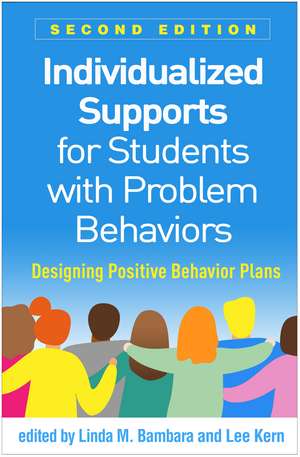
Individualized Supports for Students with Problem Behaviors, Second Edition: Designing Positive Behavior Plans
Editat de Linda M. Bambara, Lee Kernen Limba Engleză Hardback – 28 apr 2021
New to This Edition
*Incorporates current tools and practices within an expanded, whole-school PBS approach.
*Chapters on multi-tiered systems of support and the fundamentals of classroom management.
*Chapter on writing, monitoring, and evaluating a complete PBS plan.
*Two extended case examples that run through many of the chapters.
*“Commentaries from the Field” in which leading experts reflect on the contributions, challenges, and future directions of PBS.
Preț: 539.50 lei
Preț vechi: 708.66 lei
-24%
Puncte Express: 809
Carte indisponibilă temporar
Doresc să fiu notificat când acest titlu va fi disponibil:
Se trimite...
Specificații
ISBN-13: 9781462545834
ISBN-10: 1462545831
Pagini: 470
Dimensiuni: 152 x 229 x 36 mm
Greutate: 0.87 kg
Ediția:2nd edition
Editura: Guilford Publications
Colecția Guilford Press
ISBN-10: 1462545831
Pagini: 470
Dimensiuni: 152 x 229 x 36 mm
Greutate: 0.87 kg
Ediția:2nd edition
Editura: Guilford Publications
Colecția Guilford Press
Public țintă
Professional Practice & DevelopmentCuprins
1. Evolution of Positive Behavior Support, Linda M. Bambara, Raquel Burns, & Amanda Thomas
2. Schoolwide Systems of Positive Behavior Support, Angus Kittleman, Kent McIntosh, Sara C. McDaniel, Heather Peshak George, & Timothy J. Lewis
3. Supportive Classroom Contexts, Diane Myers, Sarah Wilkinson, Janet VanLone, Jennifer Freeman, & Brandi Simonsen
4. Understanding the Environmental Determinants of Problem Behaviors, Glen Dunlap, Joshua Harrower, & Lise Fox
5. Overview of the Individualized Behavior Support Process, Linda M. Bambara & Julie B. Fogt
6. Teaming, Linda M. Bambara & Jacquelyn Chovanes
7. Strategies for Measuring Behavior Change, Raymond G. Miltenberger & Jennifer L. Cook
8. Gathering Functional Assessment Information, Lee Kern, Robert E. O’Neill, Jennifer M. Fletcher, & John Mercer
9. Developing Hypothesis Statements, Lee Kern & Colleen E. Commisso
10. Antecedent and Setting Event Interventions, Lee Kern & Shelley Clarke
11. Teaching Alternative Skills, Joe Reichle, Jessica Simacek, James Halle, & Linda M. Bambara
12. Responding to Problem Behavior, Lee Kern, Rui Chen, & Devon Carter
13. Long-Term Supports, Tim Knoster, Laura Kern, Don Kincaid, & Danielle Empson
14. Putting It All Together: Developing, Monitoring, and Evaluating the Behavior Support Plan, Linda M. Bambara & Lee Kern
Index
2. Schoolwide Systems of Positive Behavior Support, Angus Kittleman, Kent McIntosh, Sara C. McDaniel, Heather Peshak George, & Timothy J. Lewis
3. Supportive Classroom Contexts, Diane Myers, Sarah Wilkinson, Janet VanLone, Jennifer Freeman, & Brandi Simonsen
4. Understanding the Environmental Determinants of Problem Behaviors, Glen Dunlap, Joshua Harrower, & Lise Fox
5. Overview of the Individualized Behavior Support Process, Linda M. Bambara & Julie B. Fogt
6. Teaming, Linda M. Bambara & Jacquelyn Chovanes
7. Strategies for Measuring Behavior Change, Raymond G. Miltenberger & Jennifer L. Cook
8. Gathering Functional Assessment Information, Lee Kern, Robert E. O’Neill, Jennifer M. Fletcher, & John Mercer
9. Developing Hypothesis Statements, Lee Kern & Colleen E. Commisso
10. Antecedent and Setting Event Interventions, Lee Kern & Shelley Clarke
11. Teaching Alternative Skills, Joe Reichle, Jessica Simacek, James Halle, & Linda M. Bambara
12. Responding to Problem Behavior, Lee Kern, Rui Chen, & Devon Carter
13. Long-Term Supports, Tim Knoster, Laura Kern, Don Kincaid, & Danielle Empson
14. Putting It All Together: Developing, Monitoring, and Evaluating the Behavior Support Plan, Linda M. Bambara & Lee Kern
Index
Notă biografică
Linda M. Bambara, EdD, is Professor Emerita and former Program Director of Special Education at Lehigh University. Her expertise in developmental disabilities spans over 40 years, and includes research in the areas of social communication, self-determination, and self-management interventions, as well as positive behavior support for individuals’ challenging behaviors. While at Lehigh University, she directed two university-based service programs for transition-age youth and adults with developmental disabilities. A former editor-in-chief of Research and Practice for Persons with Severe Disabilities, Dr. Bambara has served on the editorial boards of five academic journals; is author of numerous articles, chapters, and books; and has served on the national boards of the disability advocacy organization TASH and the Association for Positive Behavior Support.
Lee Kern, PhD, is Professor of Special Education, Director of the Center for Promoting Research to Practice, and Director of Autism Services at Lehigh University. She has worked in the field of special education since the 1980s as a classroom teacher, behavior specialist, consultant, and faculty member. Her research interests focus on severe challenging behavior, functional assessment, and curricular interventions, primarily with individuals with social, emotional, and behavioral needs. She has published numerous articles and book chapters in these areas. Her research on strategies to address children’s behavioral challenges has been supported by the U.S. Department of Education and the National Institute of Mental Health. Dr. Kern is past coeditor of the Journal of Positive Behavior Interventions and serves on the editorial boards of seven education journals.
Lee Kern, PhD, is Professor of Special Education, Director of the Center for Promoting Research to Practice, and Director of Autism Services at Lehigh University. She has worked in the field of special education since the 1980s as a classroom teacher, behavior specialist, consultant, and faculty member. Her research interests focus on severe challenging behavior, functional assessment, and curricular interventions, primarily with individuals with social, emotional, and behavioral needs. She has published numerous articles and book chapters in these areas. Her research on strategies to address children’s behavioral challenges has been supported by the U.S. Department of Education and the National Institute of Mental Health. Dr. Kern is past coeditor of the Journal of Positive Behavior Interventions and serves on the editorial boards of seven education journals.
Recenzii
"Building on the first edition, special education luminaries Bambara and Kern provide updated practical guidance for school and allied professionals. Following an outstanding review of PBS foundations, comprehensive, step-by-step procedures are presented for PBS implementation, including integrative case examples and a range of relevant resources and tools. Without question, this book is a critical asset for school professionals and for students in university preservice training programs. I am grateful to Bambara, Kern, and their cast of national leaders for this important contribution."--Mark D. Weist, PhD, Department of Psychology, University of South Carolina
"Presenting recent advances in research and practice, the second edition of this work provides a practical, step-by-step framework for developing and implementing individualized behavior supports. The editors and contributors share their collective wisdom, expertise, and experience, using a collaborative, team-based approach and keeping the central focus of the process on the student and family. Readers are able to clearly see the underlying foundation, processes, and outcomes of PBS. Whether you are a teacher educator or are working in schools to support students with problem behaviors, this user-friendly guide should be an integral part of your toolkit! I recommend this book for classes dealing with functional behavioral assessment at either the graduate or undergraduate level."--Maureen A. Conroy, PhD, Anita Zucker Endowed Professor in Early Childhood Studies and Professor of Special Education, School Psychology, and Early Childhood Studies, University of Florida
"This second edition is a timely update on a critical topic. The book covers essential theoretical foundations of the PBS approach and expertly weaves in practical advice for addressing real-life situations. In a clear and engaging style, it explores important contemporary issues for educators and interventionists who seek to improve quality of life for individuals with challenging behaviors. Bambara, Kern, and their esteemed contributors bring the science to life with rich case examples. Like the first edition, this is an indispensable go-to text--I know I will use it whenever I teach students about designing effective positive behavior supports."--Grace Gengoux, PhD, BCBA-D, Department of Psychiatry and Behavioral Sciences, Stanford University School of Medicine
"Contributors emphasize an interdisciplinary, team-based approach to problem solving, making this book appealing to a broad readership, including inservice and preservice educators, school psychologists, and behavior analysts. This text would be great for use in a course on behavior intervention and assessment. Readers gain foundational knowledge on how individual supports fit into the broader context of multi-tiered systems, as well as how to systematically design and evaluate individualized behavior interventions. Case examples throughout the book are especially helpful. On a personal note, I particularly enjoyed the end-of-chapter commentaries from giants in the field. They are a great roadmap of where we’ve been and where we need to go to support some of our most vulnerable students by using positive, respectful, evidence-based, data-driven interventions."--Allison Bruhn, PhD, Scanlan Center for School Mental Health, University of Iowa-
"Presenting recent advances in research and practice, the second edition of this work provides a practical, step-by-step framework for developing and implementing individualized behavior supports. The editors and contributors share their collective wisdom, expertise, and experience, using a collaborative, team-based approach and keeping the central focus of the process on the student and family. Readers are able to clearly see the underlying foundation, processes, and outcomes of PBS. Whether you are a teacher educator or are working in schools to support students with problem behaviors, this user-friendly guide should be an integral part of your toolkit! I recommend this book for classes dealing with functional behavioral assessment at either the graduate or undergraduate level."--Maureen A. Conroy, PhD, Anita Zucker Endowed Professor in Early Childhood Studies and Professor of Special Education, School Psychology, and Early Childhood Studies, University of Florida
"This second edition is a timely update on a critical topic. The book covers essential theoretical foundations of the PBS approach and expertly weaves in practical advice for addressing real-life situations. In a clear and engaging style, it explores important contemporary issues for educators and interventionists who seek to improve quality of life for individuals with challenging behaviors. Bambara, Kern, and their esteemed contributors bring the science to life with rich case examples. Like the first edition, this is an indispensable go-to text--I know I will use it whenever I teach students about designing effective positive behavior supports."--Grace Gengoux, PhD, BCBA-D, Department of Psychiatry and Behavioral Sciences, Stanford University School of Medicine
"Contributors emphasize an interdisciplinary, team-based approach to problem solving, making this book appealing to a broad readership, including inservice and preservice educators, school psychologists, and behavior analysts. This text would be great for use in a course on behavior intervention and assessment. Readers gain foundational knowledge on how individual supports fit into the broader context of multi-tiered systems, as well as how to systematically design and evaluate individualized behavior interventions. Case examples throughout the book are especially helpful. On a personal note, I particularly enjoyed the end-of-chapter commentaries from giants in the field. They are a great roadmap of where we’ve been and where we need to go to support some of our most vulnerable students by using positive, respectful, evidence-based, data-driven interventions."--Allison Bruhn, PhD, Scanlan Center for School Mental Health, University of Iowa-
Descriere
Noted for providing everything needed to develop individualized positive behavior support (PBS) plans for students with pervasive behavioral challenges, this authoritative guide has been revised and expanded to reflect 15 years of changes in the field.