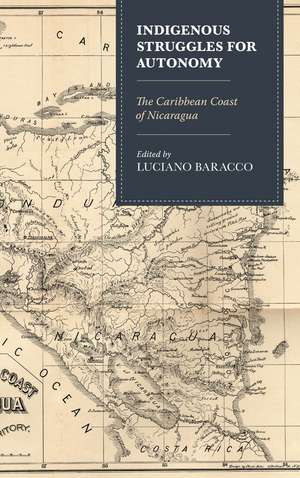
Indigenous Struggles for Autonomy: The Caribbean Coast of Nicaragua
Editat de Luciano Baracco Contribuţii de Govand Khalid Azeez, Arelly Barbeyto, Dolores Figueroa Romero, Jane Freeland, Alejandra Gaitán-Barrera, Miguel González, Colette Grinevald, Mark Jamieson, Joshua L. Mayer, Eric Rodrigo Meringeren Limba Engleză Hardback – 29 noi 2018
Preț: 583.24 lei
Preț vechi: 864.02 lei
-32%
Puncte Express: 875
Carte tipărită la comandă
Livrare economică 30 noiembrie-14 decembrie
Livrare prin curier în România Termenul estimat este afișat lângă disponibilitate.
Transport gratuit pentru acest produs Plată online sau ramburs, în funcție de opțiunile comenzii.
Retur gratuit în 14 zile Comandă securizată și suport în română.
Specificații
ISBN-13: 9781498558815
ISBN-10: 149855881X
Pagini: 258
Ilustrații: 4 b/w photos; 3 maps;
Dimensiuni: 158 x 232 x 20 mm
Greutate: 0.52 kg
Editura: Bloomsbury Publishing
Colecția Lexington Books
Locul publicării:New York, United States
ISBN-10: 149855881X
Pagini: 258
Ilustrații: 4 b/w photos; 3 maps;
Dimensiuni: 158 x 232 x 20 mm
Greutate: 0.52 kg
Editura: Bloomsbury Publishing
Colecția Lexington Books
Locul publicării:New York, United States
Cuprins
Chapter 1. Indigenous Struggles for Autonomy: The Caribbean Coast of Nicaragua
Luciano Baracco
Chapter 2. From the Kingdom of Mosquitia to the Mosquito Reservation: The Demise of British Imperialism on the Mosquito Coast and the Challenge of Nicaraguan Nation-Building
Luciano Baracco
Chapter 3. The Company Times: Neocolonialism and Ethnic Relations on Nicaragua's Caribbean Coast in the Twentieth Century
Eric Rodrigo Meringer
Chapter 4. The Sandinista Revolution and the Caribbean Coast of Nicaragua: Revolution, Counter-Revolution, and Indigenous Struggles for Autonomy
Luciano Baracco
Chapter 5. Leasing Communal Lands.In "Perpetuity": Post-Titling Scenarios on the Caribbean Coast of Nicaragua
Miguel González
Chapter 6. Negotiating Consultation: The Duty to Consult and Contestation of Autonomy in Nicaragua's Rama-Kriol Territory
Joshua L. Mayer
Chapter 7. Autonomy in the Caribbean Coast: Neoliberalism, Landless Peasants and the Resurgence of Ethnic Conflict
Govand Khalid Azeez and Alejandra Gaitán-Barrera
Chapter 8. Strong Women: Memories of Miskitu Women forging Peace and Autonomy
Dolores Figueroa Romero and Arelly Barbeyto
Chapter 9. Cocaine Money, Cement Houses, and New Residential Arrangements in a Coastal Miskitu Village
Mark Jamieson
Chapter 10. The Role of Autonomy in the Revitalization of the Languages of Nicaragua's
Caribbean Coast
Jane Freeland and Colette Grinevald
Index
About the Editor
About the Contributors
Luciano Baracco
Chapter 2. From the Kingdom of Mosquitia to the Mosquito Reservation: The Demise of British Imperialism on the Mosquito Coast and the Challenge of Nicaraguan Nation-Building
Luciano Baracco
Chapter 3. The Company Times: Neocolonialism and Ethnic Relations on Nicaragua's Caribbean Coast in the Twentieth Century
Eric Rodrigo Meringer
Chapter 4. The Sandinista Revolution and the Caribbean Coast of Nicaragua: Revolution, Counter-Revolution, and Indigenous Struggles for Autonomy
Luciano Baracco
Chapter 5. Leasing Communal Lands.In "Perpetuity": Post-Titling Scenarios on the Caribbean Coast of Nicaragua
Miguel González
Chapter 6. Negotiating Consultation: The Duty to Consult and Contestation of Autonomy in Nicaragua's Rama-Kriol Territory
Joshua L. Mayer
Chapter 7. Autonomy in the Caribbean Coast: Neoliberalism, Landless Peasants and the Resurgence of Ethnic Conflict
Govand Khalid Azeez and Alejandra Gaitán-Barrera
Chapter 8. Strong Women: Memories of Miskitu Women forging Peace and Autonomy
Dolores Figueroa Romero and Arelly Barbeyto
Chapter 9. Cocaine Money, Cement Houses, and New Residential Arrangements in a Coastal Miskitu Village
Mark Jamieson
Chapter 10. The Role of Autonomy in the Revitalization of the Languages of Nicaragua's
Caribbean Coast
Jane Freeland and Colette Grinevald
Index
About the Editor
About the Contributors
Recenzii
Written by well-known specialists in the field and based on extensive fieldwork, this book offers new perspectives on the historical preconditions and current contradictions of Nicaragua's autonomy process. The book demonstrates then as now Nicaraguan governments consider the Atlantic coast primarily a source of natural resources.
Once in the eye of a colossal geopolitical storm, the Atlantic Coast of Nicaragua faded back into the margins of public awareness soon after the intense conflict of the 1980s subsided. Yet the struggle for autonomy-one major factor in that conflict-has continued, with equally high stakes and lessons to be learned for similar struggles elsewhere. The "post-conflict" scholars of this volume offer insightful analysis of these discouraging subsequent years, along with provocative revisions of existing historical interpretations, which merit serious and sustained engagement. This book persuasively shows how Black and indigenous Nicaraguan protagonists of these struggles for autonomy, though often invisibilized and always buffeted by more powerful forces, continue to exert a profound influence on the course of Nicaraguan and Caribbean Central American history.
Once in the eye of a colossal geopolitical storm, the Atlantic Coast of Nicaragua faded back into the margins of public awareness soon after the intense conflict of the 1980s subsided. Yet the struggle for autonomy-one major factor in that conflict-has continued, with equally high stakes and lessons to be learned for similar struggles elsewhere. The "post-conflict" scholars of this volume offer insightful analysis of these discouraging subsequent years, along with provocative revisions of existing historical interpretations, which merit serious and sustained engagement. This book persuasively shows how Black and indigenous Nicaraguan protagonists of these struggles for autonomy, though often invisibilized and always buffeted by more powerful forces, continue to exert a profound influence on the course of Nicaraguan and Caribbean Central American history.