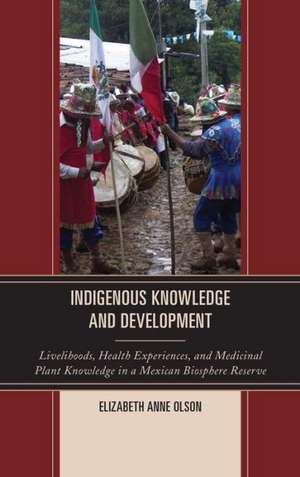
Indigenous Knowledge and Development: Livelihoods, Health Experiences, and Medicinal Plant Knowledge in a Mexican Biosphere Reserve
Autor Elizabeth Anne Olsonen Limba Engleză Hardback – 21 feb 2014
Preț: 594.11 lei
Preț vechi: 910.31 lei
-35%
Puncte Express: 891
Carte tipărită la comandă
Livrare economică 30 noiembrie-14 decembrie
Livrare prin curier în România Termenul estimat este afișat lângă disponibilitate.
Transport gratuit pentru acest produs Plată online sau ramburs, în funcție de opțiunile comenzii.
Retur gratuit în 14 zile Comandă securizată și suport în română.
Specificații
ISBN-13: 9780739176634
ISBN-10: 0739176633
Pagini: 200
Ilustrații: 10 BW Illustrations, 11 Tables
Dimensiuni: 158 x 234 x 21 mm
Greutate: 0.43 kg
Ediția:New.
Editura: Bloomsbury Publishing
Colecția Lexington Books
Locul publicării:New York, United States
ISBN-10: 0739176633
Pagini: 200
Ilustrații: 10 BW Illustrations, 11 Tables
Dimensiuni: 158 x 234 x 21 mm
Greutate: 0.43 kg
Ediția:New.
Editura: Bloomsbury Publishing
Colecția Lexington Books
Locul publicării:New York, United States
Descriere
Indigenous Knowledge and Development: Livelihoods, Health Experiences, and Medicinal Plant Knowledge in a Mexican Biosphere Reserveprovides an ethnographic account of a group of indigenous people living in a natural resource protected area in west central Mexico. The political, economic, and social history of these indigenous Nahua people is related to their cultural knowledge. As an anthropological study, the analysis presented in this book is based on household level socioeconomic data and cultural knowledge measured through the use of both structured and semi-structured interviews. The study presented here moves back and forth between the macro- and micro- to explore the relationships between three central axes-health, livelihood and cultural knowledge. The Sierra of Manantlán Biosphere Reserve is the fieldsite where this study was carried out during 2007 and 2008. This Reserve is governed by explicit goals of cultural and natural resource preservation. Exhaustive household censuses give a comprehensive view of livelihood activities, and individual health experiences are measured using a structured interview. Demonstrated through the economic activity profiles present in the study sample, the indigenous people in the Reserve subsist through low-intensity agriculture, animal husbandry, and paid labor. Political histories of Mexico and the Reserve, specifically, continually shape subsistence strategies and the agrarian communities. Medical pluralism and the health profile in Mexico influence the local-level health status and access to health care services in the Reserve, demonstrated by the persistence of medicinal plant knowledge. The interviews with medicinal plant experts and biomedical practitioners are used to illustrate the spectrum of opinions regarding usage of medicinal plants across the three study communities in the Reserve. Significantly, there is neither a direct nor linear relationship between the loss of cultural knowledge and increasing modernity. This research contributes to ethnographic knowledge about conservation and cultural heritage on protected areas in Mexico.
Cuprins
List of Figures
List of Tables
List of Abbreviations
Preface
Acknowledgments
1. Introduction
2. Sierra of Manantlán Biosphere Reserve
3. Conservation and Subsistence Strategies
4. Market Interaction and Indigenous People
5. Governance: Community Decision-Making
6. Indigenous People and Development Programs
7. Ethnomedical Systems in Mexico
8. Medicinal Plant Knowledge in the Reserve
9. Final Thoughts
Glossary
Bibliography
Index
About the Author
List of Tables
List of Abbreviations
Preface
Acknowledgments
1. Introduction
2. Sierra of Manantlán Biosphere Reserve
3. Conservation and Subsistence Strategies
4. Market Interaction and Indigenous People
5. Governance: Community Decision-Making
6. Indigenous People and Development Programs
7. Ethnomedical Systems in Mexico
8. Medicinal Plant Knowledge in the Reserve
9. Final Thoughts
Glossary
Bibliography
Index
About the Author
Recenzii
A systematic and meticulous study of community and environmental health, Olson's contribution may serve to strengthen biodiversity conservation initiatives lastingly and effectively.
As human population, growth, and globalization leave no society or economy unaffected, this volume focuses on an interesting and increasingly important topic: the erosion of indigenous knowledge about human health and natural resources. Dr. Olson focuses on medicinal plant knowledge, an important area of traditional ecological knowledge, in indigenous communities of the Sierra de Manantlán Biosphere Reserve. Applying a variety of ethnographic methods, Olson's case study is thorough, insightful, and provocative. As integrated conservation and sustainable development projects and environmental justice achieves the attention it deserves, works such as this will be instrumental to identify how the human development index can be achieved.
In Indigenous Knowledge and Development: Livelihoods, Health Experiences, and Medicinal Plant Knowledge in a Mexican Biosphere Reserve, Elizabeth Olson develops the three axes of traditional medical knowledge, sustainable activities, and the maintenance of indigenous patterns and deftly explores each one and their various intersections. It is well worthwhile to see a case of the cultural maintenance and contributions to modern practices such as sustainability. This interesting and informative text bridges several areas of concern about indigenous populations and modernization.
As human population, growth, and globalization leave no society or economy unaffected, this volume focuses on an interesting and increasingly important topic: the erosion of indigenous knowledge about human health and natural resources. Dr. Olson focuses on medicinal plant knowledge, an important area of traditional ecological knowledge, in indigenous communities of the Sierra de Manantlán Biosphere Reserve. Applying a variety of ethnographic methods, Olson's case study is thorough, insightful, and provocative. As integrated conservation and sustainable development projects and environmental justice achieves the attention it deserves, works such as this will be instrumental to identify how the human development index can be achieved.
In Indigenous Knowledge and Development: Livelihoods, Health Experiences, and Medicinal Plant Knowledge in a Mexican Biosphere Reserve, Elizabeth Olson develops the three axes of traditional medical knowledge, sustainable activities, and the maintenance of indigenous patterns and deftly explores each one and their various intersections. It is well worthwhile to see a case of the cultural maintenance and contributions to modern practices such as sustainability. This interesting and informative text bridges several areas of concern about indigenous populations and modernization.