India After Modi: Populism and the Right: Bloomsbury India
Autor Ajay Gudavarthyen Limba Engleză Hardback – 18 noi 2018
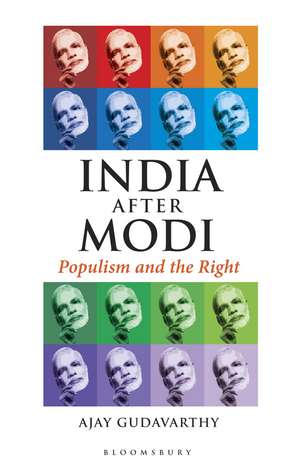
India after Modi attempts to address these questions through an analysis of events like Award Wapsi, demonetization, the crisis in JNU and higher education, and electoral outcomes, including in the states of Bihar, Delhi and Uttar Pradesh. Through this collection of essays, Ajay Gudavarthy focuses exclusively on Indian democracy after Narendra Modi took over as the prime minister in 2014. He looks at the politics that India has been witnessing since then and addresses emerging issues in Indian democracy, including that of women's participation, new urban spaces, and the role of youth.
Din seria Bloomsbury India
- 26%
 Preț: 78.77 lei
 - 27%
 Preț: 50.90 lei
 - 28%
 Preț: 100.75 lei
 - 26%
 Preț: 171.30 lei
 - 32%
 Preț: 124.61 lei
 - 28%
 Preț: 94.93 lei
 - 28%
 Preț: 66.12 lei
 - 26%
 Preț: 79.17 lei
 - 26%
 Preț: 53.68 lei
 - 28%
 Preț: 65.97 lei
 - 27%
 Preț: 77.58 lei
 - 27%
 Preț: 86.37 lei
 - 32%
 Preț: 147.05 lei
 - 31%
 Preț: 145.23 lei
 - 7%
 Preț: 60.04 lei
 - 7%
 Preț: 59.93 lei
 - 55%
 Preț: 46.89 lei
 - 27%
 Preț: 66.10 lei
 - 25%
 Preț: 54.18 lei
 - 28%
 Preț: 65.80 lei
Preț: 187.99 lei
Preț vechi: 264.09 lei
-29%
Puncte Express: 282
Carte disponibilă
Livrare economică 02-16 noiembrie
Livrare prin curier în România Termenul estimat este afișat lângă disponibilitate.
Transport gratuit de la 400.00 lei Plată online sau ramburs, în funcție de opțiunile comenzii.
Retur gratuit în 14 zile Comandă securizată și suport în română.
Specificații
ISBN-13: 9789388038829
ISBN-10: 9388038827
Pagini: 266
Dimensiuni: 135 x 216 mm
Editura: Bloomsbury Publishing
Colecția Bloomsbury India
Seria Bloomsbury India
Locul publicării:New Delhi, India
ISBN-10: 9388038827
Pagini: 266
Dimensiuni: 135 x 216 mm
Editura: Bloomsbury Publishing
Colecția Bloomsbury India
Seria Bloomsbury India
Locul publicării:New Delhi, India
Cuprins
I: POPULISM AND AUTHORITARIANISM
Introduction
Populist-Authoritarianism in India
Populism and the Strongman: From Modi to Yogi
Award Wapsi: Reasoning with Intolerance
Why the RSS Projects JNU as Anti-National?
Autonomy of Universities and a Life of the Mind
Demonetization and the 'War on Terror'
Corporate Capitalism, Hurt Pride, and Hindutva
Populism and Mass Violence: The Liberal-Illiberal Dilemma
Populism and Popular Culture: Are Muslims the Safest Enemy to Have?
Hyper-Electoralism and Pakoda Nationalism
Theorizing Populism in India
II: STATE(S) OF DEMOCRACY
Introduction
What Did BJP's Defeat in Delhi Tell Us?
Does Bihar Hold the Key to the Future of Indian Politics?
Populism and Caste Calculus in Uttar Pradesh
Telangana: The Question of Internal Colonization
Kashmir: Is It Also a Question of Internal Colonization?
Kashmiri Pandits: Precariats of Indian Democracy
Of What Value Is NOTA?
Towards 2019: Opposition Needs to Rally Behind Mayawati
BJP's Strategy for 2019
III: DALIT-BAHUJAN POLITICS
Introduction
After Rohith Vemula: Is the Dalit-Muslim Unity Sustainable?
Dalit-Bahujans and Fraternity: From Ambedkar to Kancha Illiah
Unity between the Left and the Dalit-Bahujans
Caste, Authenticity, and the Oriental Spirit
IV: FUTURE OF POLITICS
Introduction
Nehru and the Rise of Modi
Bringing Justice Back In
Women and the Future of Democracy
Anxiety, Anger, and Anomie: Mobilizing Generation Next
India's Oscillating Public Sphere
Social Ethics of Violence and the Maoist Movement in India
Introduction
Populist-Authoritarianism in India
Populism and the Strongman: From Modi to Yogi
Award Wapsi: Reasoning with Intolerance
Why the RSS Projects JNU as Anti-National?
Autonomy of Universities and a Life of the Mind
Demonetization and the 'War on Terror'
Corporate Capitalism, Hurt Pride, and Hindutva
Populism and Mass Violence: The Liberal-Illiberal Dilemma
Populism and Popular Culture: Are Muslims the Safest Enemy to Have?
Hyper-Electoralism and Pakoda Nationalism
Theorizing Populism in India
II: STATE(S) OF DEMOCRACY
Introduction
What Did BJP's Defeat in Delhi Tell Us?
Does Bihar Hold the Key to the Future of Indian Politics?
Populism and Caste Calculus in Uttar Pradesh
Telangana: The Question of Internal Colonization
Kashmir: Is It Also a Question of Internal Colonization?
Kashmiri Pandits: Precariats of Indian Democracy
Of What Value Is NOTA?
Towards 2019: Opposition Needs to Rally Behind Mayawati
BJP's Strategy for 2019
III: DALIT-BAHUJAN POLITICS
Introduction
After Rohith Vemula: Is the Dalit-Muslim Unity Sustainable?
Dalit-Bahujans and Fraternity: From Ambedkar to Kancha Illiah
Unity between the Left and the Dalit-Bahujans
Caste, Authenticity, and the Oriental Spirit
IV: FUTURE OF POLITICS
Introduction
Nehru and the Rise of Modi
Bringing Justice Back In
Women and the Future of Democracy
Anxiety, Anger, and Anomie: Mobilizing Generation Next
India's Oscillating Public Sphere
Social Ethics of Violence and the Maoist Movement in India
Recenzii
India after Modi does not merely condemn. It takes the job of a critique seriously by pointing out the many ways in which the BJP has offered numerous marginal as well as once-powerful but recently disempowered groups a fraternal space of recognition as Hindus. In a climate of generalized anxiety and rampant hatred, such people have been emboldened to seek vigilante justice by attacking Muslims as the safest enemy. Gudavarthy's book is complex and deeply disturbing.
This timely book diligently captures the qualitative kink in the history of postcolonial India with the help of various markers.a heady mix of European fascism and Indian Brahmanism.A must-read for all those who wish to understand the complex reality of contemporary India.
This book, which eschews mere moral condemnation of the Right in India to analyse its current ascendancy, and the corresponding stasis of the Left and Liberal forces, is a bold and imaginative work by a political theorist. No matter how one reacts to the author's arguments, they demand one's serious engagement.
In this timely and important book, Ajay Gudavarthy offers a compelling and critical commentary on Indian politics. The writing is engaging and jargon-free, and the analysis acute. Whilst titled India after Modi the book does not spare any political party. Rather, it offers sharp insights into the current state of Indian politics, how we got here, and where we might be headed. A must-read for all those wishing to understand the complex politics of the "world's largest democracy".
This timely book diligently captures the qualitative kink in the history of postcolonial India with the help of various markers.a heady mix of European fascism and Indian Brahmanism.A must-read for all those who wish to understand the complex reality of contemporary India.
This book, which eschews mere moral condemnation of the Right in India to analyse its current ascendancy, and the corresponding stasis of the Left and Liberal forces, is a bold and imaginative work by a political theorist. No matter how one reacts to the author's arguments, they demand one's serious engagement.
In this timely and important book, Ajay Gudavarthy offers a compelling and critical commentary on Indian politics. The writing is engaging and jargon-free, and the analysis acute. Whilst titled India after Modi the book does not spare any political party. Rather, it offers sharp insights into the current state of Indian politics, how we got here, and where we might be headed. A must-read for all those wishing to understand the complex politics of the "world's largest democracy".
Notă biografică
Ajay Gudavarthy is Assistant Professor at the Centre for Political Studies, Jawaharlal Nehru University, New Delhi. Earlier, he taught at the National Law School of India University, Bengaluru. In 2012, he had been Visiting Fellow, Centre for Citizenship, Civil Society and Rule of Law, University of Aberdeen. He was Visiting Faculty at the Centre for Human Rights, University of Hyderabad, in 2011, and Visiting Fellow, Goldsmith College, University of London, in 2010.