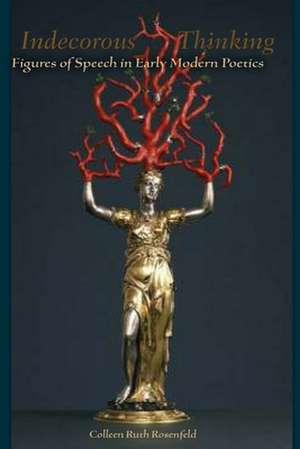
Indecorous Thinking
Autor Colleen Ruth Rosenfelden Limba Engleză Hardback – 2 ian 2018
Rosenfeld details a lost legacy of humanism that contributes to contemporary debates over literary studies' singular but deeply ambivalent commitment to form. Form, she argues, must be reexamined through the legacy of figure. Reading poetry by Philip Sidney, Edmund Spenser, and Mary Wroth alongside pedagogical debates of the period and the emergence of empiricism, with its signature commitment to the plain style, Rosenfeld offers a robust account of the triumphs and embarrassments that attended the conspicuous display of artifice. Drawing widely across the arts of rhetoric, dialectic, and poetics, Indecorous Thinking offers a defense of the epistemological value of form: not as a sign of the aesthetic but as the source of a particular kind of knowledge we might call poetic.
Preț: 914.48 lei
Preț vechi: 1044.93 lei
-12%
Puncte Express: 1372
Carte indisponibilă temporar
Doresc să fiu notificat când acest titlu va fi disponibil:
Se trimite...
Specificații
ISBN-13: 9780823277919
ISBN-10: 0823277917
Pagini: 320
Dimensiuni: 157 x 231 x 23 mm
Greutate: 0.54 kg
Editura: Fordham University Press
ISBN-10: 0823277917
Pagini: 320
Dimensiuni: 157 x 231 x 23 mm
Greutate: 0.54 kg
Editura: Fordham University Press
Descriere
Indecorous Thinking argues that early modern writers including Philip Sidney, Edmund Spenser, and Mary Wroth challenged humanism's increasingly dogmatic conflation of truth with plainness by treating figures of speech as the instruments of thinking and as the engines of poetry's imaginative worlds.