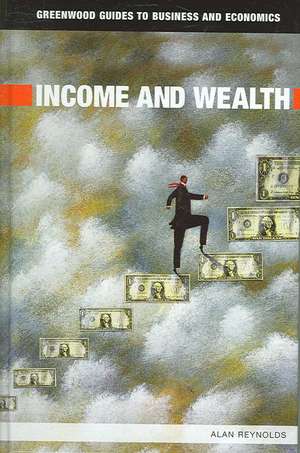
Income and Wealth: Greenwood Guides to Business and Economics
Autor Alan Reynoldsen Limba Engleză Hardback – 30 sep 2006


Preț: 268.33 lei
Preț vechi: 488.56 lei
-45%
Puncte Express: 402
Preț estimativ în valută:
47.44€ • 54.42$ • 40.99£
47.44€ • 54.42$ • 40.99£
Carte tipărită la comandă
Livrare economică 02-16 mai
Specificații
ISBN-13: 9780313336881
ISBN-10: 0313336881
Pagini: 248
Dimensiuni: 156 x 235 x 24 mm
Greutate: 0.51 kg
Editura: Bloomsbury Publishing
Colecția Greenwood
Seria Greenwood Guides to Business and Economics
Locul publicării:New York, United States
ISBN-10: 0313336881
Pagini: 248
Dimensiuni: 156 x 235 x 24 mm
Greutate: 0.51 kg
Editura: Bloomsbury Publishing
Colecția Greenwood
Seria Greenwood Guides to Business and Economics
Locul publicării:New York, United States
V-ar putea interesa
-
 The Economics of Industrial DevelopmentJohn WeissPreț: 430.45 lei
 -
 -18%Preț: 1065.77 lei1299.72 lei
 -
 Theoretical Foundations of Macroeconomic Policy: Growth, productivity and public financeGiovanni Di Bartolomeo-18%Preț: 856.82 lei1044.90 lei
 -
 Challenges for Central BankingAnthony M. Santomero-15%Preț: 615.35 lei723.94 lei
 -
 -28%Preț: 81.90 lei113.82 lei
 -
 -35%Preț: 513.11 lei791.14 lei
 -
 Principles of MacroeconomicsJoshua Lewer-23%Preț: 990.21 lei1285.99 lei
 -
 Preț: 160.28 lei
 -
 Breaking the BankAlan ReynoldsPreț: 123.22 lei
 -
 The TinkerAlan ReynoldsPreț: 127.14 lei
 -
 The CoatAlan ReynoldsPreț: 120.39 lei
 -
 VALLEY OF THE SERPENTAlan ReynoldsPreț: 126.04 lei
 -
 SMOKE SCREENAlan ReynoldsPreț: 121.49 lei
 -
 EXFILAlan ReynoldsPreț: 125.79 lei
 -
 TRENT ISLANDAlan ReynoldsPreț: 126.21 lei
 -
 The Last PoppyAlan ReynoldsPreț: 123.00 lei
 -
 Building the Impact Economy: Our Future, Yea or NayMaximilian MartinPreț: 370.48 lei
 -
 Preț: 371.93 lei
 -
 Sovereign Risk and Financial CrisesMichael Frenkel-15%Preț: 614.60 lei723.05 lei
 -
 -15%Preț: 612.68 lei720.80 lei
 -
 An Economic Analysis of Monetary UnionMichael Carlberg-15%Preț: 614.73 lei723.21 lei
 -
 Ageing, Financial Markets and Monetary PolicyAlan J. Auerbach-18%Preț: 910.71 lei1110.62 lei
 -
 Interneteconomics.net: Macroeconomics, Deregulation, and InnovationPaul J.J. Welfens-15%Preț: 612.55 lei720.65 lei
 -
 Inflation in a Monetary UnionMichael Carlberg-15%Preț: 616.95 lei725.82 lei
 -
 Preț: 367.49 lei
 -
 Risk Sharing, Risk Spreading and Efficient RegulationT. V. S. Ramamohan RaoPreț: 375.81 lei
Cuprins
Illustrations
Series Foreword by Wesley B. Truitt
Introduction
1. Concepts and Measures
2. Work Matters
3. A Vanishing Middle Class?
4. The Wage Stagnation Thesis
5. The Top 1 Percent
6. CEOs and Celebrities
7. Wealth Is Not Distributed
8. Consumption Inequality, Lifetime Income, and Mobility
9. Causes and Cures
Glossary
Online Resources
Index
Series Foreword by Wesley B. Truitt
Introduction
1. Concepts and Measures
2. Work Matters
3. A Vanishing Middle Class?
4. The Wage Stagnation Thesis
5. The Top 1 Percent
6. CEOs and Celebrities
7. Wealth Is Not Distributed
8. Consumption Inequality, Lifetime Income, and Mobility
9. Causes and Cures
Glossary
Online Resources
Index
Recenzii
Reynolds challenges many so-called myths held by academics, columnists, and public affairs junkies concerning inequities in the recent growth of individual income and wealth in the US. Beginning with a useful, lucid-to-the-general-reader chapter on concepts and measures, this book is intended to show that the growing gap between the rich and the poor in the US is mainly the result of the number of workers in households and their age and education, and that the so-called disappearance of the middle class is more statistical than actual. In fact, Reynolds contends that since 1973 total labor compensation has been increasing and that the distribution of consumption expenditures by income class points to a reduction in inequality as compared with 1986. A critical chapter refutes recent literature concerning huge increases in income going to the top 1 percent of taxpayers as being due merely to changes in tax laws. Reynolds also addresses the minimum wage, taxes, immigration, international trade, and globalization. The book excels in charts and tables, glossary of terms, and references, including online resources. An extremely useful addition to the literature in the ongoing conservative-liberal debate on the distribution of US income and wealth. Highly recommended. General readers; academic audiences, upper-division undergraduate and up; professionals.
Income and Wealth is stunning in its revelations and its deflations of popular Democratic superstitions..Reynolds, a senior fellow at the Cato Institute, is an economist of acute precision. For years he has defended the capitalist way of doing things, and this volume is a high tribute to his championship of basic American ideas.
Alan Reynolds has produced a most important examination of one of the dominant political myths for this current two-year run-up to the 2008 presidential election..Mr. Reynolds argues persuasively in Income and Wealth that poverty and wealth in America are not directly related to each other; the poor are not poor because of the well-to-do. Moreover, both the upper one percent and lowest 10 percent of incomes are affected by unrelated dynamics that have nothing to do with the Democratic nostrum of income redistribution via tax remedies--Robin Hood-onomics..In easily accessible prose, he shows us how the two Americas crowd is messing with our minds with its statistical fabrications..Whether the truths revealed by Mr. Reynolds will silence the two Americas myth will depend on how widely his book gets circulated in this coming year. The truth may set us free after all.
[E]xplodes much of the downbeat economic conventional wisdom.
The election season, once again, brought up the myth that Americans are worse off because inequality of income has been increasing in the United States. Myths are harmless in literature. But if Democrats, like Rep. Nancy Pelosi, start using it as evidence for raising taxes when the new Congress reconvenes, there is potential for real damage to the economy and to our living standards. Cato Institute senior fellow Alan Reynolds' new volume Income and Wealth assembles facts to explain and understand this myth, using figures from the Statistical Abstract of the United States. Reynolds also provides a clear guide to the countless academic studies on the subject.
As part of a series aiming to improve economic literacy and decision- making, this volume is meant for general readers, high school and college students, or as a review for graduate students and those in business. Reynolds provides a guide to the growth and distribution of income and wealth in the US. He addresses statistics purported by the press and economists, arguing that these perspectives are often influenced by a misunderstanding of basic concepts and measures. He then explains those concepts and measures, as well as work and income, the idea that the middle class is declining, and claims that average wages have not increased, and includes a discussion of the income of the top one percent. He discusses CEOs and stock options, the distribution of wealth, using consumption as a measure of living standards, and recommendations to fix wage or income inequality.
Income and Wealth is stunning in its revelations and its deflations of popular Democratic superstitions..Reynolds, a senior fellow at the Cato Institute, is an economist of acute precision. For years he has defended the capitalist way of doing things, and this volume is a high tribute to his championship of basic American ideas.
Alan Reynolds has produced a most important examination of one of the dominant political myths for this current two-year run-up to the 2008 presidential election..Mr. Reynolds argues persuasively in Income and Wealth that poverty and wealth in America are not directly related to each other; the poor are not poor because of the well-to-do. Moreover, both the upper one percent and lowest 10 percent of incomes are affected by unrelated dynamics that have nothing to do with the Democratic nostrum of income redistribution via tax remedies--Robin Hood-onomics..In easily accessible prose, he shows us how the two Americas crowd is messing with our minds with its statistical fabrications..Whether the truths revealed by Mr. Reynolds will silence the two Americas myth will depend on how widely his book gets circulated in this coming year. The truth may set us free after all.
[E]xplodes much of the downbeat economic conventional wisdom.
The election season, once again, brought up the myth that Americans are worse off because inequality of income has been increasing in the United States. Myths are harmless in literature. But if Democrats, like Rep. Nancy Pelosi, start using it as evidence for raising taxes when the new Congress reconvenes, there is potential for real damage to the economy and to our living standards. Cato Institute senior fellow Alan Reynolds' new volume Income and Wealth assembles facts to explain and understand this myth, using figures from the Statistical Abstract of the United States. Reynolds also provides a clear guide to the countless academic studies on the subject.
As part of a series aiming to improve economic literacy and decision- making, this volume is meant for general readers, high school and college students, or as a review for graduate students and those in business. Reynolds provides a guide to the growth and distribution of income and wealth in the US. He addresses statistics purported by the press and economists, arguing that these perspectives are often influenced by a misunderstanding of basic concepts and measures. He then explains those concepts and measures, as well as work and income, the idea that the middle class is declining, and claims that average wages have not increased, and includes a discussion of the income of the top one percent. He discusses CEOs and stock options, the distribution of wealth, using consumption as a measure of living standards, and recommendations to fix wage or income inequality.