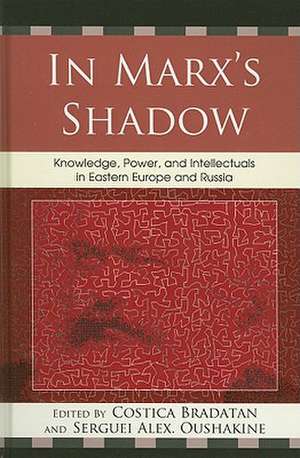
In Marx's Shadow: Knowledge, Power, and Intellectuals in Eastern Europe and Russia
Editat de Costica Bradatan, Serguei Oushakine Contribuţii de Dr Clemena Antonova, Aurelian Craiutu, Mikhail Epstein, Elena Gapova, Letitia Guran, Ivars Ijabs, Natasa Kovacevic, Jeffrey Murer, Veronika Tuckerová, Vladimir Tismaneanu, Maria Todorovaen Limba Engleză Hardback – 19 mar 2010
The examination of the underlying structures of Communism as an intellectual project provides convincing evidence for questioning a dominant approach that routinely frames the post-Communist intellectual development as a "revival" or, at least, as a "return" of the repressed intellectual traditions. As the book shows, the logic of a radical break, suggested by this approach, is in contradiction with historical evidence: a significant number of philosophical, theoretical and ideological debates in post-Communist world are in fact the logical continuation of intellectual conversations and confrontations initiated long before 1989.
Preț: 728.00 lei
Preț vechi: 1072.99 lei
-32%
Puncte Express: 1092
Carte tipărită la comandă
Livrare economică 26 noiembrie-10 decembrie
Livrare prin curier în România Termenul estimat este afișat lângă disponibilitate.
Transport gratuit pentru acest produs Plată online sau ramburs, în funcție de opțiunile comenzii.
Retur gratuit în 14 zile Comandă securizată și suport în română.
Specificații
ISBN-13: 9780739136249
ISBN-10: 0739136240
Pagini: 304
Dimensiuni: 152 x 230 x 24 mm
Greutate: 0.6 kg
Editura: Bloomsbury Publishing
Colecția Lexington Books
Locul publicării:New York, United States
ISBN-10: 0739136240
Pagini: 304
Dimensiuni: 152 x 230 x 24 mm
Greutate: 0.6 kg
Editura: Bloomsbury Publishing
Colecția Lexington Books
Locul publicării:New York, United States
Cuprins
Chapter 1 Introduction
Part 2 I. The Sickle, the Hammer and the Typewriter
Chapter 3 1) Ideas against Ideocracy: The Platonic Drama of Russian Thought
Chapter 4 2) Asking for More: Finding Utopia in the Critical Sociology of the Budapest School and the Praxis Movement
Chapter 5 3) Aesthetics: a Modus Vivendi in East Central Europe?
Chapter 6 4) Changing Perceptions of Pavel Florensky in Russian and Soviet Scholarship
Part 7 II. Heretics
Chapter 8 5) The Totalitarian Languages of Utopia and Dystopia: Fidelius and Havel
Chapter 9 6) Martyrdom and Philosophy. The Case of Jan Patocka
Chapter 10 7) Anti-Communist Orientalism: Shifting Boundaries of Europe in Dissident Writing
Part 11 III. In Search of a (New) Mission
Chapter 12 8) Vitality Rediscovered: Theorizing Post-Soviet Ethnicity in Russia
Chapter 13 9) Balkanism and postcolonilaism or on the Beauty of the Airplane View
Chapter 14 10) Anxious Intellectuals: Framing the Nation as a class in Belarus
Part 15 IV. Reinventing Hope
Chapter 16 11) The Demise of Leninism and the Future of Liberal Values
Chapter 17 12) "Politics of Authenticity" and/or Civil Society
Chapter 18 13) Mihai Sora: A Philosopher of Dialogue and Hope
Part 2 I. The Sickle, the Hammer and the Typewriter
Chapter 3 1) Ideas against Ideocracy: The Platonic Drama of Russian Thought
Chapter 4 2) Asking for More: Finding Utopia in the Critical Sociology of the Budapest School and the Praxis Movement
Chapter 5 3) Aesthetics: a Modus Vivendi in East Central Europe?
Chapter 6 4) Changing Perceptions of Pavel Florensky in Russian and Soviet Scholarship
Part 7 II. Heretics
Chapter 8 5) The Totalitarian Languages of Utopia and Dystopia: Fidelius and Havel
Chapter 9 6) Martyrdom and Philosophy. The Case of Jan Patocka
Chapter 10 7) Anti-Communist Orientalism: Shifting Boundaries of Europe in Dissident Writing
Part 11 III. In Search of a (New) Mission
Chapter 12 8) Vitality Rediscovered: Theorizing Post-Soviet Ethnicity in Russia
Chapter 13 9) Balkanism and postcolonilaism or on the Beauty of the Airplane View
Chapter 14 10) Anxious Intellectuals: Framing the Nation as a class in Belarus
Part 15 IV. Reinventing Hope
Chapter 16 11) The Demise of Leninism and the Future of Liberal Values
Chapter 17 12) "Politics of Authenticity" and/or Civil Society
Chapter 18 13) Mihai Sora: A Philosopher of Dialogue and Hope
Recenzii
Bradatan and Oushakine's volume maps out the vast territory of philosophical issues shaped and left behind by decades of state socialism. It is the first attempt of its kind in conditions of post-socialism, and as such it will provide an immense assistance to those seeking to understand what the real, deep, and abiding philosophical conflicts are around the ideas of communism. This is an excellent volume with outstanding contributions from anthropologists, historians, philosophers, and political scientists.
The voices of those who dissented from Communism in Russia and Eastern Europe were heard in distinct ways in the West and faintly at times in their own societies. The editors of this collection have brought leading scholars of culture and discourse to explore analytically the words and images with which dissident intellectuals explained their world of "unfreedom." Some of those thinkers and writers rejected entirely the Leninist enterprise; others hoped to reform it into a humane socialism. Seldom have Western observers listened as attentively to the voices of those within as the participants in this volume. Here we find language and aesthetics as weapons, utopia as hope and despair, and both the enabling power of words and the limits of imagination.
The variety of views informing this book makes for a rewarding read. The fact that they are often at methodological, if not political, loggerheads increases rather than diminishes its attractiveness. Just as much can be learned from different treatments of the same subject, so there is, for western scholars, ample reason to appreciate the advancement in our terms of discussion brought about by the addition of scholars from the former socialist states to our conferences, publishing outlets, and universities. Where we once ambled about the arid ideoscape of Cold War categories and, then, neoliberal simplicities such as "democratization" and "institution building," we now engage with richer, more promising, and certainly more challenging ways of thought introduced in no small measure by those who used to be over there.
The voices of those who dissented from Communism in Russia and Eastern Europe were heard in distinct ways in the West and faintly at times in their own societies. The editors of this collection have brought leading scholars of culture and discourse to explore analytically the words and images with which dissident intellectuals explained their world of "unfreedom." Some of those thinkers and writers rejected entirely the Leninist enterprise; others hoped to reform it into a humane socialism. Seldom have Western observers listened as attentively to the voices of those within as the participants in this volume. Here we find language and aesthetics as weapons, utopia as hope and despair, and both the enabling power of words and the limits of imagination.
The variety of views informing this book makes for a rewarding read. The fact that they are often at methodological, if not political, loggerheads increases rather than diminishes its attractiveness. Just as much can be learned from different treatments of the same subject, so there is, for western scholars, ample reason to appreciate the advancement in our terms of discussion brought about by the addition of scholars from the former socialist states to our conferences, publishing outlets, and universities. Where we once ambled about the arid ideoscape of Cold War categories and, then, neoliberal simplicities such as "democratization" and "institution building," we now engage with richer, more promising, and certainly more challenging ways of thought introduced in no small measure by those who used to be over there.