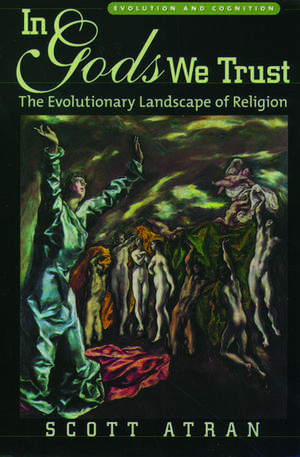
In Gods We Trust: The Evolutionary Landscape of Religion
Autor Scott Atranen Limba Engleză Paperback – 6 ian 2005
Considerăm In Gods We Trust o resursă academică fundamentală pentru studenții și cercetătorii din domeniile antropologiei, psihologiei cognitive și filozofiei religiei, fiind o lectură relevantă pentru examenele de specialitate care vizează bazele evoluționiste ale culturii. Scott Atran propune o teză riguroasă: religia nu este o instituție sau o doctrină, ci un rezultat inevitabil al funcționării obișnuite a minții umane. Remarcăm modul în care autorul analizează supraviețuirea istorică a religiei ca o acomodare a unor elemente existențiale și morale specifice condiției umane.
Textul extinde cadrul propus de Minds and Gods de Todd Tremlin cu date noi extrase din cercetarea de teren și analize psihologice aprofundate asupra modului în care mintea umană procesează agenția supranaturală. Spre deosebire de alte abordări care tratează religia ca pe o adaptare biologică directă, Scott Atran o definește ca pe un produs secundar (by-product) al arhitecturii noastre cognitive, integrând selecția culturală în ecuație. Această perspectivă se aliniază cu lucrările sale anterioare, precum Cognitive Foundations of Natural History, unde a explorat bazele cognitive ale gândirii științifice. Dacă în Talking to the Enemy autorul investiga radicalizarea contemporană, volumul de față oferă fundamentul teoretic necesar înțelegerii mecanismelor psihice care fac aceste credințe posibile.
Structura narativă este una academică, susținută de numeroase figuri și tabele care facilitează înțelegerea conceptelor complexe de antropologie cognitivă. Ediția de față, publicată de Oxford University Press, rămâne un text de referință prin rigoarea cu care tratează intersecția dintre evoluție și spiritualitate, fără a recurge la simplificări reducționiste.
Preț: 303.73 lei
Preț vechi: 327.13 lei
-7%
Carte tipărită la comandă
Livrare economică 05-16 iunie
Specificații
ISBN-10: 0195178033
Pagini: 388
Ilustrații: numerous figures; 2 tables and 24pp halftones
Dimensiuni: 159 x 234 x 23 mm
Greutate: 0.54 kg
Editura: Oxford University Press
Colecția OUP USA
Locul publicării:New York, United States
V-ar putea interesa
-
 Essays on Religion and EducationR. M. Hare-15%Preț: 361.68 lei425.24 lei
 -
 -31%Preț: 372.75 lei541.01 lei
 -
 Theism, Atheism, and Big Bang CosmologyWilliam Lane Craig-23%Preț: 431.16 lei563.20 lei
 -
 -24%Preț: 405.07 lei536.21 lei
 -
 Plotinus: An Introduction to the EnneadsDominic J. O'Meara-31%Preț: 334.57 lei485.53 lei
 -
 Repetition and Philosophical CrumbsSoren Kierkegaard-21%Preț: 64.45 lei81.52 lei
 -
 -23%Preț: 332.89 lei432.47 lei
 -
 -24%Preț: 395.68 lei520.50 lei
 -
 -31%Preț: 429.20 lei624.39 lei
 -
 Preț: 53.37 lei
 -
 Was Jesus God?Richard Swinburne-15%Preț: 55.57 lei65.70 lei
 -
 Molinism: The Contemporary DebateKen Perszyk-14%Preț: 591.84 lei688.19 lei
 -
 Reason, Morality, and Law: The Philosophy of John FinnisJohn Keown DCL-8%Preț: 824.23 lei895.99 lei
 -
 Spirituality: What It Is and Why It MattersRoger S. GottliebPreț: 305.85 lei
 -
 Talking to the EnemyScott AtranPreț: 123.83 lei
 -
 Maps of Meaning: The Architecture of BeliefJordan B. PetersonPreț: 291.61 lei
 -
 Economic Facts and Fallacies: Second EditionThomas Sowell-28%Preț: 83.22 lei114.89 lei
 -
 After PikettyHeather BousheyPreț: 156.79 lei
 -
 Money Changes EverythingWilliam N. GoetzmannPreț: 148.04 lei
 -
 Who's Afraid of Postmodernism?James K. A. SmithPreț: 121.37 lei
 -
 An Easy-To-Understand Guide for Defeating Darwinism by Opening MindsPhillip E. JohnsonPreț: 99.53 lei
 -
 Tanks: 100 years of evolutionProfessor Richard Ogorkiewicz-26%Preț: 67.01 lei90.60 lei
 -
 I Am ProvidenceS. T. JoshiPreț: 204.95 lei
 -
 The Village EffectSusan Pinker-19%Preț: 83.66 lei103.92 lei
 -
 The Fear And Trembling And The Book On AdlerSoren Kierkegaard-18%Preț: 85.96 lei105.15 lei
De ce să citești această carte
Recomandăm această carte oricărui cititor interesat de o explicație științifică, nu dogmatică, a fenomenului religios. Veți câștiga o perspectivă clară asupra motivelor pentru care mintea umană este „cablată” să creadă în supranatural. Este un instrument esențial pentru a înțelege cum evoluția cognitivă ne-a modelat sistemele de valori și supraviețuirea culturală, oferind răspunsuri documentate la întrebări fundamentale despre natura umană.
Despre autor
Scott Atran este un reputat cercetător în antropologie la Centrul Național de Cercetare Științifică din Paris și profesor vizitator la Universitatea din Michigan. Expertiza sa este vastă, fiind cofondator al ARTIS Research și un fin observator al psihologiei publice. În lucrările sale, precum The Native Mind and the Cultural Construction of Nature, Atran explorează modul în care diferențele culturale afectează percepția asupra lumii naturale. Cariera sa este marcată de un interes constant pentru modul în care structura cognitivă a speciei noastre influențează formarea credințelor complexe, de la biologia populară până la ideologiile religioase radicale.
Descriere
Recenzii
In Gods We Trust is by far the best exploration so far of the evolutionary basis of religious behavior.
Scott Atran, a cognitive anthropologist and psychologist, presents in this volume a rich, nuanced cognitive-evolutionary account of religion... From this vantage, religion is not doctrine, or institutions, or even faith. Religion ensues from the ordinary workings of the human mind as it deals with emotionally compelling problems of human existence, such as birth, aging, death, unforeseen calamities, and love... I have little but praise for this marvelous book... It does not take long to realize that one is dealing with a formidable mind; Atran is not only a fine writer, his breadth of knowledge and intellectual depth are nothing short of inspiring. This book is one to read slowly and savor. Keep a post-it pad handy, to mark the pages: the scope of this book is so wide-ranging that whatever your research interest in evolutionary psychology, it is bound to be touched upon at some point in these 400 pages of informative analysis.