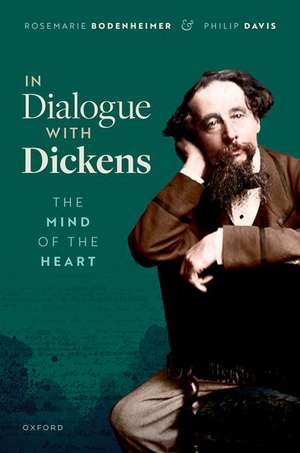
In Dialogue with Dickens: The Mind of the Heart
Autor Rosemarie Bodenheimer, Philip Davisen Limba Engleză Hardback – 29 feb 2024
Preț: 260.12 lei
Preț vechi: 294.48 lei
-12%
Puncte Express: 390
Carte disponibilă
Livrare economică 12-18 noiembrie
Livrare express 24-30 octombrie pentru 72.71 lei
Livrare prin curier în România Termenul estimat este afișat lângă disponibilitate.
Transport gratuit de la 400.00 lei Plată online sau ramburs, în funcție de opțiunile comenzii.
Retur gratuit în 14 zile Comandă securizată și suport în română.
Specificații
ISBN-13: 9780192886743
ISBN-10: 0192886746
Pagini: 216
Ilustrații: 20 Illustrations
Dimensiuni: 162 x 240 x 20 mm
Greutate: 0.52 kg
Editura: OUP OXFORD
Colecția OUP Oxford
Locul publicării:Oxford, United Kingdom
ISBN-10: 0192886746
Pagini: 216
Ilustrații: 20 Illustrations
Dimensiuni: 162 x 240 x 20 mm
Greutate: 0.52 kg
Editura: OUP OXFORD
Colecția OUP Oxford
Locul publicării:Oxford, United Kingdom
Recenzii
In Dialogue with Dickens is an exhilarating book. It shows how good readers read, and the way they make literature part of their lives. If one wanted a book to persuade a young person that academic criticism can be inspiring, this work by two veterans would be a good choice.
It is impossible for me to exemplify more than an iota of the joys I have felt reading their conversations with Dickens.... This is a book to buy... It's perfect as a conversant for a reading group, or to pass out, in stages, to a class studying one of these novels... It's perfect for reading on your own. And it is foundational for the next generation of Victorianists and lovers of fiction.
The "exploratory method" of their exchanges allows Bodenheimer and Davis to retain Dickens' distinct rawness, the better to understand it. In Dialogue with Dickens can serve as a model of collaborative critical experimentation, and should be read by anyone undertaking a thoughtful reading of Dickens' novels. ... The freedom of their experimentation and the encouragement of their collaboration are welcome reminders of the exhilarations that can accompany the difficulties of thinking and writing about literature.
It is impossible for me to exemplify more than an iota of the joys I have felt reading their conversations with Dickens.... This is a book to buy... It's perfect as a conversant for a reading group, or to pass out, in stages, to a class studying one of these novels... It's perfect for reading on your own. And it is foundational for the next generation of Victorianists and lovers of fiction.
The "exploratory method" of their exchanges allows Bodenheimer and Davis to retain Dickens' distinct rawness, the better to understand it. In Dialogue with Dickens can serve as a model of collaborative critical experimentation, and should be read by anyone undertaking a thoughtful reading of Dickens' novels. ... The freedom of their experimentation and the encouragement of their collaboration are welcome reminders of the exhilarations that can accompany the difficulties of thinking and writing about literature.
Notă biografică
Rosemarie Bodenheimer has been trying to get her head around Dickens since her undergraduate days. She spent her working life as Professor of English at Boston College, specializing in Victorian and modern fiction. In The Real Life of Mary Ann Evans: George Eliot, Her Letters and Fiction (1994) and Knowing Dickens (2007), she fashioned a form of biographical criticism that juxtaposes a writer's letters with published works, as mutually illuminating forms of writing. After retirement, she published in various areas, most recently Samuel Beckett in the OUP series My Reading (2022).Philip Davis was, until his retirement, Director of the Centre for Research into Reading, Literature and Society (CRILS) at the University of Liverpool, with strong interests in reading and inner being, with particular relation to emotion, memory, auto/biography, and fictional realism. His work on Victorian writing includes Memory and Writing, The Victorians volume in the Oxford English Literary History series, Why Victorian Literature Still Matters, and The Transferred Life of George Eliot. He is an editor of two OUP series: The Literary Agenda and My Reading.