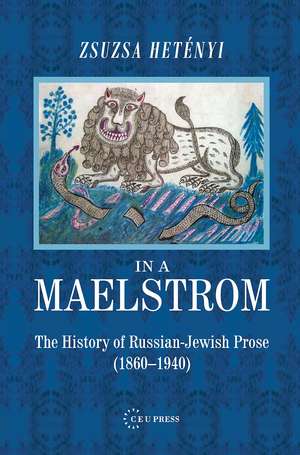
In a Maelstrom: The History of Russian-Jewish Prose, 1860-1940
Autor Zsuzsa Hetényi Traducere de János Borisen Limba Engleză Hardback – 10 ian 2008
Preț: 871.99 lei
Preț vechi: 1013.94 lei
-14%
Puncte Express: 1308
Carte disponibilă
Livrare economică 31 octombrie-14 noiembrie
Livrare prin curier în România Termenul estimat este afișat lângă disponibilitate.
Transport gratuit pentru acest produs Plată online sau ramburs, în funcție de opțiunile comenzii.
Retur gratuit în 14 zile Comandă securizată și suport în română.
Specificații
ISBN-13: 9789637326912
ISBN-10: 963732691X
Pagini: 324
Dimensiuni: 152 x 229 x 30 mm
Greutate: 0.62 kg
Ediția:1
Editura: Amsterdam University Press
Colecția Central European University Press
Locul publicării:Oxford, United Kingdom
ISBN-10: 963732691X
Pagini: 324
Dimensiuni: 152 x 229 x 30 mm
Greutate: 0.62 kg
Ediția:1
Editura: Amsterdam University Press
Colecția Central European University Press
Locul publicării:Oxford, United Kingdom
V-ar putea interesa
-
 The Alice Behind WonderlandSimon Winchester-19%Preț: 85.24 lei105.75 lei
 -
 Epic: Britain's Heroic Muse 1790-1910Herbert F. Tucker-10%Preț: 341.03 lei380.75 lei
 -
 Yeats and ViolenceMichael Wood-13%Preț: 375.75 lei431.29 lei
 -
 Popular Medievalism in Romantic-Era BritainC. SimmonsPreț: 399.43 lei
 -
 Travel Writing and Tourism in Britain and IrelandBenjamin ColbertPreț: 404.81 lei
 -
 Coleridge, Language and the SublimeC. StokesPreț: 398.83 lei
 -
 Minds, Bodies, Machines, 1770-1930D. ColemanPreț: 403.61 lei
 -
 Preț: 276.87 lei
 -
 A. E. HousmanA. S. F. GowPreț: 291.36 lei
 -
 The Lake Poets and Professional IdentityBrian GoldbergPreț: 328.63 lei
 -
 Mark Twain: The Contemporary ReviewsLouis BuddPreț: 507.87 lei
 -
 American Women Authors and Literary Property, 1822 1869Melissa J. HomesteadPreț: 358.79 lei
 -
 Preț: 294.64 lei
 -
 KudrunIan R. CampbellPreț: 303.03 lei
 -
 Preț: 179.54 lei
 -
 Preț: 371.68 lei
 -
 Graphing Jane AustenJ. CarrollPreț: 393.74 lei
 -
 Preț: 90.31 lei
 -
 York Notes Companions: Victorian LiteratureBeth PalmerPreț: 89.94 lei
 -
 Reading ChekhovJanet MalcolmPreț: 90.61 lei
Public țintă
AcademicNotă biografică
Zsuzsa Hetényi is Professor at the Institute for Slavic Studies, ELTE University, Budapest, and translator (Hungarian Academy of Sciences, Award for translation, 2002). With 180 articles in six languages to her credit, she has also authored a monograph study on Biblical and messianic motifs in Babel's Red Cavalry (1991) and edited and co-authored the History of the Russian Literature (I-II., 1997-2002). Her main field of interest is 20th century Russian Prose.
Cuprins
Preface, The Concept of Russian-Jewish Literature and its Ambiguities, THE HISTORY OF RUSSIAN-JEWISH PROSE (1860–1940), I. “Turbulent Times”—The Utopia of Assimilation, II. “In a Maelstrom”—After the Pogroms, III. “At a Crossroads”—Choosing Paths, IV. “Motherland” and “Cemetery”—Climax and Endgame, V. A Pattern of Narrative in Jewish Assimilation Literature. The Child’s Eye View—Isaac Babel in a Russian-Jewish, American and European Literary Context. A Comparative Conclusion, Biographies of Authors, Appendix, Bibliography, Index
Descriere
The first concise history of Russian-Jewish literary prose, this book discusses Russian-Jewish literarature in four periods, analyzing the turning points (1881–82, 1897, 1917) and proposing that the selected epoch (1860–1940) represents a special strand that was unfairly left out of both Russian and Jewish national literatures.