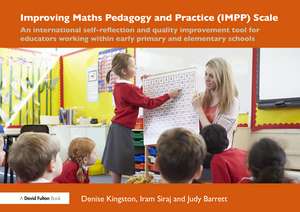
Improving Maths Pedagogy and Practice (IMPP) Scale: An international self-reflection and quality improvement tool for educators working within early primary and elementary schools
Autor Denise Kingston, Iram Siraj, Judy Barretten Limba Engleză Paperback – 28 oct 2025
The IMPP supports both the ‘how’ and ‘what’ of teaching mathematics to young children, encourages positive dispositions towards maths, and addresses issues such as maths anxiety and disengagement. It focuses on teaching developmentally appropriate maths with understanding, using ‘maths talk’, child-friendly contexts, concrete, pictorial and abstract representations to their best effect.
This unique measurement scale supports:
- the teaching of early mathematics in primary/elementary schools, using the evidence base of what works best to support fluency and mastery
- teachers’ content and pedagogical content knowledge of mathematics, including comprehensive sets of practical examples
- quality improvement processes and self-assessment of the mathematics taught in classrooms
- children learning mathematics with understanding, which also supports their engagement, enjoyment and achievements
- researchers, auditors and/or inspectors looking for a measure of mathematical quality and effectiveness in the classroom
Preț: 193.83 lei
Puncte Express: 291
Carte disponibilă
Livrare economică 17 noiembrie-01 decembrie
Livrare express 03-07 noiembrie pentru 29.69 lei
Livrare prin curier în România Termenul estimat este afișat lângă disponibilitate.
Transport gratuit de la 400.00 lei Plată online sau ramburs, în funcție de opțiunile comenzii.
Retur gratuit în 14 zile Comandă securizată și suport în română.
Specificații
ISBN-13: 9781032912219
ISBN-10: 1032912219
Pagini: 142
Ilustrații: 16
Dimensiuni: 297 x 210 x 16 mm
Greutate: 0.45 kg
Ediția:1
Editura: Taylor & Francis
Colecția David Fulton Publishers
Locul publicării:Oxford, United Kingdom
ISBN-10: 1032912219
Pagini: 142
Ilustrații: 16
Dimensiuni: 297 x 210 x 16 mm
Greutate: 0.45 kg
Ediția:1
Editura: Taylor & Francis
Colecția David Fulton Publishers
Locul publicării:Oxford, United Kingdom
Public țintă
Professional Practice & DevelopmentRecenzii
The IMPP booklet offers a research-based, tried and tested approach to mathematics teaching development in the early years of primary education; with detailed attention to supporting children's mathematical engagement, thinking and understanding.
- Tim Rowland, University of Cambridge, UK.
A school's approach to mathematics will, typically, be scheme driven, with a focus on pupil attainment and curriculum coverage, often to the detriment of research. The IMPP successfully fills the void, providing a research-informed mathematics tool that positions teachers' professional development at the heart of subject-pedagogical improvements. With approaches and considerations that are incremental in focus, the IMPP facilitates opportunities for teachers to become self-directed agents of their own learning. Aligned directly to classroom practice, teachers are clear on its impact in supporting improved mathematics outcomes for children.
- Stephanie Flower, Oxford Brookes University, UK.
Around the world, early childhood curricula and learning frameworks refer to the importance of supporting children’s numeracy. However, they differ widely in the degree to which they address specific mathematics concepts and skills – beyond counting and shapes. Knowing what mathematics strands to focus on and how children’s learning progresses along continua, are crucial first steps towards encouraging children to apply these concepts and skills in their everyday lives. Yet, many early childhood educators are uncertain about how to support mathematical thinking as well as what words to use. The Improving Maths Pedagogy and Practice Scale sets out key content areas, pedagogical considerations, and the characteristics of ‘maths talk’ that teachers want. By suggesting ways to partner with parents, the IMPP also gives guidance on enhancing the home numeracy environment. With the primary aim of supporting reflective practice by providing concrete indicators of good basic, very good and excellent practice, the IMPP can be used by researchers or by educational leaders to support professional learning. This must-have resource will elevate your professional library and expand your expertise.
- Caroline Cohrssen, University of New England, Australia.
- Tim Rowland, University of Cambridge, UK.
A school's approach to mathematics will, typically, be scheme driven, with a focus on pupil attainment and curriculum coverage, often to the detriment of research. The IMPP successfully fills the void, providing a research-informed mathematics tool that positions teachers' professional development at the heart of subject-pedagogical improvements. With approaches and considerations that are incremental in focus, the IMPP facilitates opportunities for teachers to become self-directed agents of their own learning. Aligned directly to classroom practice, teachers are clear on its impact in supporting improved mathematics outcomes for children.
- Stephanie Flower, Oxford Brookes University, UK.
Around the world, early childhood curricula and learning frameworks refer to the importance of supporting children’s numeracy. However, they differ widely in the degree to which they address specific mathematics concepts and skills – beyond counting and shapes. Knowing what mathematics strands to focus on and how children’s learning progresses along continua, are crucial first steps towards encouraging children to apply these concepts and skills in their everyday lives. Yet, many early childhood educators are uncertain about how to support mathematical thinking as well as what words to use. The Improving Maths Pedagogy and Practice Scale sets out key content areas, pedagogical considerations, and the characteristics of ‘maths talk’ that teachers want. By suggesting ways to partner with parents, the IMPP also gives guidance on enhancing the home numeracy environment. With the primary aim of supporting reflective practice by providing concrete indicators of good basic, very good and excellent practice, the IMPP can be used by researchers or by educational leaders to support professional learning. This must-have resource will elevate your professional library and expand your expertise.
- Caroline Cohrssen, University of New England, Australia.
Cuprins
1. Introducing the 'Improving Maths Pedagogy and Practice' Scale
2. Background
3. Underlying Principles of the IMPP Scale
4. Content of the IMPP Scale
5. Using the 'Improving Maths Pedagogy and Practice' Scale
6. Scoring the Scale
7. The IMPP Score Sheet, Inter-Rater Reliability Sheet and Profile
8. Glossary of Terms
2. Background
3. Underlying Principles of the IMPP Scale
4. Content of the IMPP Scale
5. Using the 'Improving Maths Pedagogy and Practice' Scale
6. Scoring the Scale
7. The IMPP Score Sheet, Inter-Rater Reliability Sheet and Profile
8. Glossary of Terms
Notă biografică
Denise Kingston is senior researcher at the University of Oxford, honorary research fellow at the University of Sussex and an educational psychologist. She has a special interest in children’s development, including their mathematical and scientific understandings, as well as other important school skills such as self-regulation, socialisation and inclusion. Denise has previously published The Early Childhood Quality Rating Scale – Emergent Curriculum (ECQRS–EC) (2026, Routledge), The Pedagogical Leadership in the Early Years (PLEY) Quality Rating Scale (2026, Routledge) and The Sustained Shared Thinking and Emotional Well-being (SSTEW) Scale (2024, Routledge).
Iram Siraj is Professor of Child Development and Education at the University of Oxford and Research Professor at the University of Maynooth, Ireland. She has run trials using the Curriculum, Leadership and Interaction Quality Rating Scales (CLIQRS) in Australia, Singapore, China and the UK. She specialises in researching environments which enhance young children’s learning, especially as part of mixed-method, longitudinal studies. Her previous publications include The Early Childhood Quality Rating Scale – Emergent Curriculum (ECQRS–EC) (2026, Routledge), The Pedagogical Leadership in the Early Years (PLEY) Quality Rating Scale (2026, Routledge), The Movement Environment Rating Scale (MOVERS) (2024, Routledge) and The Sustained Shared Thinking and Emotional Well-being (SSTEW) Scale (2024, Routledge).
Judy Barrett is a former primary school teacher. She has taught in state-run nurseries, Reception and Year 1 classes in areas of social deprivation in the UK. Alongside her PGCE (specialising in early years mathematics), she has a Master's in Pure Mathematics and is a keen advocate of empowering and inspiring girls to overcome maths anxiety. Over the past decade, Judy has worked on a number of education-related research and outreach projects across the UK, mainland Europe and sub-Saharan Africa. She has previously published in the citizen science sphere.
Iram Siraj is Professor of Child Development and Education at the University of Oxford and Research Professor at the University of Maynooth, Ireland. She has run trials using the Curriculum, Leadership and Interaction Quality Rating Scales (CLIQRS) in Australia, Singapore, China and the UK. She specialises in researching environments which enhance young children’s learning, especially as part of mixed-method, longitudinal studies. Her previous publications include The Early Childhood Quality Rating Scale – Emergent Curriculum (ECQRS–EC) (2026, Routledge), The Pedagogical Leadership in the Early Years (PLEY) Quality Rating Scale (2026, Routledge), The Movement Environment Rating Scale (MOVERS) (2024, Routledge) and The Sustained Shared Thinking and Emotional Well-being (SSTEW) Scale (2024, Routledge).
Judy Barrett is a former primary school teacher. She has taught in state-run nurseries, Reception and Year 1 classes in areas of social deprivation in the UK. Alongside her PGCE (specialising in early years mathematics), she has a Master's in Pure Mathematics and is a keen advocate of empowering and inspiring girls to overcome maths anxiety. Over the past decade, Judy has worked on a number of education-related research and outreach projects across the UK, mainland Europe and sub-Saharan Africa. She has previously published in the citizen science sphere.
Descriere
The Improving Maths Pedagogy and Practice scale (IMPP) is an innovative way of assessing and improving the quality and effectiveness of mathematics teaching in the first few years of schooling. It is informed by the evidence-based practice shown to improve children’s outcomes, and extensive professional development delivered by the authors.