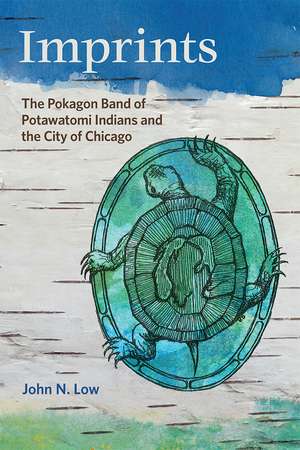
Imprints
Autor John N Lowen Limba Engleză Paperback – feb 2016
The Pokagon Band of Potawatomi Indians has been a part of Chicago since its founding. In very public expressions of indigeneity, they have refused to hide in plain sight or assimilate. Instead, throughout the city’s history, the Pokagon Potawatomi Indians have openly and aggressively expressed their refusal to be marginalized or forgotten—and in doing so, they have contributed to the fabric and history of the city.
Imprints: The Pokagon Band of Potawatomi Indians and the City of Chicago examines the ways some Pokagon Potawatomi tribal members have maintained a distinct Native identity, their rejection of assimilation into the mainstream, and their desire for inclusion in the larger contemporary society without forfeiting their “Indianness.” Mindful that contact is never a one-way street, Low also examines the ways in which experiences in Chicago have influenced the Pokagon Potawatomi. Imprints continues the recent scholarship on the urban Indian experience before as well as after World War II.
Imprints: The Pokagon Band of Potawatomi Indians and the City of Chicago examines the ways some Pokagon Potawatomi tribal members have maintained a distinct Native identity, their rejection of assimilation into the mainstream, and their desire for inclusion in the larger contemporary society without forfeiting their “Indianness.” Mindful that contact is never a one-way street, Low also examines the ways in which experiences in Chicago have influenced the Pokagon Potawatomi. Imprints continues the recent scholarship on the urban Indian experience before as well as after World War II.
Preț: 229.94 lei
Puncte Express: 345
Preț estimativ în valută:
40.69€ • 47.56$ • 35.33£
40.69€ • 47.56$ • 35.33£
Carte indisponibilă temporar
Doresc să fiu notificat când acest titlu va fi disponibil:
Se trimite...
Preluare comenzi: 021 569.72.76
Specificații
ISBN-13: 9781611861884
ISBN-10: 1611861888
Pagini: 328
Ilustrații: 48
Dimensiuni: 152 x 226 x 25 mm
Greutate: 0.45 kg
Ediția:1
Editura: Michigan State University Press
ISBN-10: 1611861888
Pagini: 328
Ilustrații: 48
Dimensiuni: 152 x 226 x 25 mm
Greutate: 0.45 kg
Ediția:1
Editura: Michigan State University Press
Notă biografică
John N. Low received his PhD in American Culture at the University of Michigan and is an enrolled citizen of the Pokagon Band of Potawatomi Indians. He is an assistant professor in comparative studies at Ohio State University–Newark where he also teaches in history and American Indian studies.
Cuprins
Contents
Preface
Acknowledgments
Introduction
Chapter 1. The Potawatomi as Chicago’s Early Urban Indians
Chapter 2. Simon Pokagon’s Claims of Equality and Appeals for Inclusion
Chapter 3. Claims Making to the Chicago Lakefront
Chapter 4. The Legacies of Turner, Cody, Streeter, and the Pokagon Potawatomi
Chapter 5. Leroy Wesaw and the Chicago Canoe Club
Chapter 6. Monuments, Memorials, and the Continued Presence of the Potawatomi in Chicago
Appendix 1. Transcription of Pottawattamie Book of Genesis: Legend of the Creation of Man
Appendix 2. Selected Essays, Articles, and Monographs Regarding Simon Pokagon
Appendix 3. List of Works by Simon Pokagon
Appendix 4. Timeline of the 1812 Battle of Fort Dearborn
Notes
Bibliography
Index
Recenzii
“This is not only a sophisticated narrative of the inextricable relations of Native peoples to historical and contemporary urban spaces, but also the story of a stubborn tribe who insisted on making and maintaining places for themselves all around their southern Lake Michigan homeland.”
—Brian Klopotek, author of Recognition Odysseys: Indigeneity, Race, and Federal Tribal Recognition Policy in Three Louisiana Indian Communities
—Brian Klopotek, author of Recognition Odysseys: Indigeneity, Race, and Federal Tribal Recognition Policy in Three Louisiana Indian Communities
Descriere
Imprints: The Pokagon Band of Potawatomi Indians and the City of Chicago examines how some Pokagon Potawatomi tribal members have maintained a distinct Native identity in Chicago and the ways in which experiences in the city have influenced the tribe. The book also explores their rejection of assimilation into the mainstream and their desire for inclusion in the larger contemporary society without forfeiting their “Indianness.”