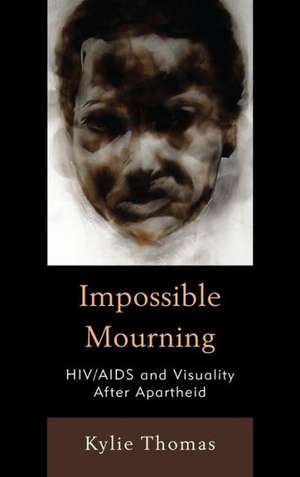
Impossible Mourning: HIV/AIDS and Visuality After Apartheid
Autor Kylie Thomasen Limba Engleză Hardback – 24 oct 2013
This book engages with multiple forms of visual representation that work variously to compound, undo, and complicate the politics of loss. Drawing on work Thomas did in art and narrative support groups while working with people living with HIV/AIDS in Khayelitsha, a township outside of the city of Cape Town this book also includes analyses of the work of South African visual artists and photographers Jane Alexander, Gille de Vlieg, Jillian Edelstein, Pieter Hugo, Ezrom Legae, Gideon Mendel, Zanele Muholi, Sam Nhlengethwa, Paul Stopforth, and Diane Victor.
Preț: 520.63 lei
Preț vechi: 816.90 lei
-36%
Puncte Express: 781
Carte tipărită la comandă
Livrare economică 26 noiembrie-10 decembrie
Livrare prin curier în România Termenul estimat este afișat lângă disponibilitate.
Transport gratuit pentru acest produs Plată online sau ramburs, în funcție de opțiunile comenzii.
Retur gratuit în 14 zile Comandă securizată și suport în română.
Specificații
ISBN-13: 9781611485349
ISBN-10: 1611485347
Pagini: 169
Ilustrații: 40 b/w photos
Dimensiuni: 157 x 238 x 20 mm
Greutate: 0.42 kg
Editura: Bloomsbury Publishing
Colecția Bucknell University Press
Locul publicării:New York, United States
ISBN-10: 1611485347
Pagini: 169
Ilustrații: 40 b/w photos
Dimensiuni: 157 x 238 x 20 mm
Greutate: 0.42 kg
Editura: Bloomsbury Publishing
Colecția Bucknell University Press
Locul publicării:New York, United States
V-ar putea interesa
-
 HIV in World Cultures: Three Decades of RepresentationsGustavo SuberoPreț: 407.63 lei
 -
 Queer ArtGemma Rolls-Bentley-21%Preț: 156.99 lei198.67 lei
 -
 Visual Redress in Africa from Indigenous and New Materialist PerspectivesElmarie CostandiusPreț: 407.48 lei
 -
 Afterimages of Apartheid: Photography and ResistanceKylie ThomasPreț: 386.91 lei
 -
 -25%Preț: 208.15 lei279.33 lei
 -
 -24%Preț: 71.23 lei94.17 lei
 -
 Ideas of AfricaOluremi C. Onabanjo-18%Preț: 256.93 lei313.61 lei
 -
 Southern African Queer and Trans Narratives in Digital LandscapesPrincess A. Sibanda-32%Preț: 594.97 lei879.11 lei
 -
 The Second WaveRustom BharuchaPreț: 135.79 lei
 -
 And the Walls Became the World All AroundJohanna EkstromPreț: 123.50 lei
 -
 Somebody Is Walking on Your GraveMariana EnríquezPreț: 142.85 lei
 -
 The Observable UniverseHeather MccaldenPreț: 109.29 lei
 -
 -20%Preț: 110.67 lei138.01 lei
 -
 Ken Gonzales-DayAmelia JonesPreț: 365.93 lei
 -
 Beyond the VeilPaul Gambino-17%Preț: 134.85 lei161.96 lei
 -
 Life ItselfBradley J. BorougerdiPreț: 317.60 lei
 -
 -25%Preț: 357.73 lei475.28 lei
 -
 Preț: 133.22 lei
 -
 Framing Fatherhood: A Celebration of Black FathersImani M. Cheers-23%Preț: 161.18 lei208.77 leiRecomandat
Cuprins
Contents
Dedication
Table of Contents
List of Illustrations
Acknowledgments
Introduction: A Language for Mourning
One: Speaking Bodies
Two: Passing and the Politics of Queer Loss Post-apartheid
Three: Traumatic Witnessing: Photography and Disappearance
Four: Mourning the Present
Five: Disavowed Loss during Apartheid and After in the Time of AIDS
Six: Refusing Transcendence: The Deaths of Biko and the Archives of Apartheid
(Without) Conclusion: "The Crisis is Not Over"
Bibliography
About the Author
Dedication
Table of Contents
List of Illustrations
Acknowledgments
Introduction: A Language for Mourning
One: Speaking Bodies
Two: Passing and the Politics of Queer Loss Post-apartheid
Three: Traumatic Witnessing: Photography and Disappearance
Four: Mourning the Present
Five: Disavowed Loss during Apartheid and After in the Time of AIDS
Six: Refusing Transcendence: The Deaths of Biko and the Archives of Apartheid
(Without) Conclusion: "The Crisis is Not Over"
Bibliography
About the Author