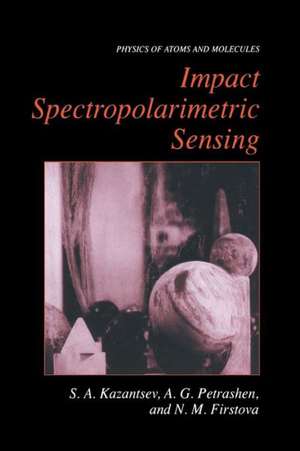
Impact Spectropolarimetric Sensing: Physics of Atoms and Molecules
Autor Sergi Kazantsev, Natalia M. Firstova, Alexander G. Petrashenen Limba Engleză Paperback – 27 sep 2012
Din seria Physics of Atoms and Molecules
-
 Preț: 377.79 lei
 - 18%
 Preț: 913.75 lei
 - 18%
 Preț: 957.20 lei
 - 18%
 Preț: 1238.56 lei
 -
 Preț: 380.93 lei
 - 18%
 Preț: 954.94 lei
 - 18%
 Preț: 1231.27 lei
 - 18%
 Preț: 953.15 lei
 - 5%
 Preț: 351.12 lei
 - 18%
 Preț: 957.81 lei
 - 15%
 Preț: 652.21 lei
 - 15%
 Preț: 667.15 lei
 - 18%
 Preț: 1185.07 lei
 -
 Preț: 378.32 lei
 - 18%
 Preț: 1226.69 lei
 - 15%
 Preț: 632.00 lei
 - 18%
 Preț: 956.18 lei
 - 18%
 Preț: 964.06 lei
 - 15%
 Preț: 669.72 lei
 - 24%
 Preț: 1182.14 lei
 - 18%
 Preț: 1231.22 lei
 - 18%
 Preț: 956.08 lei
 -
 Preț: 375.08 lei
 - 15%
 Preț: 692.44 lei
 - 15%
 Preț: 666.13 lei
 -
 Preț: 403.65 lei
 - 15%
 Preț: 625.44 lei
 -
 Preț: 406.12 lei
 - 15%
 Preț: 655.26 lei
 - 15%
 Preț: 638.90 lei
 - 15%
 Preț: 591.29 lei
 -
 Preț: 408.64 lei
 - 15%
 Preț: 629.98 lei
 - 18%
 Preț: 960.51 lei
 - 15%
 Preț: 636.31 lei
 - 20%
 Preț: 600.45 lei
 - 18%
 Preț: 1233.70 lei
Preț: 1225.68 lei
Preț vechi: 1494.74 lei
-18%
Puncte Express: 1839
Carte tipărită la comandă
Livrare economică 13-27 august
Livrare prin curier în România Termenul estimat este afișat lângă disponibilitate.
Transport gratuit pentru acest produs Plată online sau ramburs, în funcție de opțiunile comenzii.
Retur gratuit în 14 zile Comandă securizată și suport în română.
Specificații
ISBN-13: 9781461371946
ISBN-10: 1461371945
Pagini: 376
Ilustrații: XI, 361 p.
Dimensiuni: 155 x 235 x 21 mm
Greutate: 0.57 kg
Ediția:Softcover reprint of the original 1st ed. 1999
Editura: Springer
Colecția Physics of Atoms and Molecules
Seria Physics of Atoms and Molecules
Locul publicării:New York, NY, United States
ISBN-10: 1461371945
Pagini: 376
Ilustrații: XI, 361 p.
Dimensiuni: 155 x 235 x 21 mm
Greutate: 0.57 kg
Ediția:Softcover reprint of the original 1st ed. 1999
Editura: Springer
Colecția Physics of Atoms and Molecules
Seria Physics of Atoms and Molecules
Locul publicării:New York, NY, United States
V-ar putea interesa
-
 Fundamental Properties of the NeutronYu.A. Alexandrov-11%Preț: 285.57 lei319.13 lei
 -
 Nuclear Power: A Very Short IntroductionMaxwell Irvine-21%Preț: 54.99 lei69.94 lei
 -
 Deep Inelastic ScatteringRobin Devenish-22%Preț: 462.60 lei594.92 lei
 -
 -33%Preț: 543.78 lei811.97 lei
 -
 ColliderPaul HalpernPreț: 88.49 lei
 -
 The Experimental Foundations of Particle PhysicsRobert N. Cahn-14%Preț: 729.24 lei847.95 lei
 -
 -18%Preț: 717.87 lei875.46 lei
 -
 Advanced Nanotube & Nanofiber MaterialsA K Haghi-29%Preț: 476.62 lei675.62 lei
 -
 -31%Preț: 1176.21 lei1695.77 lei
 -
 -29%Preț: 476.11 lei675.30 lei
 -
 Neutron Physics for Nuclear ReactorsEnrico Fermi-18%Preț: 1442.83 lei1759.55 lei
Public țintă
ResearchCuprins
1. Physical Introduction: Concepts, Phenomenology, Retrospectives, Applications.- 1.1. Polarization of Atomic Ensembles in Ionized Media.- 1.2. Polarization of Solar Flare Emission.- 1.3. Impact Polarization.- 1.4. Gas Discharge Studies.- 1.5. Collisional Kinetics of Polarization.- 1.6. Spectropolarimetric Sensing.- 1.7. Polarization Effects in the Earth Atmosphere.- 2. Polarization of a Photon Beam.- 2.1. Introduction.- 2.2. Wave Function of a Photon.- 2.3. Momentum, Spin, and Parity of a Photon.- 2.4. Rotation Matrix.- 2.5. Spinors.- 2.6. Relationship between the Polarization Direction and Characteristics of a Photon.- 2.7. Relationship between Stokes Parameters and the Characteristics of an Optical Field.- 2.8. Concluding Remarks.- 3. Theory of Collisional Spectropolarimetric Effects.- 3.1. Introduction.- 3.2. Density Matrix of an Atomic Ensemble.- 3.3. Polarization Density Matrix.- 3.4. Polarization Moments of the Density Matrix.- 3.5. Physical Meaning of Polarization Moments.- 3.6. Polarization Moments and Spectral Characteristics of an Atomic Ensemble.- 3.7. Density Matrix Relaxation Theory.- 3.8. Collisional Evolution of Polarization Moments.- 3.9. Interaction with an Electromagnetic Field.- 3.10. Impact Alignment Cross Section.- 3.11. Anisotropic Collisional Relaxation of Excited Hydrogen Atoms.- 3.12. Spectropolarimetric Effects for Angular Correlation Experiments.- 3.13. Concluding Remarks.- 4. Fast Particle Collision with a Heavy Atomic Target.- 4.1. Introduction.- 4.2. Born Expansion of the Scattering Amplitude.- 4.3. The Glauber Approximation.- 4.4. The System of Impact Parameter Equations.- 4.5. Concluding Remarks.- 5. Theory of Anisotropic Collisional Relaxation.- 5.1. Introduction.- 5.2. Symmetry of the Collisional Relaxation Cross Section Matrix.- 5.3.Rate Constants of Collisional Relaxation in Case of Partial Anisotropy.- 5.4. Distribution Functions of Relative Velocities.- 5.5. Collisional Relaxation of Polarization Moments under Intermultiplet Mixing.- 5.6. Anisotropie Collisional Alignment of a Narrow Multiplet.- 5.7. Anisotropie Relaxation and Polarization of Light.- 5.8. Depolarizing Collisions with Charged Particles.- 5.9. Concluding Remarks.- 6. Theory of Charge Exchange Polarization.- 6.1. Introduction.- 6.2. Theory of an Electron in the Field of Two Coulomb Centers.- 6.3. Distorted Wave Approximation Theory.- 6.4. Pseudolevel Technique for Computing the Polarization of Ions.- 6.5. Concluding Remarks.- 7. Spectropolarimeters for Solar Problems.- 7.1. Introduction.- 7.2. Spectropolarimetric Techniques of Meudon Observatory (France).- 7.3. Polarimetric Observations in the Crimean Astrophysical Observatory (Ukraine).- 7.4. The Spectropolarimeter of the Institute of Solar and Terrestrial Physics (Irkutsk, Russia).- 7.5. Solar Spectropolarimeter of Sacramento Peak Observatory (USA).- 7.6. Concluding Remarks.- 8. Solar Flare Observations at the Crimean Astrophysical Observatory (Ukraine).- 8.1. Introduction.- 8.2. Technique of Observation and Data Processing.- 8.3. Degree of Polarization along the Hydrogen H? Line.- 8.4. Spatial Distribution of the Degree of Polarization.- 8.5. Orientation of the Polarization Plane.- 8.6. Concluding Remarks.- 9. Observations of Polarization Effects at the Irkutsk Institute of Solar and Terrestrial Physics (Russia).- 9.1. Introduction.- 9.2. Spectropolarimetric Parameters of H? and H? Lines for the Flare on 15.09.1981.- 9.3. Spectropolarimetric Parameters of the Active Region 5669 (SGD) on 07.09.1989.- 9.4. Detection of the Linear Polarization of the Flare on 16.05.1991.- 9.5.Concluding Remarks.- 10. Solar Flare Observations at Meudon Observatory (France).- 10.1. Introduction.- 10.2. Linear Polarization of Emission of the Flare on 17.05.1980.- 10.3. Spectropolarimetric Effects of the Flare on 15.07.1980.- 10.4. Spectropolarimetric Features of Three Flares on 11.07.1982.- 10.5. Polarization Effects of the Emission of Two Flares on 17.07.1982.- 10.6. Concluding Remarks.- 11. Spectropolarimetric Measurements of Mustaches.- 11.1. Introduction.- 11.2. Polarization of Emission of Mustaches near the Solar Limb.- 11.3. Spectropolarimetric Measurements of Mustaches with an H? Filter.- 11.4. Improved Spectropolarimetric Observations of Mustaches on 14.11.1985.- 11.5. Observations of Mustaches at Baikal Astrophysical Observatory.- 11.6. Observations of Mustaches at Sacramento Peak Observatory.- 11.7. Concluding Remarks.- 12. Methodology of Impact Spectropolarimetric Sensing.- 12.1. Introduction.- 12.2. Spectropolarimetric Sensing Using Ground-Based Observations.- 12.3. Role of the Solar Magnetic Field.- 12.4. Linear Polarization of H? and H? Hydrogen Lines in the Born Approximation.- 12.5. Linear Polarization of the H? Hydrogen Line in the Glauber Approximation.- 12.6. Linear Polarization of H? and H? Hydrogen Lines by the Impact Parameter Method.- 12.7. Linear Polarization of the L? Hydrogen Line.- 12.8. Concluding Remarks.- 13. Impact Spectropolarimetric Diagnostics of Nonthermal Phenomena in the Solar Atmosphere.- 13.1. Introduction.- 13.2. Energy Transport into the Chromospheric Region of a Solar Flare.- 13.3. Determination of Proton Energy for the Flare on 16.05.1991.- 13.4. Impact Spectropolarimetric Sensing for the Flare on 15.09.1981.- 13.5. Impact Spectropolarimetric Sensing of Mustaches.- 13.6. Concluding Remarks.- 14. Conclusions.-References.