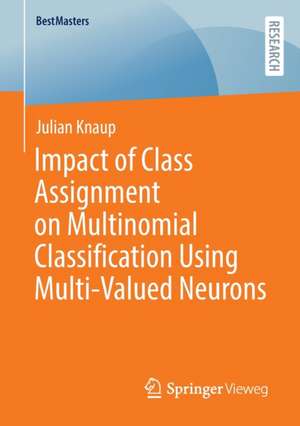
Impact of Class Assignment on Multinomial Classification Using Multi-Valued Neurons: BestMasters
Autor Julian Knaupen Limba Engleză Paperback – 8 aug 2022
Din seria BestMasters
- 20%
 Preț: 403.67 lei
 - 15%
 Preț: 576.73 lei
 - 15%
 Preț: 479.34 lei
 -
 Preț: 398.08 lei
 - 20%
 Preț: 326.11 lei
 -
 Preț: 430.31 lei
 -
 Preț: 376.08 lei
 -
 Preț: 432.79 lei
 -
 Preț: 380.12 lei
 - 15%
 Preț: 477.28 lei
 -
 Preț: 335.08 lei
 -
 Preț: 430.54 lei
 -
 Preț: 363.99 lei
 -
 Preț: 379.29 lei
 - 15%
 Preț: 447.95 lei
 - 5%
 Preț: 529.09 lei
 -
 Preț: 432.79 lei
 -
 Preț: 363.38 lei
 -
 Preț: 363.58 lei
 -
 Preț: 429.09 lei
 -
 Preț: 358.12 lei
 -
 Preț: 298.06 lei
 - 15%
 Preț: 420.91 lei
 -
 Preț: 429.71 lei
 -
 Preț: 376.93 lei
 -
 Preț: 430.74 lei
 -
 Preț: 378.84 lei
 -
 Preț: 431.14 lei
 -
 Preț: 366.04 lei
 -
 Preț: 363.99 lei
 -
 Preț: 371.93 lei
 - 15%
 Preț: 523.54 lei
 -
 Preț: 365.42 lei
 -
 Preț: 431.56 lei
 -
 Preț: 364.61 lei
 -
 Preț: 362.56 lei
 -
 Preț: 363.58 lei
 -
 Preț: 381.78 lei
 -
 Preț: 379.49 lei
 - 20%
 Preț: 286.01 lei
 -
 Preț: 313.10 lei
 -
 Preț: 363.18 lei
 -
 Preț: 366.82 lei
 -
 Preț: 382.12 lei
 -
 Preț: 430.94 lei
 -
 Preț: 366.82 lei
 - 5%
 Preț: 532.46 lei
 -
 Preț: 364.41 lei
 -
 Preț: 361.16 lei
 - 15%
 Preț: 476.06 lei
Preț: 526.16 lei
Preț vechi: 657.70 lei
-20%
Puncte Express: 789
Carte disponibilă
Livrare economică 12-26 noiembrie
Livrare express 28 octombrie-03 noiembrie pentru 19.77 lei
Livrare prin curier în România Termenul estimat este afișat lângă disponibilitate.
Transport gratuit pentru acest produs Plată online sau ramburs, în funcție de opțiunile comenzii.
Retur gratuit în 14 zile Comandă securizată și suport în română.
Specificații
ISBN-13: 9783658389543
ISBN-10: 3658389540
Pagini: 92
Ilustrații: XII, 77 p. 44 illus.
Dimensiuni: 148 x 210 x 6 mm
Greutate: 0.13 kg
Ediția:1st edition 2022
Editura: SpringerGabler
Colecția Bestmasters
Seria BestMasters
Locul publicării:Wiesbaden, Germany
ISBN-10: 3658389540
Pagini: 92
Ilustrații: XII, 77 p. 44 illus.
Dimensiuni: 148 x 210 x 6 mm
Greutate: 0.13 kg
Ediția:1st edition 2022
Editura: SpringerGabler
Colecția Bestmasters
Seria BestMasters
Locul publicării:Wiesbaden, Germany
Cuprins
1 Introduction.- 2 Preliminaries.- 3 Scientific State of the Art.- 4 Approach.- 5 Evaluation.- 6 Conclusion and Outlook.
Textul de pe ultima copertă
Multilayer neural networks based on multi-valued neurons (MLMVNs) have been proposed to combine the advantages of complex-valued neural networks with a plain derivative-free learning algorithm. In addition, multi-valued neurons (MVNs) offer a multi-valued threshold logic resulting in the ability to replace multiple conventional output neurons in classification tasks. Therefore, several classes can be assigned to one output neuron. This book introduces a novel approach to assign multiple classes to numerous MVNs in the output layer. It was found that classes that possess similarities should be allocated to the same neuron and arranged adjacent to each other on the unit circle. Since MLMVNs require input data located on the unit circle, two employed transformations are reevaluated. The min-max scaler utilizing the exponential function, and the 2D discrete Fourier transform restricting to the phase information for image recognition. The evaluation was performed on the Sensorless Drive Diagnosis dataset and the Fashion MNIST dataset.
About the Author
Julian Knaup received his B. Sc. in Electrical Engineering and his M. Sc. in Information Technology from the University of Applied Sciences and Arts Ostwestfalen-Lippe. He is currently working on machine learning algorithms at the Institute Industrial IT and researching AI potentials in product creation.