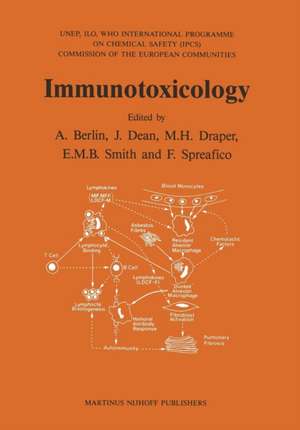
Immunotoxicology: Proceedings of the International Seminar on the Immunological System as a Target for Toxic Damage — Present Status, Open Problems and Future Perspectives: Developments in Hematology and Immunology, cartea 16
Autor The Commission of the European Communities & UNEP, ILO, WHO International Programme on Chemical Safety Editat de A. Berlin, J.R. Dean, M.H. Draper, E.M.B. Smith, F. Spreaficoen Limba Engleză Paperback – 13 oct 2011
Din seria Developments in Hematology and Immunology
- 5%
 Preț: 680.54 lei
 - 5%
 Preț: 1098.33 lei
 - 5%
 Preț: 1049.48 lei
 - 5%
 Preț: 360.78 lei
 - 5%
 Preț: 352.80 lei
 - 5%
 Preț: 2182.49 lei
 - 5%
 Preț: 744.93 lei
 - 5%
 Preț: 688.44 lei
 - 5%
 Preț: 349.76 lei
 - 5%
 Preț: 363.88 lei
 - 5%
 Preț: 1052.66 lei
 - 5%
 Preț: 350.88 lei
 - 5%
 Preț: 687.23 lei
 - 5%
 Preț: 1457.99 lei
 - 5%
 Preț: 1352.40 lei
 - 5%
 Preț: 2035.26 lei
 - 5%
 Preț: 1462.03 lei
 - 5%
 Preț: 1135.90 lei
 - 5%
 Preț: 1052.47 lei
 - 5%
 Preț: 744.10 lei
 - 5%
 Preț: 741.65 lei
 - 18%
 Preț: 908.91 lei
 - 5%
 Preț: 1102.53 lei
 - 5%
 Preț: 1099.85 lei
 - 5%
 Preț: 1352.75 lei
 - 5%
 Preț: 1136.88 lei
 - 5%
 Preț: 1190.20 lei
 - 5%
 Preț: 1190.44 lei
 - 5%
 Preț: 1103.40 lei
 - 5%
 Preț: 1355.72 lei
 - 5%
 Preț: 355.43 lei
 - 5%
 Preț: 359.75 lei
 - 5%
 Preț: 715.85 lei
 - 5%
 Preț: 1050.57 lei
 - 5%
 Preț: 370.25 lei
Preț: 373.70 lei
Preț vechi: 393.37 lei
-5%
Puncte Express: 561
Carte tipărită la comandă
Livrare economică 24 noiembrie-08 decembrie
Livrare prin curier în România Termenul estimat este afișat lângă disponibilitate.
Transport gratuit de la 400.00 lei Plată online sau ramburs, în funcție de opțiunile comenzii.
Retur gratuit în 14 zile Comandă securizată și suport în română.
Specificații
ISBN-13: 9789401084147
ISBN-10: 9401084149
Pagini: 528
Ilustrații: 528 p.
Dimensiuni: 178 x 254 x 28 mm
Greutate: 0.91 kg
Ediția:1987
Editura: SPRINGER NETHERLANDS
Colecția Springer
Seria Developments in Hematology and Immunology
Locul publicării:Dordrecht, Netherlands
ISBN-10: 9401084149
Pagini: 528
Ilustrații: 528 p.
Dimensiuni: 178 x 254 x 28 mm
Greutate: 0.91 kg
Ediția:1987
Editura: SPRINGER NETHERLANDS
Colecția Springer
Seria Developments in Hematology and Immunology
Locul publicării:Dordrecht, Netherlands
V-ar putea interesa
-
 Clinical Immunology: Principles and PracticeRobert R. Rich-23%Preț: 1302.07 lei1695.66 lei
 -
 Exploring Immunology – Concepts and EvidenceG MacPherson-5%Preț: 290.86 lei306.17 lei
 -
 Visualizing ImmunityDorian McGavern-5%Preț: 1463.47 lei1540.49 lei
 -
 Allergy in PracticeJohannes Ring-5%Preț: 842.26 lei886.59 lei
 -
 Immunology of the Female Genital TractErnst Rainer Weissenbacher-5%Preț: 704.44 lei741.51 lei
 -
 Biotechnology of Hairy Root SystemsPauline M Doran-5%Preț: 1460.33 lei1537.18 lei
 -
 Allergy Frontiers:Future PerspectivesRuby Pawankar-5%Preț: 786.11 lei827.48 lei
Public țintă
ResearchCuprins
Session I.- A Toxicologist’s View of Immunotoxicology.- The Cells of the Immune System. An Up-date on their Interactions and Signals.- Relationships Between the Immune System and Cancer.- The Immune System and Infections.- Mechanisms of Autoimmunity.- Session II.- Primary Immunodeficiencies.- The Neoplastic Consequences of Immunodepression.- Immunological Abnormalities in the Acquired Immunodeficiency Syndrome.- Monitoring the Human Immune System.- Immunorestoration in Secondary Immunodeficiency.- Session III.- The Role of Histopathology in Assessment of Immunotoxicology.- Experience with Validation of Methodology for Immunotoxicity Assessment in Rodents.- An In Vitro Model for Studying Cellular and Molecular Mechanisms of Thymic Atrophy Induced by Chlorinated Aromatic Compounds.- The Gut-Associated Lymphoid Tissue as a Model of a Specialized Immune Subsystem.- Immunodepressive Drugs as Prototype Immunotoxicants.- The Toxicology of Biological Response Modifiers.- MTP-PE, a Synthetic Lipophilic Muramyltripeptide: Biological and Toxicological Properties.- Session IV.- Altered Immune Function and Host Resistance Following Exposure to Common Airborne Pollutants.- Immunotoxicity of Organotin Compounds. A Cell Biological Approach to Dialkyltin Induced Thymus Atrophy.- Immunosuppressive Effects of Benzidine in BCF Mice.- Mechanisms of Metal-Induced Immunotoxicity.- Some Aspects of Immune Alterations Induced by Chloro-Dibenzo-p-dioxins and Chloro-Dibenzofurans.- Immunotoxicological Effects of Asbestos.- Immunotoxicity of Dimethylnitrosamine.- Session V.- Clinical Immunology Studies in Individuals Exposed to Environmental Chemicals.- Immunological Effects of Diethylstilbestrol in the Human.- Immune System Disorders Associated with Adulterated Cooking Oil.- Vulnerability toToxic or Therapeutic Immunomodulation — As Two Complementary Aspects of Age and Nutrition Dependent Immunodeficiency.- Session VI.- Basic Mechanisms in Hypersensitivity. An Update.- Mechanisms of Pseudo-allergy.- Prospective Modeling for Delayed Contact Hypersensitivity.- Allergic Drug Reactions.- Contact Hypersensitivity to Environmental Chemicals.- Lung Reactions to Environmental Chemicals.