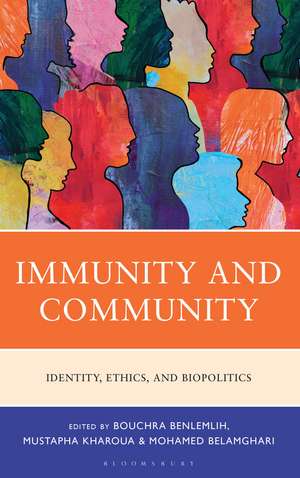
Immunity and Community: Identity, Ethics, and Biopolitics
Editat de Bouchra Benlemlih, Dr. Mustapha Kharoua, Dr. Mohamed Belamgharien Limba Engleză Hardback – 25 iun 2025
Drawing on frameworks from medical humanities, biopolitics, and ethics, the multidisciplinary contributors interrogate how immunization protocols reflect and reshape societal dynamics-illuminating the ways power, vulnerability, and identity are negotiated in public health discourse. With chapters exploring topics such as migration, representation, global governance, and the logic of action, the book offers a compelling critique of immunitary regimes and their impact on the social body. Rich in theoretical insight and grounded in contemporary relevance, this work will be useful reading for academics, policy makers, and students seeking to understand the cultural and political stakes of life preservation in a post-pandemic world.
Preț: 534.74 lei
Preț vechi: 600.83 lei
-11%
Puncte Express: 802
Carte disponibilă
Livrare economică 10-24 noiembrie
Livrare prin curier în România Termenul estimat este afișat lângă disponibilitate.
Transport gratuit pentru acest produs Plată online sau ramburs, în funcție de opțiunile comenzii.
Retur gratuit în 14 zile Comandă securizată și suport în română.
Specificații
ISBN-13: 9798216380443
Pagini: 160
Dimensiuni: 152 x 229 mm
Editura: Bloomsbury Publishing
Colecția Bloomsbury Academic
Locul publicării:New York, United States
Pagini: 160
Dimensiuni: 152 x 229 mm
Editura: Bloomsbury Publishing
Colecția Bloomsbury Academic
Locul publicării:New York, United States
Cuprins
Acknowledgments
Foreword by Anouar Majid
Introduction by Bouchra Benlemlih and Mustapha Kharoua
Chapter 1: Techne or Politeia? Some Notes on Roberto Esposito's Hermeneutic of the Pandemic by Agostino Cera
Chapter 2: The Sociological Approach to Collective Behavior in the Context of the Coronavirus Pandemic: A Critical Review to the Concept of the Logic of Action in French Sociological Literature by Sidi Mohamed Elhassani
Chapter 3: The Concept of Man in the West amid the Pandemic, a Hyper-Phenomenon in Nature or an Epiphenomenon to it? By Moulay Abdessadek Ahlbentaleb
Chapter 4: Denied Personhood: The Necropolitical Production of Disposability in Mediterranean Migration by Rachid Benharrousse
Chapter 5: Pandemics and Socio-economic Reforms: A Comparative-Historical Perspective on Infectious Diseases' Impact on Societies by Mohamed Belamghari and Sara Tabza
Chapter 6: Slovenian Crime Fiction in the Time of the Covid-19 Pandemic and Neoliberalism: A Case Study of Imaginary Immunities by Primoz Mlacnik
Chapter 7: A Postscript in Verse: Seven Circles of Self by Hassan Mekouar
Index
About the Editors
About the Contributors
Foreword by Anouar Majid
Introduction by Bouchra Benlemlih and Mustapha Kharoua
Chapter 1: Techne or Politeia? Some Notes on Roberto Esposito's Hermeneutic of the Pandemic by Agostino Cera
Chapter 2: The Sociological Approach to Collective Behavior in the Context of the Coronavirus Pandemic: A Critical Review to the Concept of the Logic of Action in French Sociological Literature by Sidi Mohamed Elhassani
Chapter 3: The Concept of Man in the West amid the Pandemic, a Hyper-Phenomenon in Nature or an Epiphenomenon to it? By Moulay Abdessadek Ahlbentaleb
Chapter 4: Denied Personhood: The Necropolitical Production of Disposability in Mediterranean Migration by Rachid Benharrousse
Chapter 5: Pandemics and Socio-economic Reforms: A Comparative-Historical Perspective on Infectious Diseases' Impact on Societies by Mohamed Belamghari and Sara Tabza
Chapter 6: Slovenian Crime Fiction in the Time of the Covid-19 Pandemic and Neoliberalism: A Case Study of Imaginary Immunities by Primoz Mlacnik
Chapter 7: A Postscript in Verse: Seven Circles of Self by Hassan Mekouar
Index
About the Editors
About the Contributors
Recenzii
Never before has the immune system become so embedded in the community as in the recent COVID pandemic. This book analyzes the full ambivalence of this process, simultaneously medical, social, and political-the necessity, but also the risk, underlying immunization practices in a world riven by economic, ethnic, and environmental inequalities. Drawing on contemporary philosophical debate, it opens a powerful and original perspective on our world, bridging the languages of biology, law, and ethics.