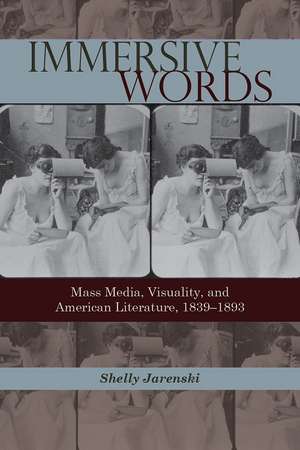
Immersive Words: Mass Media, Visuality, and American Literature, 1839–1893
Autor Shelly Jarenskien Limba Engleză Hardback – 30 apr 2015
Observăm în Immersive Words o abordare metodologică riguroasă a modului în care cultura vizuală a secolului al XIX-lea a reconfigurat estetica literară americană. Structura volumului este construită în jurul a patru piloni tehnologici: dagherotipul, panoramele, turismul mecanizat și spectacolul expozițiilor mondiale. Autoarea Shelly Jarenski argumentează convingător că provocările actuale generate de mediile virtuale își au rădăcinile în anxietățile și inovațiile autorilor din perioada 1839–1893. Ne-a atras atenția analiza aplicată asupra lui Herman Melville, despre care Jarenski afirmă că a preluat tehnica dagherotipului nu doar ca descriere, ci ca structură narativă, folosind perspective fragmentate pentru a simula experiența vizuală a epocii.
Suntem de părere că relevanța acestui studiu pentru curriculumul de literatură americană rezidă în capacitatea sa de a șterge granițele rigide dintre text și imagine. Volumul demonstrează cum Frederick Douglass a utilizat estetica panoramică pentru a submina narațiunile spațio-temporale convenționale, în timp ce Sarah Orne Jewett a simulat interactivitatea marilor expoziții pentru a explora comunicarea estetică marcată de gen și rasă. Cititorii familiarizați cu Through the Negative de Megan Williams vor aprecia modul în care Jarenski extinde discuția de la fotografia de război către o gamă mult mai largă de dispozitive optice și spații imersive, oferind o perspectivă mai vastă asupra modernizării percepției americane. În timp ce alte lucrări se concentrează strict pe tehnica fotografică, Immersive Words integrează dimensiunea performativă a spațiilor expoziționale, oferind un context esențial pentru înțelegerea identității naționale americane aflate în plină formare.
Preț: 406.14 lei
Carte disponibilă
Livrare economică 28 noiembrie-12 decembrie
Livrare express 17-21 noiembrie pentru 39.13 lei
Specificații
ISBN-10: 0817318674
Pagini: 248
Ilustrații: 29 B&W illustrations
Dimensiuni: 152 x 229 x 28 mm
Greutate: 0.54 kg
Ediția:First Edition
Editura: University Of Alabama Press
Colecția University Alabama Press
V-ar putea interesa
-
 Byron's HeroinesCaroline Franklin-33%Preț: 787.58 lei1171.29 lei
-
 Testamentary Acts: Browning, Tennyson, James, HardyMichael Millgate-22%Preț: 151.25 lei193.06 lei
-
 Novels of the Eighteen-FortiesKathleen Tillotson-19%Preț: 296.97 lei367.52 lei
-
 Words Alone: Yeats and his InheritancesR. F. Foster-15%Preț: 111.39 lei131.61 lei
-
 Dive Deeper: Journeys with Moby-DickGeorge Cotkin-16%Preț: 219.68 lei262.06 lei
-
 -31%Preț: 496.25 lei718.11 lei
-
 -10%Preț: 381.36 lei422.43 lei
-
 Uses of AustenGillian DowPreț: 406.58 lei
-
 José MartíE. BejelPreț: 401.53 lei
-
 Preț: 405.55 lei
-
 -26%Preț: 69.50 lei93.37 lei
-
 Preț: 63.39 lei
-
 In Other Worlds: SF and the Human ImaginationMargaret Atwood-26%Preț: 68.31 lei92.70 lei
-
 Bleak HouseChristine Geraghty-11%Preț: 175.72 lei196.57 lei
-
 Eyes Wide Shut: Re-Envisioning Christina Rossetti’s Poetry and ProseMelanie A. Hanson-18%Preț: 152.72 lei185.75 lei
De ce să citești această carte
Această lucrare este esențială pentru cercetătorii și studenții interesați de intersecția dintre tehnologie și literatură. Immersive Words nu este doar o critică literară, ci o istorie culturală a modului în care am învățat să „vedem” prin cuvinte. Cititorul câștigă o înțelegere profundă a rădăcinilor culturii noastre vizuale contemporane, descoperind cum marii scriitori americani au anticipat imersiunea digitală prin tehnici narative revoluționare acum un secol și jumătate.
Despre autor
Shelly Jarenski este o cercetătoare specializată în literatura americană a secolului al XIX-lea și în studii de cultură vizuală. Lucrarea sa, publicată la University Of Alabama Press, reflectă un interes academic profund pentru modul în care tehnologiile emergente de imagine modelează identitatea națională, rasa și genul în contextul Statelor Unite. Prin analiza sa asupra unor autori canonici precum Melville și Hawthorne, Jarenski s-a impus ca o voce importantă în dialogul dintre istoria artei și critica literară, aducând la lumină conexiuni anterior neglijate între dispozitivele optice pre-cinematice și structura romanului clasic.
Descriere scurtă
The middle of the nineteenth century witnessed the emergence of numerous visual technologies and techniques: the daguerreotype, immersive exhibition spaces such as cycloramas and panoramas, mechanized tourism, and large-scale exhibitions and spectacles such as the World’s Fair. In closely argued chapters devoted to these four visual forms, Jarenski demonstrates that the popularity of these novelties catalyzed a shift by authors of the period beyond narratives that merely described images to ones that invoked aesthetic experiences.
Jarenski describes how Herman Melville adapts the aesthetic of the daguerreotype through his use of dramatic point-of-view and unexpected shifts that disorient readers. Frederick Douglass is shown to appropriate a panoramic aesthetic that severs spatial and temporal narratives from standard expectations. Jarenski traces how Nathaniel Hawthorne’s The Marble Faun found success as a travel guide to Rome, though intended as a work of serious fiction. Finally, Sarah Orne Jewett is shown to simulate the interactivity of the World Columbian Exposition to promote racialized and gendered forms of aesthetic communication. These techniques and strategies drawn from visual forms blur the just-so boundary critics and theorists have traditionally drawn between text and image.
In the mid-nineteenth century, the national identity of the United States remained fluid and hinged upon matters of gender, sexuality, and, crucially, race. Authors both reflected that evolving identity and contributed to its ongoing evolution. In demonstrating how the aesthetic and visual technologies of the nineteenth century changed the fundamental aesthetics of American literature, the importance of Immersive Words goes far beyond literary criticism.
Notă biografică
Recenzii
—CHOICE
“Immersive Words continues a line of argument about visual culture that has invigorated the study of nineteenth-century American literature, but it also forges new, interdisciplinary relations between literary studies and the burgeoning field of American studies. While its central texts are by nineteenth-century authors such as Melville, Douglass, and Hawthorne, Jarenski enriches her analysis with many other ancillary cultural texts, events, and subgenres that open the book up to other periods and forms of cultural production, ultimately making Immersive Words much more than the sum of its parts.”
—Michael A. Chaney, author of Fugitive Vision: Slave Image and Black Identity in Antebellum Narrative and editor of Graphic Subjects: Critical Essays on Autobiography and Graphic Novels