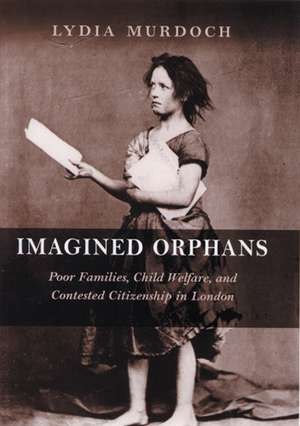
Imagined Orphans: Poor Families, Child Welfare, and Contested Citizenship in London: Rutgers Series in Childhood Studies
Autor Professor Lydia Murdochen Limba Engleză Hardback – 16 feb 2006
With his dirty, tattered clothes and hollowed-out face, Oliver Twist is the enduring symbol of the young indigent spilling out of orphanages and haunting the streets of late-nineteenth-century London. Although poor children were often portrayed as real-life Oliver Twists—either orphaned or abandoned by unworthy parents—they in fact frequently maintained contact and were eventually reunited with their families.
In Imagined Orphans, Lydia Murdoch focuses on this discrepancy between the representation and the reality of children’s experiences within welfare institutions—a discrepancy that she argues stems from conflicts over middle- and working-class notions of citizenship that arose in the 1870s and persisted until the First World War. Reformers’ efforts to depict poor children as either orphaned or endangered by abusive or “no-good” parents fed upon the poor’s increasing exclusion from the Victorian social body. Reformers used the public’s growing distrust and pitiless attitude toward poor adults to increase charity and state aid to the children.
With a critical eye to social issues of the period, Murdoch urges readers to reconsider the complex situations of families living in poverty. While reformers’ motivations seem well intentioned, she shows how their methods solidified the public’s antipoor sentiment and justified a minimalist welfare state that engendered a cycle of poverty. As they worked to fashion model citizens, reformers’ efforts to protect and care for children took on an increasingly imperial cast that would continue into the twentieth century.
In Imagined Orphans, Lydia Murdoch focuses on this discrepancy between the representation and the reality of children’s experiences within welfare institutions—a discrepancy that she argues stems from conflicts over middle- and working-class notions of citizenship that arose in the 1870s and persisted until the First World War. Reformers’ efforts to depict poor children as either orphaned or endangered by abusive or “no-good” parents fed upon the poor’s increasing exclusion from the Victorian social body. Reformers used the public’s growing distrust and pitiless attitude toward poor adults to increase charity and state aid to the children.
With a critical eye to social issues of the period, Murdoch urges readers to reconsider the complex situations of families living in poverty. While reformers’ motivations seem well intentioned, she shows how their methods solidified the public’s antipoor sentiment and justified a minimalist welfare state that engendered a cycle of poverty. As they worked to fashion model citizens, reformers’ efforts to protect and care for children took on an increasingly imperial cast that would continue into the twentieth century.
Din seria Rutgers Series in Childhood Studies
-
 Preț: 239.05 lei
 -
 Preț: 247.77 lei
 -
 Preț: 188.79 lei
 -
 Preț: 225.03 lei
 -
 Preț: 295.20 lei
 -
 Preț: 273.96 lei
 -
 Preț: 281.76 lei
 -
 Preț: 297.51 lei
 -
 Preț: 293.00 lei
 -
 Preț: 303.03 lei
 -
 Preț: 273.96 lei
 -
 Preț: 306.58 lei
 - 27%
 Preț: 793.83 lei
 -
 Preț: 273.96 lei
 -
 Preț: 301.93 lei
 - 27%
 Preț: 793.83 lei
 -
 Preț: 307.68 lei
 -
 Preț: 275.02 lei
 -
 Preț: 329.80 lei
 -
 Preț: 327.77 lei
 -
 Preț: 301.93 lei
 -
 Preț: 288.34 lei
 -
 Preț: 273.96 lei
 -
 Preț: 295.20 lei
 - 27%
 Preț: 796.36 lei
 - 23%
 Preț: 806.17 lei
 - 27%
 Preț: 795.49 lei
 -
 Preț: 285.41 lei
 -
 Preț: 248.17 lei
 - 5%
 Preț: 352.01 lei
 -
 Preț: 354.58 lei
 -
 Preț: 370.35 lei
 -
 Preț: 312.73 lei
 -
 Preț: 278.70 lei
 - 32%
 Preț: 197.04 lei
Preț: 391.85 lei
Preț vechi: 483.77 lei
-19%
Puncte Express: 588
Preț estimativ în valută:
69.37€ • 80.71$ • 60.16£
69.37€ • 80.71$ • 60.16£
Carte disponibilă
Livrare economică 07-21 februarie
Livrare express 24-30 ianuarie pentru 34.12 lei
Preluare comenzi: 021 569.72.76
Specificații
ISBN-13: 9780813537221
ISBN-10: 0813537223
Pagini: 288
Ilustrații: 24 b&w illustrations
Dimensiuni: 152 x 229 x 23 mm
Greutate: 0.51 kg
Ediția:None edition
Editura: Rutgers University Press
Colecția Rutgers University Press
Seria Rutgers Series in Childhood Studies
ISBN-10: 0813537223
Pagini: 288
Ilustrații: 24 b&w illustrations
Dimensiuni: 152 x 229 x 23 mm
Greutate: 0.51 kg
Ediția:None edition
Editura: Rutgers University Press
Colecția Rutgers University Press
Seria Rutgers Series in Childhood Studies
V-ar putea interesa
-
 Adjustment with a Human Face: Volume 1, Protecting the Vulnerable and Promoting GrowthGiovanni Andrea Cornia-20%Preț: 255.27 lei317.85 lei
 -
 Preț: 264.79 lei
 -
 Youth Work PracticeTony Jeffs-26%Preț: 229.19 lei311.28 lei
 -
 -25%Preț: 276.27 lei369.82 lei
 -
 Preț: 137.32 lei
 -
 -5%Preț: 350.86 lei369.33 lei
 -
 The Inside Guide to Being a ChildminderAllison Lee-43%Preț: 76.05 lei133.07 lei
 -
 Preț: 371.25 lei
 -
 Achieving Positive Outcomes for Children in CareColin MaginnPreț: 400.39 lei
 -
 Practical Interventions for Young People at RiskKathryn Geldard-15%Preț: 414.75 lei487.94 lei
 -
 -26%Preț: 230.45 lei311.57 lei
Notă biografică
LYDIA MURDOCH is an assistant professor of history at Vassar College in Poughkeepsie, New York.
Cuprins
"A little waif of London, rescued from the streets": melodrama and popular representations of poor children
From barrack schools to family cottages: creating domestic space and civic identity for poor children
The parents of "nobody's children": family backgrounds and the causes of poverty
"That most delicate of all questions in an Englishman's mind": the rights of parents and their continued contact with institutionalized children
Training "Street Arabs" into British citizens: making artisans and members of empire
"Their charge and ours": changing notions of child welfare and citizenship
From barrack schools to family cottages: creating domestic space and civic identity for poor children
The parents of "nobody's children": family backgrounds and the causes of poverty
"That most delicate of all questions in an Englishman's mind": the rights of parents and their continued contact with institutionalized children
Training "Street Arabs" into British citizens: making artisans and members of empire
"Their charge and ours": changing notions of child welfare and citizenship
Recenzii
Lydia Murdoch's engaging study complements scholarship on childcare and offers the first book-length scholarly treatment of institutional care provided by agencies such as Barnardo's.
Imagined Oftens makes many useful connections among the developing starnds of Victorian social history. ... Murdoch's work could mark an important milestone in the history of official willingness to remove poor children from parents depicted as incapable of raising them properly, a policy that has been detected as early as the seventeenth century.
Descriere
In Imagined Orphans, Lydia Murdoch focuses on this discrepancy between the representation and the reality of children’s experiences within welfare institutions—a discrepancy that she argues stems from conflicts over middle- and working-class notions of citizenship that arose in the 1870s and persisted until the First World War. Reformers’ efforts to depict poor children as either orphaned or endangered by abusive or “no-good” parents fed upon the poor’s increasing exclusion from the Victorian social body. Reformers used the public’s growing distrust and pitiless attitude toward poor adults to increase charity and state aid to the children.