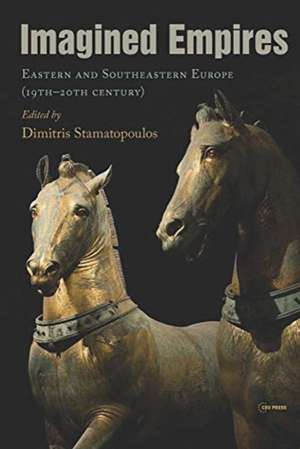
Imagined Empires: Tracing Imperial Nationalism in Eastern and Southeastern Europe
Autor Dimitris Stamatopoulosen Limba Engleză Hardback – 15 iul 2021
With a balance between historical and literary contributions, the focus is on the ideological hybridity of the new national identities and on the effects of “imperial nationalisms” on the emerging Balkan nationalisms. The authors of the twelve essays reveal the relation between empire and nation-state, proceeding from the observation that many of the new nation-states acquired some imperial features and behaved as empires. This original and stimulating approach reveals the imperialistic nature of so-called ethnic or cultural nationalism.
Preț: 751.53 lei
Preț vechi: 825.85 lei
-9%
Puncte Express: 1127
Carte disponibilă
Livrare economică 23 octombrie-06 noiembrie
Livrare prin curier în România Termenul estimat este afișat lângă disponibilitate.
Transport gratuit pentru acest produs Plată online sau ramburs, în funcție de opțiunile comenzii.
Retur gratuit în 14 zile Comandă securizată și suport în română.
Specificații
ISBN-13: 9789633861776
ISBN-10: 9633861772
Pagini: 316
Dimensiuni: 152 x 229 x 25 mm
Greutate: 0.74 kg
Ediția:1
Editura: Amsterdam University Press
Colecția Central European University Press
Locul publicării:Oxford, United Kingdom
ISBN-10: 9633861772
Pagini: 316
Dimensiuni: 152 x 229 x 25 mm
Greutate: 0.74 kg
Ediția:1
Editura: Amsterdam University Press
Colecția Central European University Press
Locul publicării:Oxford, United Kingdom
Public țintă
AcademicNotă biografică
Dimitris Stamatopoulos is Associate Professor at the Department of Balkan, Slavic and Oriental Studies, University of Macedonia, Thessaloniki, Greece.
Cuprins
Introduction, PART I. THE OTTOMAN EMPIRES, PART II. THE BALKAN EMPIRES, PART III. EASTERN SLAVIC EMPIRES, PART IV. OTTOMAN UTOPIAS AND DYSTOPIAS, List of Contributors, Index
Descriere
The Balkans offer classic examples of how empires imagine they can transform themselves into national states (Ottomanism) and how nation-states project themselves into future empires. By examining the interaction between these two aspirations this volume sheds light on the ideological prerequisites for the emergence of Balkan nationalisms.