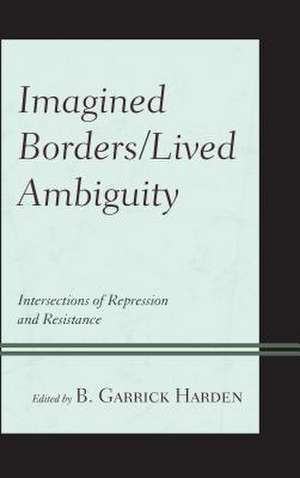
Imagined Borders/Lived Ambiguity: Intersections of Repression and Resistance
Editat de B. Garrick Harden Contribuţii de Hilario Molina II, Robert F. Carley, Ian Barnard, G. Dillon Nicholson, Ryan Ashley Caldwell, Eric Gamino, Juan José Bustamante, Jesús A. Garcia, Chad Richardson, Rogelio Saenz, Dejun Suen Limba Engleză Hardback – 7 iun 2019
Preț: 555.22 lei
Preț vechi: 837.03 lei
-34%
Puncte Express: 833
Carte tipărită la comandă
Livrare economică 11-25 iunie
Specificații
ISBN-13: 9781498580991
ISBN-10: 1498580998
Pagini: 252
Ilustrații: 25 BW Illustrations, 3 Tables
Dimensiuni: 161 x 229 x 21 mm
Greutate: 0.49 kg
Editura: Bloomsbury Publishing
Colecția Lexington Books
Locul publicării:New York, United States
ISBN-10: 1498580998
Pagini: 252
Ilustrații: 25 BW Illustrations, 3 Tables
Dimensiuni: 161 x 229 x 21 mm
Greutate: 0.49 kg
Editura: Bloomsbury Publishing
Colecția Lexington Books
Locul publicării:New York, United States
Cuprins
Introduction
B. Garrick Harden
Chapter 1: A Note on How Historical Patterns of American Ideology Led to President Icarus
B. Garrick Harden
Chapter 2: Alie(N)ation: A Qualitative Multi-Method Approach to Language, Domination, and Unauthorized Migration
Hilario Molina II and Robert F. Carley
Chapter 3: Incest Rhetorics and Queerphobic Sex Panics
Ian Barnard
Chapter 4: A Queer Marxian Analysis of the Construction of Race in the US
G. Dillon Nicholson and B. Garrick Harden
Chapter 5: THE KEYS FOR LOCKS: Border Queers/Queer Borders or Community and Possibilities for Identity
Ryan Ashley Caldwell
Chapter 6: Refusing to Decompose: How Cyber-ojo Makes Indigenous Rituals Palatable to Modern Society
Hilario Molina II
Chapter 7: U.S.-Mexico Border Control: The Use of Deportation Threats as a Method of Enforcing Control on Residents in South Texas
Eric Gamino
Chapter 8: U.S. Immigration Enforcement by Proxy: The Making of a New South-to-South Border between Mexico and Central America
Juan José Bustamante
Chapter 9: Unauthorized Latino/a Migration in an Era of Global Displacement: A Mixed Methods and World-Systems Perspective
Hilario Molina II
Chapter 10: Assessing Assimilation in the Borderlands: How Rapidly Do Mexican Americans Assimilate?
Jesús A. Garcia, Chad Richardson, Rogelio Saenz, and Dejun Su
References
B. Garrick Harden
Chapter 1: A Note on How Historical Patterns of American Ideology Led to President Icarus
B. Garrick Harden
Chapter 2: Alie(N)ation: A Qualitative Multi-Method Approach to Language, Domination, and Unauthorized Migration
Hilario Molina II and Robert F. Carley
Chapter 3: Incest Rhetorics and Queerphobic Sex Panics
Ian Barnard
Chapter 4: A Queer Marxian Analysis of the Construction of Race in the US
G. Dillon Nicholson and B. Garrick Harden
Chapter 5: THE KEYS FOR LOCKS: Border Queers/Queer Borders or Community and Possibilities for Identity
Ryan Ashley Caldwell
Chapter 6: Refusing to Decompose: How Cyber-ojo Makes Indigenous Rituals Palatable to Modern Society
Hilario Molina II
Chapter 7: U.S.-Mexico Border Control: The Use of Deportation Threats as a Method of Enforcing Control on Residents in South Texas
Eric Gamino
Chapter 8: U.S. Immigration Enforcement by Proxy: The Making of a New South-to-South Border between Mexico and Central America
Juan José Bustamante
Chapter 9: Unauthorized Latino/a Migration in an Era of Global Displacement: A Mixed Methods and World-Systems Perspective
Hilario Molina II
Chapter 10: Assessing Assimilation in the Borderlands: How Rapidly Do Mexican Americans Assimilate?
Jesús A. Garcia, Chad Richardson, Rogelio Saenz, and Dejun Su
References
Recenzii
What I especially appreciate about this timely assemblage is that it brings together various and varied cross-disciplinary approaches/perspectives to bear on the effects of borders, categories, categorizations-material and imaginary. These are thought-provoking, critical, not predictable interventions.
We live in a world in which not adhering to dominant ideas, identities, and politics have real, often severe, and in many instances deadly consequences. This volume offers an array of articles, synergistically aligned to challenge us to think about both the absurdity of borders and how they affect everyday people, especially those who do not fit neatly into prescribed boxes. Here is a timely and provocative book that goes where few academic books dare, but should. It is a book we should all have on our shelves, if only to offer alternative rigorous scholarship that re-centers itself on scholars (and scholarship) denied, ignored, or minimized. This is one book we should all be reading.
We live in a world in which not adhering to dominant ideas, identities, and politics have real, often severe, and in many instances deadly consequences. This volume offers an array of articles, synergistically aligned to challenge us to think about both the absurdity of borders and how they affect everyday people, especially those who do not fit neatly into prescribed boxes. Here is a timely and provocative book that goes where few academic books dare, but should. It is a book we should all have on our shelves, if only to offer alternative rigorous scholarship that re-centers itself on scholars (and scholarship) denied, ignored, or minimized. This is one book we should all be reading.