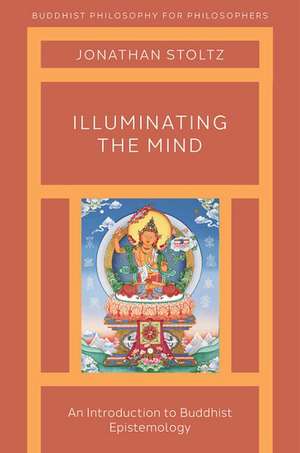
Illuminating the Mind: An Introduction to Buddhist Epistemology: Buddhist Philosophy For Philosophers
Autor Jonathan Stoltzen Limba Engleză Paperback – 3 sep 2021
Preț: 205.64 lei
Preț vechi: 233.38 lei
-12%
Puncte Express: 308
Carte disponibilă
Livrare economică 12-18 noiembrie
Livrare prin curier în România Termenul estimat este afișat lângă disponibilitate.
Transport gratuit de la 400.00 lei Plată online sau ramburs, în funcție de opțiunile comenzii.
Retur gratuit în 14 zile Comandă securizată și suport în română.
Specificații
ISBN-13: 9780190907549
ISBN-10: 0190907541
Pagini: 280
Dimensiuni: 157 x 236 x 25 mm
Greutate: 0.61 kg
Editura: Oxford University Press
Colecția OUP USA
Seria Buddhist Philosophy For Philosophers
Locul publicării:New York, United States
ISBN-10: 0190907541
Pagini: 280
Dimensiuni: 157 x 236 x 25 mm
Greutate: 0.61 kg
Editura: Oxford University Press
Colecția OUP USA
Seria Buddhist Philosophy For Philosophers
Locul publicării:New York, United States
Recenzii
Illuminating the Mind skillfully relates various Buddhist positions to contemporary debates in analytic epistemology, carefully navigating the issues that arise from the fundamental differences in orientation between the two traditions. Stoltz has clearly demonstrated that Buddhist philosophers can be valuable contributors to contemporary epistemology.
There is a need for this unique book, in which numerous Western epistemologists dialogue with Indian epistemologists.
This volume is a great source for those who study contemporary philosophy and seek to discover novel theories of knowledge from a Buddhist/Indian perspective.
There is a need for this unique book, in which numerous Western epistemologists dialogue with Indian epistemologists.
This volume is a great source for those who study contemporary philosophy and seek to discover novel theories of knowledge from a Buddhist/Indian perspective.
Notă biografică
Jonathan Stoltz is a professor of philosophy at the University of St. Thomas (Minnesota) where he has been teaching since 2006. His scholarly research is focused on the areas of epistemology and the philosophy of logic, both in the 'Western' tradition and in the Indian and Tibetan traditions of philosophy.
Cuprins
- Preface
- Chapter 1: Preliminaries
- 1. Two Histories
- 2. Core Terms and Concepts
- 3. Pramana
- 4. The Episodic Nature of Cognition/Knowledge
- 5. Main Themes of the Book
- Chapter 2: Knowledge
- 1. Defining Knowledge?
- 2. Revealing the Unknown
- 3. Non-deceptive Cognition
- 4. Analytic Theories of Knowledge and 'The Standard Analysis'
- 5. Pramana and Reliabilism
- Chapter 3: Perception
- 1. Perception and Non-conceptual Awareness
- 2. Perceptual Judgment
- 3. Four Types of Perception
- 4. Reflexive Perception and Self-awareness
- 5. Perception, Illusion, and Hallucination
- Chapter 4: Inference
- 1. Two Forms of Inference
- 2. Inference and Conceptual Cognition
- 3. The Structure of Inferential Reasoning
- 4. Evidence and Entailment
- 5. Epistemic Closure
- Chapter 5: Testimony
- 1. The Nyaya Account and the Buddhist Response
- 2. Reductive and Non-reductive Theories of Testimonial Knowledge
- 3. Speakers, Hearers, and Knowledge
- 4. The Transmission Theory of Testimony
- Chapter 6: Ignorance
- 1. Mistaken Cognition
- 2. Ignorant Perception
- 3. Ignorant Veridical Conception
- Chapter 7: Skepticism
- 1. Skepticism and Skeptical Scenarios
- 2. Knowledge and Instruments of Knowledge
- 3. Nagarjuna and the Epistemic Regress Problem
- 4. The Structure of Knowledge
- Chapter 8: Sensitivity and Safety
- 1. Knowledge, Perception, and Inference
- 2. Tracking and Sensitivity
- 3. Safety and Knowledge
- 4. Discrimination and Alternatives
- Chapter 9: Internalism and Externalism
- 1. The Etiology of Cognition
- 2. Analyzing Knowledge and Internalism
- 3. Intrinsic vs. Extrinsic Determination of Knowledge Status
- 4. Factive Mental Episodes and Externalism
- Chapter 10: Experimental and Cross-cultural Epistemology
- 1. Philosophical Intuitions and Experimental Epistemology
- 2. Cross-cultural Intuitions about Knowledge
- 3. The Value of Buddhist Epistemology
- Notes
- Bibliography
- Index