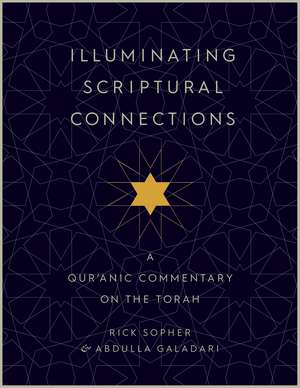
Illuminating Scriptural Connections: A Qur'anic Commentary on the Torah
Autor Rick Sopher, Abdulla Galadarien Limba Engleză Hardback – 28 sep 2026
Rick Sopher and Abdulla Galadari show that the Qur’an has something meaningful to add to each weekly portion. The Qur’an designates the Torah as a source of “guidance and light” and responds to the Torah’s central narratives, from creation and prophecy to law, covenant, and divine mercy. Many commentaries compare key biblical narratives, such as Abraham’s intended sacrifice, Joseph’s life story, and Moses’s leadership, revealing the Qur’an’s perspectives. Sometimes the Qur’an upholds the Torah’s understandings; at other times it accentuates its own motifs and messages. Additionally, sometimes the Qur’an appears to engage with some early rabbinic traditions, and sometimes later Jewish literature seems to engage with the Qur’an too.
Along the way, the authors confront texts viewed as sources of tension between the two faiths. They argue that the belief that the Qur’an is hostile to all Jews is rooted in textual misunderstandings. The Qur’an both esteems certain Jews and sharply criticizes others. Muhammad’s encounters with Jewish communities, especially in Madinah later in his life, shaped the Qur’an’s portrayal.
Engaging both scripture and history, Illuminating Scriptural Connections underscores the shared linguistic heritage of Hebrew and Arabic, and challenges assumptions of opposition to demonstrate instead a profound reciprocity of ideas. It opens new spaces for interfaith understanding and connection, showing that the spiritual DNA of Judaism and Islam are intertwined far more closely than centuries of misunderstanding have allowed us to see.
Preț: 259.61 lei
Nou
Puncte Express: 389
Carte disponibilă
Livrare economică 07-21 noiembrie
Livrare prin curier în România Termenul estimat este afișat lângă disponibilitate.
Transport gratuit de la 400.00 lei Plată online sau ramburs, în funcție de opțiunile comenzii.
Retur gratuit în 14 zile Comandă securizată și suport în română.
Specificații
ISBN-13: 9780827615731
ISBN-10: 0827615736
Pagini: 448
Ilustrații: 13 tables, 2 indexes
Dimensiuni: 216 x 279 mm
Greutate: 1.52 kg
Editura: The Jewish Publication Society
Colecția The Jewish Publication Society
Locul publicării:United States
ISBN-10: 0827615736
Pagini: 448
Ilustrații: 13 tables, 2 indexes
Dimensiuni: 216 x 279 mm
Greutate: 1.52 kg
Editura: The Jewish Publication Society
Colecția The Jewish Publication Society
Locul publicării:United States
Notă biografică
Rick Sopher is a key figure in interfaith scriptural dialogue, especially known for fostering relations between Jewish and Muslim communities. He is a fellow of the Woolf Institute, an academic institute in Cambridge, England, dedicated to the study of interfaith relations between Jews, Christians, and Muslims. In 2007 French President Jacques Chirac awarded him with the Chevalier de la Légion d’Honneur for his work in religious education.
Abdulla Galadari is an associate professor of Islamic studies at Khalifa University of Science and Technology, Abu Dhabi. He is the author of Qur’anic Hermeneutics: Between Science, History, and the Bible; Metaphors of Death and Resurrection in the Qur’an: An Intertextual Approach with Biblical and Rabbinic Literature; and Spiritual Meanings of the Ḥajj Rituals: A Philological Approach.
Abdulla Galadari is an associate professor of Islamic studies at Khalifa University of Science and Technology, Abu Dhabi. He is the author of Qur’anic Hermeneutics: Between Science, History, and the Bible; Metaphors of Death and Resurrection in the Qur’an: An Intertextual Approach with Biblical and Rabbinic Literature; and Spiritual Meanings of the Ḥajj Rituals: A Philological Approach.
Cuprins
Acknowledgments
Introduction
Notes on Transliteration and Translation
Notes about the Cover
1. Bere’shit (Genesis)
Bere’shit: Creation; Adam and Eve; Cain and Abel
Noaḥ: Noah; Faith Over Family; Profiling of Biblical Characters; Tower of Babel
Lekh Lekha: How the Qur’an Views Other Scriptures; Abraham the “Hebrew” and the
“Muslim”; Circumcision; Lot
Va-yera’: Binding of Isaac or Ishmael; Pilgrimage; Abraham’s Three Guests
Ḥayyei Sarah: Death and Burial
Toledot: Jacob
Va-yetse’: Stairway to Heaven
Va-yishlaḥ: Ritual Purity
Va-yeshev: Joseph and Surat Yūsuf; Christian Interpretations Found in the Qur’an
Miqqets: Intermarriage
Va-yiggash: Jacob’s Gladness; In shaʾ Allah in the Qur’an
Va-yeḥi: Joseph’s Parental Devotion; Jacob’s Final Words to His Sons; Forgiveness
2. Shemot (Exodus)
Shemot: Character of Moses; Life of Moses; Revelation of God’s Name
Va-era’: Pharaoh’s Character
Bo’: The Plagues
Be-shallaḥ: Pharaoh’s Fate at the Sea; Conversion
Yitro: The Ten Commandments
Mishpatim: Obedience and Disobedience
Terumah: Charitable Giving
Tetsavveh: Understandings of Priests and Priesthood
Ki Tissa’: The Golden Calf; Names and Attributes of God
Va-yaqhel: A Jewish Day of Rest, A Muslim Day of Gathering
Pequdei: Shakhan and Sakīnah
3. Va-yiqra’ (Leviticus)
Va-yiqra’: Ṭaharah and Ṭahārah; Va-yiqra’ and Iqraʾ
Tsav: Sacrifices
Shemini: Dietary Laws
Tazria‘: Physical Circumcision and Circumcision of the Heart
Metsora‘: Purity Laws about Menstruation and Entering Sacred Sites
’Aḥarei Mot: Fast Days of Yom Kippur and Ashura
Qedoshim: Love of Others; Fear of God
’Emor: The Priests’ Instructions and the Five Pillars of Islam
Be-har: Protection for Slaves
Be-ḥuqqotai: Warnings of Admonishment and Punishment
4. Be-midbar (Numbers)
Be-midbar: Exile; The Tribute Verse
Naso’: Wine
Be-ha‘alotekha: Avoiding Slander; Manannā and Manna
Shelaḥ-Lekha: The Scouts; Sabbath Law Breaking
Qoraḥ: Qoraḥ’s Rebellion
Ḥuqqat: The “Red” Heifer
Balaq: Prophets
Pineḥas: Inheritance; Succession
Mattot: Keeping Vows
Mas‘ei: “Chosen People” and “Best Nation”
5. Devarim (Deuteronomy)
Devarim: The Land; Significance of Jerusalem
Va-etḥannan: The Shema and Qibla
‘Eqev: Sword Verses; Comparing Violence
Re’eh: Violent Verses; Taḥrīf
Shofetim: Kings; Prophets
Ki Tetse’: Interest on Loans
Ki Tavo’: God’s Open Hand; Anthropomorphism; Final Addresses
Nitsavim: Following the Commandments; Human Comprehension
Va-yelekh: Public Reading of the Torah and the Qur’an
Ha’azinu: Poetry; Recitation Styles
Ve-zot ha-berakhah: Moses as Prophet; Development of Scriptural Interpretation and Legislation
Conclusion
A Lexicon of Jewish-Muslim Spiritual Connections
Notes
Bibliography
Index of Scriptural Verses
Index
Introduction
Notes on Transliteration and Translation
Notes about the Cover
1. Bere’shit (Genesis)
Bere’shit: Creation; Adam and Eve; Cain and Abel
Noaḥ: Noah; Faith Over Family; Profiling of Biblical Characters; Tower of Babel
Lekh Lekha: How the Qur’an Views Other Scriptures; Abraham the “Hebrew” and the
“Muslim”; Circumcision; Lot
Va-yera’: Binding of Isaac or Ishmael; Pilgrimage; Abraham’s Three Guests
Ḥayyei Sarah: Death and Burial
Toledot: Jacob
Va-yetse’: Stairway to Heaven
Va-yishlaḥ: Ritual Purity
Va-yeshev: Joseph and Surat Yūsuf; Christian Interpretations Found in the Qur’an
Miqqets: Intermarriage
Va-yiggash: Jacob’s Gladness; In shaʾ Allah in the Qur’an
Va-yeḥi: Joseph’s Parental Devotion; Jacob’s Final Words to His Sons; Forgiveness
2. Shemot (Exodus)
Shemot: Character of Moses; Life of Moses; Revelation of God’s Name
Va-era’: Pharaoh’s Character
Bo’: The Plagues
Be-shallaḥ: Pharaoh’s Fate at the Sea; Conversion
Yitro: The Ten Commandments
Mishpatim: Obedience and Disobedience
Terumah: Charitable Giving
Tetsavveh: Understandings of Priests and Priesthood
Ki Tissa’: The Golden Calf; Names and Attributes of God
Va-yaqhel: A Jewish Day of Rest, A Muslim Day of Gathering
Pequdei: Shakhan and Sakīnah
3. Va-yiqra’ (Leviticus)
Va-yiqra’: Ṭaharah and Ṭahārah; Va-yiqra’ and Iqraʾ
Tsav: Sacrifices
Shemini: Dietary Laws
Tazria‘: Physical Circumcision and Circumcision of the Heart
Metsora‘: Purity Laws about Menstruation and Entering Sacred Sites
’Aḥarei Mot: Fast Days of Yom Kippur and Ashura
Qedoshim: Love of Others; Fear of God
’Emor: The Priests’ Instructions and the Five Pillars of Islam
Be-har: Protection for Slaves
Be-ḥuqqotai: Warnings of Admonishment and Punishment
4. Be-midbar (Numbers)
Be-midbar: Exile; The Tribute Verse
Naso’: Wine
Be-ha‘alotekha: Avoiding Slander; Manannā and Manna
Shelaḥ-Lekha: The Scouts; Sabbath Law Breaking
Qoraḥ: Qoraḥ’s Rebellion
Ḥuqqat: The “Red” Heifer
Balaq: Prophets
Pineḥas: Inheritance; Succession
Mattot: Keeping Vows
Mas‘ei: “Chosen People” and “Best Nation”
5. Devarim (Deuteronomy)
Devarim: The Land; Significance of Jerusalem
Va-etḥannan: The Shema and Qibla
‘Eqev: Sword Verses; Comparing Violence
Re’eh: Violent Verses; Taḥrīf
Shofetim: Kings; Prophets
Ki Tetse’: Interest on Loans
Ki Tavo’: God’s Open Hand; Anthropomorphism; Final Addresses
Nitsavim: Following the Commandments; Human Comprehension
Va-yelekh: Public Reading of the Torah and the Qur’an
Ha’azinu: Poetry; Recitation Styles
Ve-zot ha-berakhah: Moses as Prophet; Development of Scriptural Interpretation and Legislation
Conclusion
A Lexicon of Jewish-Muslim Spiritual Connections
Notes
Bibliography
Index of Scriptural Verses
Index
Recenzii
“An extraordinary resource reflecting sophisticated scholarship and accessible erudition, Illuminating Scriptural Connections is a perfect tool for bringing communities together to dig deeply into the fascinating similarities and no less important distinctions between the great religious civilizations of Judaism and Islam. Learn and consider the many parallels in narratives, values, spiritual aspirations, religious commitments, and actions such as prayer, fasting, pilgrimage, and celebration.”—Reuven Firestone, Regenstein Professor in Medieval Judaism and Islam at Hebrew Union College-Jewish Institute of Religion, Los Angeles
“In an era when religious difference is too often weaponized, this groundbreaking work offers something transformative: a scriptural foundation for cooperation, mutual respect, and peace rooted in concrete textual evidence that Jewish and Muslim communities share far more than what divides them: a common reverence for the One God, shared prophets, overlapping sacred wisdom, and a commitment to deep spirituality and divine truth.”—Mehnaz M. Afridi, professor of religious studies and director of the Holocaust, Genocide, and Interfaith Education Center at Manhattan University
“An inspirational masterpiece born of friendship and shared seeking—a Muslim scholar and a Jewish scholar journeying together to uncover the deep connections between the Torah and the Qur’an and the sacred uniqueness of each faith—foundations for the healing our world so deeply needs.”—Rabbi Yakov Nagen, director, Ohr Torah Blickle Institute for Interfaith Dialogue
“By offering a framework for understanding the Qur’an as part of an ongoing commentary on the Torah, and by combining scholarly depth with accessibility, Illuminating Scriptural Connections is sure to advance both intertextual study and Jewish-Muslim dialogue.”—Imam Sayed Razawi, Chief Imam of Scotland, director-general of the Scottish Ahlul-Bayt Society, and leader of the 2025 Drumlanrig Accords between rabbis and imams
“At a time of resurgent prejudice and ignorance about Judaism and Islam, Illuminating Scriptural Connections is a deeply important and invaluable work.”—Ed Kessler, founder and president, Woolf Institute, Cambridge
“A textured, knowledgeable, well-documented account of the Qur’an’s relationship with the Torah that brings the two scriptures into conversation in creative, original ways.”—Walid Saleh, professor in the Department for the Study of Religion at the University of Toronto
“In an era when religious difference is too often weaponized, this groundbreaking work offers something transformative: a scriptural foundation for cooperation, mutual respect, and peace rooted in concrete textual evidence that Jewish and Muslim communities share far more than what divides them: a common reverence for the One God, shared prophets, overlapping sacred wisdom, and a commitment to deep spirituality and divine truth.”—Mehnaz M. Afridi, professor of religious studies and director of the Holocaust, Genocide, and Interfaith Education Center at Manhattan University
“An inspirational masterpiece born of friendship and shared seeking—a Muslim scholar and a Jewish scholar journeying together to uncover the deep connections between the Torah and the Qur’an and the sacred uniqueness of each faith—foundations for the healing our world so deeply needs.”—Rabbi Yakov Nagen, director, Ohr Torah Blickle Institute for Interfaith Dialogue
“By offering a framework for understanding the Qur’an as part of an ongoing commentary on the Torah, and by combining scholarly depth with accessibility, Illuminating Scriptural Connections is sure to advance both intertextual study and Jewish-Muslim dialogue.”—Imam Sayed Razawi, Chief Imam of Scotland, director-general of the Scottish Ahlul-Bayt Society, and leader of the 2025 Drumlanrig Accords between rabbis and imams
“At a time of resurgent prejudice and ignorance about Judaism and Islam, Illuminating Scriptural Connections is a deeply important and invaluable work.”—Ed Kessler, founder and president, Woolf Institute, Cambridge
“A textured, knowledgeable, well-documented account of the Qur’an’s relationship with the Torah that brings the two scriptures into conversation in creative, original ways.”—Walid Saleh, professor in the Department for the Study of Religion at the University of Toronto
Descriere
Illuminating Scriptural Connections views the Torah’s fifty-four weekly portions through the lens of the Qur’an, uncovering both the variations between the two texts as well as shared stories, prophets, principles, and visions.