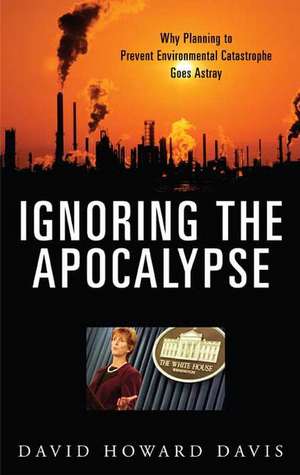
Ignoring the Apocalypse: Why Planning to Prevent Environmental Catastrophe Goes Astray: Politics and the Environment
Autor David Howard Davisen Limba Engleză Hardback – 30 iun 2007
This provocative book begins by asking whether American planning is different for dangers that are truly apocalyptic-ones that could end life on the planet or at least modern economic prosperity. It goes on to ask why Americans ignore so many problems like the greenhouse effect or an oil shortage or nuclear war, problems that have been forecast many times. Then when the United States does plan, why do those plans often go astray?
Preț: 366.98 lei
Preț vechi: 449.63 lei
-18%
Puncte Express: 550
Carte tipărită la comandă
Livrare economică 07-21 decembrie
Livrare prin curier în România Termenul estimat este afișat lângă disponibilitate.
Transport gratuit de la 400.00 lei Plată online sau ramburs, în funcție de opțiunile comenzii.
Retur gratuit în 14 zile Comandă securizată și suport în română.
Specificații
ISBN-13: 9780275996635
ISBN-10: 0275996638
Pagini: 248
Dimensiuni: 156 x 235 x 25 mm
Greutate: 0.54 kg
Editura: Bloomsbury Publishing
Colecția Praeger
Seria Politics and the Environment
Locul publicării:New York, United States
ISBN-10: 0275996638
Pagini: 248
Dimensiuni: 156 x 235 x 25 mm
Greutate: 0.54 kg
Editura: Bloomsbury Publishing
Colecția Praeger
Seria Politics and the Environment
Locul publicării:New York, United States
V-ar putea interesa
-
 The Anti-Catastrophe LeagueTom OughPreț: 157.16 lei
 -
 ApocalypseLizzie WadePreț: 143.12 lei
 -
 Apocalypse NeverMichael ShellenbergerPreț: 160.51 lei
 -
 BunkerBradley Garrett-31%Preț: 63.96 lei92.22 lei
 -
 Preț: 93.66 lei
 -
 DoomsdayNigel CawthornePreț: 72.36 lei
 -
 -25%Preț: 107.00 lei142.66 lei
 -
 Hope Dies LastAlan WeismanPreț: 125.56 lei
 -
 How to ApocalypseStephen Wildish-16%Preț: 80.63 lei95.77 lei
 -
 2052Jorgen RandersPreț: 146.93 lei
 -
 Nuclear War and Enviromental CatastropheNoam Chomsky-30%Preț: 63.31 lei89.87 lei
 -
 Preț: 156.98 lei
 -
 Notes from an ApocalypseMark O'ConnellPreț: 78.82 lei
 -
 What We Can KnowIan McEwanPreț: 115.91 leiRecomandat
 -
 The Next CrisisDanny DorlingPreț: 170.42 lei
 -
 Nuclear WarAnnie Jacobsen-17%Preț: 66.06 lei79.89 leiRecomandat
 -
 Could Should Might Don'tNick FosterPreț: 123.47 lei
 -
 Going NuclearTim GregoryPreț: 124.00 lei
 -
 Prophecy in Politics: Or, the Wigram AspectKenneth WeisbrodePreț: 62.08 lei
 -
 Life on a Little-Known PlanetElizabeth KolbertPreț: 193.02 lei
Recenzii
Davis has served in the US government and as a consultant on energy and environmental issues for some three decades. Picking up on America's love affair with apocalypse, inherited from the Puritans, he discusses four threats that could destroy the world as we know it: global climate change, nuclear war, over-population, and the energy crisis.
Davis provides a critical assessment of how Americans go about understanding environmental catastrophes, including the formulation of plans for averting or mitigating the expected outcomes. He examines the reason why Americans often ignore impending dangers, even apocalyptic ones based on rigorous scientific and mathematical analysis, and why government solutions and policies often fail to deal realistically with their potential consequences for future generations of people and ecosystems..This is an important book to read in order to learn how people, Americans in particular, go about framing or avoiding issues that have dire consequences for the quality of human life. Recommended. Upper-division undergraduate through professional collections.
Davis provides a critical assessment of how Americans go about understanding environmental catastrophes, including the formulation of plans for averting or mitigating the expected outcomes. He examines the reason why Americans often ignore impending dangers, even apocalyptic ones based on rigorous scientific and mathematical analysis, and why government solutions and policies often fail to deal realistically with their potential consequences for future generations of people and ecosystems..This is an important book to read in order to learn how people, Americans in particular, go about framing or avoiding issues that have dire consequences for the quality of human life. Recommended. Upper-division undergraduate through professional collections.