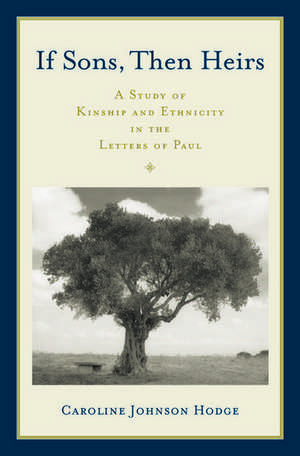
If Sons, Then Heirs: A Study of Kinship and Ethnicity in the Letters of Paul
Autor Caroline Johnson Hodgeen Limba Engleză Hardback – 12 iul 2007
Observăm în această lucrare o abordare riguroasă a studiilor pauline care pornește de la analiza concretă a termenilor de rudenie și etnie, elemente adesea ignorate în interpretările tradiționale care tind să universalizeze mesajul creștinismului timpuriu. Caroline Johnson Hodge propune o reevaluare a scrisorilor lui Pavel, argumentând că noțiunile de descendență și apartenență etnică nu sunt eliminate, ci constituie pilonii centrali ai evangheliei sale. Ne-a atras atenția modul în care autoarea explică statutul „neamurilor” (gentiles) nu ca pe o dizolvare a identității, ci ca pe o adoptare formală în familia lui Avraam prin botez, păstrând totodată liniile genealogice distincte.
Suntem de părere că structura argumentației, bazată pe logica patriliniară a secolului I, oferă o perspectivă istorică vitală pentru înțelegerea modului în care identitatea se negocia în antichitate. Volumul publicat de Oxford University Press funcționează ca o alternativă academică solidă la "When You Were Gentiles" de Cavan W. Concannon pentru cursurile de exegeză a Noului Testament. Dacă Cavan W. Concannon se concentrează pe identitatea civică și politică a corintenilor, Caroline Johnson Hodge aduce avantajul unei analize teologice profunde asupra modului în care Pavel folosește „mitul originilor” pentru a integra neamurile în povestea lui Israel, fără a respinge iudaismul. Stilul este cel al unei teze clasice, precis și bine documentat, fiind esențial pentru cercetătorii care doresc să depășească viziunea de secol XX asupra unui Pavel care ar fi rupt legăturile cu tradiția sa etnică.
Preț: 603.80 lei
Preț vechi: 702.09 lei
-14%
Carte tipărită la comandă
Livrare economică 11-16 iunie
Specificații
ISBN-10: 0195182162
Pagini: 240
Dimensiuni: 239 x 155 x 23 mm
Greutate: 0.54 kg
Ediția:1
Editura: Oxford University Press
Colecția OUP USA
Locul publicării:New York, United States
V-ar putea interesa
-
 Confessions of a SinnerSaint Augustine-22%Preț: 42.20 lei53.89 lei
 -
 -22%Preț: 367.01 lei469.85 lei
 -
 The Hastening that Waits: Karl Barth's EthicsNigel Biggar-24%Preț: 352.47 lei464.41 lei
 -
 Life in the Flesh: An Anti-Gnostic Spiritual PhilosophyAdam G. Cooper-14%Preț: 660.21 lei767.68 lei
 -
 -13%Preț: 385.85 lei442.14 lei
 -
 -14%Preț: 278.74 lei323.91 lei
 -
 -34%Preț: 869.35 lei1317.27 lei
 -
 Karl Barth on Theology and PhilosophyKenneth Oakes-14%Preț: 932.72 lei1084.56 lei
 -
 Rethinking Fundamental TheologyGerald O'CollinsPreț: 238.63 lei
 -
 Good God: The Theistic Foundations of MoralityDavid Baggett-10%Preț: 277.77 lei307.63 lei
 -
 Preț: 88.57 lei
 -
 Losing Our VirtueDavid F WellsPreț: 142.18 lei
 -
 Bernard of ClairvauxDennis TamburelloPreț: 105.13 lei
 -
 -43%Preț: 94.38 lei165.92 lei
 -
 Saints in ArtRosa GiorgiPreț: 145.09 lei
 -
 Embraced By The LightBetty J. EadiePreț: 60.67 lei
De ce să citești această carte
Această monografie este esențială pentru studenții și specialiștii în teologie biblică ce doresc să înțeleagă rădăcinile evreiești ale creștinismului. Cititorul câștigă o perspectivă clară asupra modului în care etnia și rudenia au modelat primele comunități creștine. Este o recomandare certă pentru cei interesați de sociologia lumii biblice și de modul în care identitatea religioasă a fost construită istoric prin concepte de descendență și adopție.