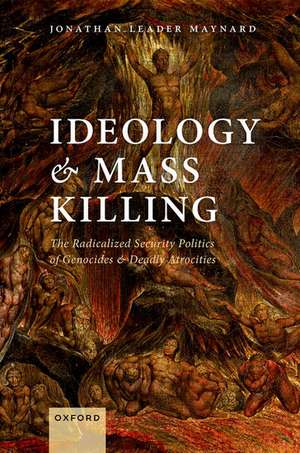
Ideology and Mass Killing: The Radicalized Security Politics of Genocides and Deadly Atrocities
Autor Jonathan Leader Maynarden Limba Engleză Hardback – 28 iun 2022
În cadrul programelor de studii dedicate Relațiilor Internaționale, Sociologiei Politice și Analizei Conflictelor, lucrarea Ideology and Mass Killing de Jonathan Leader Maynard ocupă un loc central, oferind un cadru teoretic pentru înțelegerea atrocităților la scară largă. Considerăm că această monografie publicată de OUP Oxford reușește să depășească dihotomia clasică dintre ideologie ca motor principal al violenței și ideologie ca simplă justificare post-factum pentru interese raționale. Găsim în acest volum o perspectivă „neo-ideologică” originală, care demonstrează cum justificările pentru violență modelează acțiunile politice chiar și în absența unui angajament ideologic profund al făptuitorilor. Reținem argumentul central al autorului: fundamentul crimelor în masă nu rezidă neapărat în obiective politice extraordinare, ci în radicalizarea ideilor de securitate acceptate în societățile obișnuite. Această teză este susținută prin examinarea a patru studii de caz distincte, de la represiunea stalinistă și genocidul din Rwanda, până la campaniile de bombardament ale aliaților asupra Germaniei și Japoniei. Lucrarea reprezintă o alternativă la Final Solutions – Mass Killing and Genocide in the 20th Century de Benjamin A. Valentino pentru cursurile de Studii de Securitate, cu avantajul că oferă o teorie dedicată și comparativă a rolului ideologiei ca infrastructură a violenței, în loc să privească crimele în masă doar ca pe o strategie militară de rezolvare a problemelor politice. Jonathan Leader Maynard își extinde aici expertiza acumulată în The Routledge Handbook of Ideology and International Relations, trecând de la sistematizarea literaturii de specialitate la o analiză aplicată și multidisciplinară a violenței de stat.
Preț: 757.06 lei
Preț vechi: 983.19 lei
-23%
Carte disponibilă
Livrare economică 16-30 mai
Livrare express 02-08 mai pentru 217.46 lei
Specificații
ISBN-10: 0198776799
Pagini: 394
Dimensiuni: 162 x 240 x 30 mm
Greutate: 0.76 kg
Editura: OUP OXFORD
Colecția OUP Oxford
Locul publicării:Oxford, United Kingdom
De ce să citești această carte
Această lucrare este esențială pentru cercetătorii care doresc să înțeleagă mecanismele psihologice și politice din spatele genocidului. Cititorul câștigă o perspectivă nouă asupra modului în care limbajul securității poate fi pervertit pentru a justifica atrocități. Este o recomandare solidă pentru bibliografia cursurilor de Relații Internaționale, oferind un model riguros de analiză comparativă între contexte istorice și geografice foarte diferite.
Despre autor
Jonathan Leader Maynard este un specialist recunoscut în studiul ideologiei și al violenței politice. Expertiza sa este consolidată prin contribuții academice majore, fiind editorul lucrării de referință The Routledge Handbook of Ideology and International Relations, unde a unificat cercetările fragmentate despre impactul ideologiei în politica globală. Lucrările sale se remarcă prin abordarea multidisciplinară, îmbinând rigoarea științelor politice cu perspective din psihologia socială și istorie. În volumul de față, publicat la OUP Oxford, Maynard își rafinează teoriile despre modul în care ideile radicalizate influențează deciziile politice la nivel macro.
Descriere
Recenzii
In this excellent book, Jonathan Leader Maynard develops a powerful argument about the centrality of ideology to the occurrence of mass killing and genocide. The book takes us farther than previous scholarship in showing how ideology drives the selection and perpetration of mass atrocity. A major contribution to the study of violence, the work should be read widely as a rigorous account of how and why ideas matter in shaping political outcomes
Either dismissed as causally inconsequential or else overstated as the paramount factor, the role of ideology in mass killings has long been a bone of scholarly contention. Jonathan Leader Maynard brings a welcome fresh perspective to this debate and offers a new theory of how and why ideology matters in such violence. We should stop picking sides - strategic security objectives are entirely reconcilable with extremist beliefs. This book explains in legible English the various ways in which ideology operated for the architects and executioners of violence in places as disparate as the Soviet Union, Guatemala, and Rwanda. It will bring much-needed momentum to the debate and move it forward.
Ideology and Mass Killing has a...typical social scientific structure...The writing anticipates questions one imagines the author has received many times and addresses them with genuine intellectual excitement. The text is clearly structured and easy to navigate. Readers with different backgrounds can read chapters in different orders.
The core thrust of Ideology and Mass Killing is that looking at the political ideology of the perpetrators can explain issues of genocide and mass murder. The argument continues that these ideologies provide the distinctive world view necessary for genocide or mass killing to occur. Leader Maynard (King's College London) does well to explain how ideologies work toward the commission of genocide or mass killing...This offers a new take on an important area of exploration for genocide and mass killing scholars.
Leader Maynard's multidisciplinary framework sheds light on the complex processes that leads to mass killing,...it can fill in the gaps of many important tools,...Historians too, will benefit from applying the book's 'ideological infrastructure'.