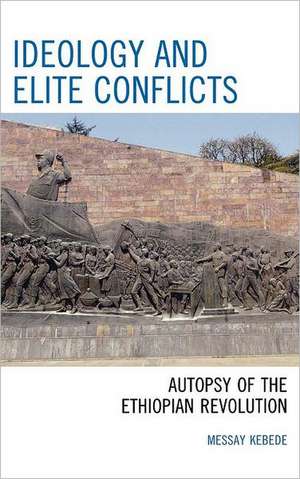
Ideology and Elite Conflicts: Autopsy of the Ethiopian Revolution
Autor Messay Kebedeen Limba Engleză Hardback – 22 sep 2011
Moreover, the book shows how the struggle of exclusive elites for the control of the state explains the Derg's need to put its fate in the hands of a providential leader, to wit, Mengistu Haile Mariam. In light of the theoretical debate over the role of charismatic leaders in history, the book establishes how Mengistu's narcissism led him to become the sole owner of the revolution and how his dictatorial rule brought about his own demise and that of the Derg, following the military defeat of the Ethiopian army in the hands of ethnonationalist insurgents. Another fundamental contribution of the book is a theoretical articulation of political conflicts and ideology that critically intervenes in the divisive issue of the primary cause of revolutions. Granted that ideology is more of a justification than a drive, the Ethiopian case illustrates how conflicts between mutually exclusive elites favor the path of political outbidding mobilizing utopian projects so as to galvanize the support of the masses. The perceived transcendence
Preț: 808.24 lei
Preț vechi: 1245.24 lei
-35%
Puncte Express: 1212
Carte tipărită la comandă
Livrare economică 03-17 decembrie
Livrare prin curier în România Termenul estimat este afișat lângă disponibilitate.
Transport gratuit pentru acest produs Plată online sau ramburs, în funcție de opțiunile comenzii.
Retur gratuit în 14 zile Comandă securizată și suport în română.
Specificații
ISBN-13: 9780739137963
ISBN-10: 0739137964
Pagini: 388
Dimensiuni: 162 x 240 x 35 mm
Greutate: 0.73 kg
Editura: Bloomsbury Publishing
Colecția Lexington Books
Locul publicării:New York, United States
ISBN-10: 0739137964
Pagini: 388
Dimensiuni: 162 x 240 x 35 mm
Greutate: 0.73 kg
Editura: Bloomsbury Publishing
Colecția Lexington Books
Locul publicării:New York, United States
Cuprins
Chapter 1. Controversies over the Nature of the Ethiopian Social Change
Chapter 2. Theories of Revolution and the Ethiopian Discrepancies
Chapter 3. Ideology and Power Struggle
Chapter 4. Subjective Conditions of Social Revolutions
Chapter 5. The Ideological Origins of Haile Selassie's Regime
Chapter 6. Sociopolitical Origins of Haile Selassie's Regime
Chapter 7. The Politics of Cooptation: Strengths and Weaknesses
Chapter 8. Social Blockage and Rising Discontent
Chapter 9. The Ethiopian Military and the Formation of the Derg
Chapter 10. Disputes over the Radicalization of the Derg
Chapter 11. Power Struggle and Radicalization
Chapter 12. Conflicts for Power and the Rise of Mengistu Haile Mariam
Chapter 13. Narcissism and Revolution
Chapter 14. Ethnonationalism and Political Competition
Chapter 15. The Fall of Mengistu and the Derg
Chapter 16. Why Social Revolutions Fail?
Chapter 17. Philosophical Extensions
Chapter 2. Theories of Revolution and the Ethiopian Discrepancies
Chapter 3. Ideology and Power Struggle
Chapter 4. Subjective Conditions of Social Revolutions
Chapter 5. The Ideological Origins of Haile Selassie's Regime
Chapter 6. Sociopolitical Origins of Haile Selassie's Regime
Chapter 7. The Politics of Cooptation: Strengths and Weaknesses
Chapter 8. Social Blockage and Rising Discontent
Chapter 9. The Ethiopian Military and the Formation of the Derg
Chapter 10. Disputes over the Radicalization of the Derg
Chapter 11. Power Struggle and Radicalization
Chapter 12. Conflicts for Power and the Rise of Mengistu Haile Mariam
Chapter 13. Narcissism and Revolution
Chapter 14. Ethnonationalism and Political Competition
Chapter 15. The Fall of Mengistu and the Derg
Chapter 16. Why Social Revolutions Fail?
Chapter 17. Philosophical Extensions
Recenzii
There are books, and then there are Books. Messay Kebede has written a Book. With sustained analytical brilliance, he demonstrates how understanding Ethiopia contributes to the understanding of the world. Ideology and Elite Conflicts represents a major achievement in combining comparative history with political and cultural analysis, all set within a philosophical frame.
Messay Kebede has written an enormously important book. He definitively places the Ethiopian revolution as one of the 20th century's 'great revolutions,' on par with the Russian or Chinese in terms of scope of transformation. Kebede provides a systematic and compelling argument on one of the key puzzles of the revolution. Internal power struggles within the military junta known as the Derg, Kebede argues, drove this movement of revolutionary change. Everyone interested in contemporary Ethiopia or comparative revolutions will benefit from this book.
This is a very informative book as it offers much needed help for comprehending a critical period in Ethiopian history. In well-research and organized chapters, it presents a synthesis of both classical and contemporary works on revolutions in general and the Ethiopian revolution in particular. This makes it useful for readers who already know a lot about Ethiopian politics as well as for those who are novices to the subject. Moreover, the book has a multidisciplinary character and uses innovative and sophisticated analysis that makes it appealing to political scientists, philosophers, and historians and can serve as a guide to understanding revolutions in the Third World.
Messay Kebede has written an enormously important book. He definitively places the Ethiopian revolution as one of the 20th century's 'great revolutions,' on par with the Russian or Chinese in terms of scope of transformation. Kebede provides a systematic and compelling argument on one of the key puzzles of the revolution. Internal power struggles within the military junta known as the Derg, Kebede argues, drove this movement of revolutionary change. Everyone interested in contemporary Ethiopia or comparative revolutions will benefit from this book.
This is a very informative book as it offers much needed help for comprehending a critical period in Ethiopian history. In well-research and organized chapters, it presents a synthesis of both classical and contemporary works on revolutions in general and the Ethiopian revolution in particular. This makes it useful for readers who already know a lot about Ethiopian politics as well as for those who are novices to the subject. Moreover, the book has a multidisciplinary character and uses innovative and sophisticated analysis that makes it appealing to political scientists, philosophers, and historians and can serve as a guide to understanding revolutions in the Third World.