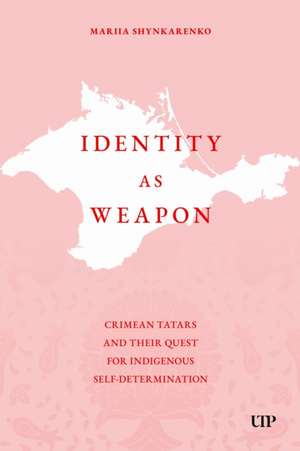
Identity As Weapon
Autor Mariia Shynkarenkoen Limba Engleză Hardback – 13 oct 2026
In her investigation of Crimean Tatar political activism, researcher Mariia Shynkarenko shows the continuity of Crimean Tatar claims to self-determination. During the early years of the Soviet Union, Crimean Tatar activists embraced the language of “backwardness” to access political resources available to them through Soviet korenizatsiia (indigenization) policies. Since the collapse of the Soviet empire, Crimean Tatars have alternately invoked European, Indigenous, Ukrainian, and Muslim identities. These identities – sometimes state sponsored, but often not – have been powerful weapons of the Crimean Tatar struggle for self-determination.
Shynkarenko critically applies lessons from Indigenous studies to explain why Indigeneity has become an important category for Crimean Tatar politics, while challenging presumptions about the nature of Indigenous identity and politics that have been drawn predominantly from examples in the Americas, Australia, and New Zealand.
Preț: 443.11 lei
Nou
Puncte Express: 665
Carte disponibilă
Livrare economică 07-21 noiembrie
Livrare express 24-30 octombrie pentru 37.81 lei
Livrare prin curier în România Termenul estimat este afișat lângă disponibilitate.
Transport gratuit pentru acest produs Plată online sau ramburs, în funcție de opțiunile comenzii.
Retur gratuit în 14 zile Comandă securizată și suport în română.
Specificații
ISBN-13: 9781049805405
ISBN-10: 1049805402
Pagini: 218
Dimensiuni: 160 x 236 x 18 mm
Greutate: 0.42 kg
Editura: University of Toronto Press
ISBN-10: 1049805402
Pagini: 218
Dimensiuni: 160 x 236 x 18 mm
Greutate: 0.42 kg
Editura: University of Toronto Press
Cuprins
Acknowledgments
List of Abbreviations
Note on Translation and Transliteration
List of Illustrations and Tables
Introduction
Chapter 1: Mobilization of Ethnicity: İsmail Gaspıralı, Young Tatars, and the Russian Revolution
Chapter 2: From “Backward” to Soviet Crimean Tatars: Double Assimilation or Instrumentalization?
Chapter 3: From Soviet Citizens to Indigenous Peoples: Reframing the Movement
Chapter 4: Becoming European: Orthodox Islam and Russkii Mir
Chapter 5: Loyalty and Patriotism: The Role of Crimean Tatars in Ukraine’s Nation-building Project
Chapter 6: Russian Collaboration and Islamic Revivalism: Authenticity and Membership in Crimean Tatar Indigenous Identity
Conclusion
Notes
Bibliography
List of Abbreviations
Note on Translation and Transliteration
List of Illustrations and Tables
Introduction
Chapter 1: Mobilization of Ethnicity: İsmail Gaspıralı, Young Tatars, and the Russian Revolution
Chapter 2: From “Backward” to Soviet Crimean Tatars: Double Assimilation or Instrumentalization?
Chapter 3: From Soviet Citizens to Indigenous Peoples: Reframing the Movement
Chapter 4: Becoming European: Orthodox Islam and Russkii Mir
Chapter 5: Loyalty and Patriotism: The Role of Crimean Tatars in Ukraine’s Nation-building Project
Chapter 6: Russian Collaboration and Islamic Revivalism: Authenticity and Membership in Crimean Tatar Indigenous Identity
Conclusion
Notes
Bibliography
Notă biografică
Mariia Shynkarenko is a political scientist specializing in resistance, nationalism, and identity. She is an assistant professor and principal investigator at the Institute of Political Studies, Polish Academy of Sciences.