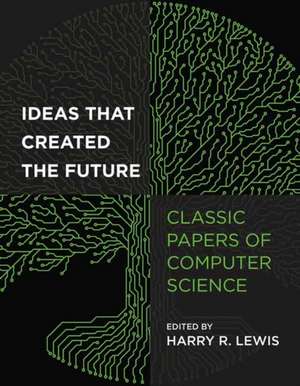
Ideas That Created the Future
Autor Harry Lewisen Limba Engleză Paperback – 2 feb 2021
ABORDAREA PRACTICĂ: Ideas That Created the Future nu este doar o antologie istorică, ci un raport tehnic asupra modului în care conceptele abstracte s-au transformat în arhitecturi de calcul concrete. Remarcăm modul în care Harry Lewis echilibrează rigoarea textelor sursă cu eseuri explicative care traduc relevanța fiecărei descoperiri pentru tehnologia modernă. Dacă Selected Papers on Computer Science de Donald E. Knuth v-a oferit cadrul teoretic asupra naturii algoritmilor, această carte oferă instrumentele practice și documentele primare care au pus bazele industriei, de la analiza circuitelor de comutație la primele schițe pentru EDVAC. Considerăm că forța acestui volum rezidă în structura sa progresivă. Cuprinsul urmărește o evoluție logică, începând cu logica aristoteliană și 'Metoda Adevărată' a lui Leibniz, trecând prin momentele de cotitură din 1936 (Turing) și 1948 (Shannon), până la dezvoltarea codurilor corectoare de erori. Această progresie demonstrează că informatica nu a apărut în vid, ci este rezultatul unei acumulări de soluții la probleme matematice și inginerești specifice. În contextul operei sale, Harry Lewis continuă demersul de clarificare a fundamentelor început în Essential Discrete Mathematics for Computer Science, însă aici părăsește zona didactică pentru a explora geneza ideilor. Față de abordarea critică din Blown to Bits, acest volum se concentrează pe arhitectura intelectuală a domeniului, oferind cititorului acces direct la mintea inovatorilor care au definit era digitală.
Preț: 409.63 lei
Preț vechi: 520.62 lei
-21%
Carte disponibilă
Livrare economică 02-09 noiembrie
Livrare express 17-23 octombrie pentru 55.62 lei
Specificații
ISBN-10: 0262045303
Pagini: 520
Ilustrații: 120
Dimensiuni: 228 x 175 x 25 mm
Greutate: 0.81 kg
Editura: MIT Press Ltd
V-ar putea interesa
-
 Blown to BitsHal Abelson-20%Preț: 119.10 lei148.87 lei
 -
 -14%Preț: 569.09 lei661.73 lei
 -
 Baseball as a Second LanguageHarry LewisPreț: 64.92 lei
 -
 Examining Internet and Technology around the WorldLaura M. Steckman-44%Preț: 451.04 lei803.87 lei
 -
 Preț: 129.17 lei
 -
 DATA ANALYTICS AND KNOWLEDGE MANAGEMENTInternational Management School-20%Preț: 91.61 lei114.51 lei
 -
 iPad 7th GenerationPhila Perry-20%Preț: 226.67 lei283.34 lei
 -
 iPhone 8Phila Perry-20%Preț: 357.18 lei446.46 lei
 -
 iPhone 11Phila Perry-20%Preț: 392.21 lei490.25 lei
 -
 iPhone XPhila Perry-20%Preț: 131.41 lei164.27 lei
 -
 Apple Watch SeriesPhila Perry-20%Preț: 80.86 lei101.08 lei
 -
 Password KeeperEightidd Ge. Press-20%Preț: 60.26 lei75.32 lei
 -
 Hands-On Artificial Intelligence for CybersecurityAlessandro Parisi-20%Preț: 267.02 lei333.78 lei
 -
 Machine LearningSamuel Hack-20%Preț: 150.52 lei188.15 lei
 -
 Scratch Coding for KidsZach Codings-20%Preț: 190.41 lei238.01 lei
 -
 Linux Systems for beginnersMichael Smith-20%Preț: 160.78 lei200.98 lei
 -
 Coding GamesRobert C Matthews-20%Preț: 108.91 lei136.14 lei
 -
 Coding in PythonRobert C. Matthews-20%Preț: 217.52 lei271.89 lei
 -
 Planning and Control Using Microsoft Project 365Paul E. Harris-20%Preț: 340.56 lei425.70 lei
 -
 Python programming for beginnersJason Cannon-20%Preț: 123.68 lei154.59 lei
 -
 python for data scienceJason Cannon-20%Preț: 120.52 lei150.66 lei
 -
 Das C++Builder Rezeptbuch, Teil 2Wilfried Koch-20%Preț: 116.06 lei145.08 lei
 -
 Data structure for coding interviewsKamal RawatPreț: 187.89 lei
 -
 WEB TECHNOLOGY (HTML--JSS--CSS)Bhupesh Taunk-20%Preț: 124.66 lei155.83 lei
 -
 RELATIONAL DATABASEMs. MANISHA Bharambe-20%Preț: 137.97 lei172.46 lei
 -
 DATA WAREHOUSING WITH MINING TECHNIQUES (22621)MeenakshiA. Thalor-20%Preț: 94.19 lei117.75 lei
 -
 CLOUD COMPUTING (22624)KishorS. Wagh-20%Preț: 124.16 lei155.20 lei
 -
 NETWORK AND INFORMATION SECURITY (22620)MrunalP. FatangarePreț: 125.05 lei
De ce să citești această carte
Recomandăm această carte profesioniștilor IT și studenților care doresc să înțeleagă mecanismele fundamentale ale calculatoarelor direct de la sursă. Veți câștiga o perspectivă tehnică profundă asupra evoluției algoritmilor și arhitecturilor hardware, trecând dincolo de utilizarea uneltelor moderne către înțelegerea principiilor care le fac posibile. Este un instrument esențial pentru oricine dorește să stăpânească logica din spatele tehnologiei actuale.
Despre autor
Harry Lewis este un distins profesor de informatică la Harvard, cunoscut pentru capacitatea sa de a contextualiza evoluția tehnologică în raport cu impactul social și fundamentele matematice. Autor al unor lucrări de referință precum Blown to Bits, unde explorează explozia informației digitale, și Essential Discrete Mathematics for Computer Science, Lewis îmbină expertiza academică cu o perspectivă istorică bogată. În Ideas That Created the Future, el își folosește experiența de educator pentru a ghida cititorul prin cele mai complexe texte tehnice ale secolului XX, făcând legătura între logica clasică și sistemele software contemporane.
Descriere scurtă
Cuprins
2 The True Method (1677) 5
3 Sketch of the Analytical Engine (1843) 9
4 An Investigation of the Laws of Thought on Which Are Founded the Mathematical Theories of Logic and Probabilities (1854) 27
5 Mathematical Problems (1900) 45
6 On Computable Numbers, with an Application to the Entscheidungsproblem (1936) 51
7 A Proposed Automatic Calculating Machine (1937) 61
8 A Symbolic Analysis of Relay and Switching Circuits (1938) 71
9 A Logical Calculus of the Ideas Immanent in Nervous Activity (1943) 79
10 First Draft of a Report on the EDVAC (1945) 89
11 As We May Think (1945) 107
12 A Mathematical Theory of Communication (1948) 121
13 Error Detecting and Error Correcting Codes (1950) 135
14 Computing Machinery and Intelligence (1950) 147
15 The Best Way to Design an Automatic Calculating Machine (1951) 165
16 The Education of a Computer (1952) 169
17 On the Shortest Spanning Subtree of a Graph and the Traveling Salesman Problem (1956) 179
18 The Perceptron: A Probabilistic Model for Information Storage and Organization (1958) 183
19 Some Moral and Technical Consequences of Automation (1960) 191
20 Man-Computer Symbiosis (1960) 201
21 Recursive Functions of Symbolic Expressions and Their Computation by Machine (1960) 213
22 Augmenting Human Intellect: A Conceptual Framework (1962) 225
23 An Experimental Time-Sharing System (1962) 237
24 Sketchpad (1963) 251
25 Cramming More Components onto Integrated Circuits (1965) 261
26 Solution of a Problem in Concurrent Program Control (1965) 267
27 ELIZA-A Computer Program for the Study of Natural Language Communication between Man and Machine (1966) 271
28 The Structure of the "THE"-Multiprogramming System (1968) 279
29 Go To Statement Considered Harmful (1968) 289
30 Gaussian Elimination is Not Optimal (1969) 293
31 An Axiomatic Basis for Computer Programming (1969) 297
32 A Relational Model of Large Shared Data Banks (1970) 307
33 Managing the Development of Large Software Systems (1970) 321
34 The Complexity of Theorem-Proving Procedures (1971) 333
35 A Statistical Interpretation of Term Specificity and Its Application in Retrieval (1972) 339
36 Reducibility among Combinatorial Problems (1972) 349
37 The Unix Time-Sharing System (1974) 357
38 A Protocol for Packet Network Intercommunication (1974) 373
39 Programming with Abstract Data Types (1974) 387
40 The Mythical Man-Month (1975) 399
41 Ethernet: Distributed Packet Switching for Local Computer Networks (1976) 407
42 New Directions in Cryptography (1976) 421
43 Big Omicron and Big Omega and Big Theta (1976) 441
44 Social Processes and Proofs of Theorems and Programs (1977) 447
45 A Method for Obtaining Digital Signatures and Public-Key Cryptosystems (1978) 463
46 How to Share a Secret (1979) 475
Bibliography 479
Index 491