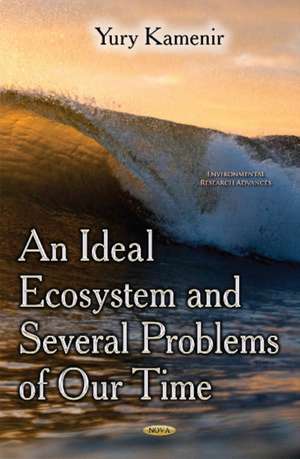
Ideal Ecosystem & Several Problems of Our Time
Autor Yury Kameniren Limba Engleză Hardback – feb 2016
În lucrarea Ideal Ecosystem & Several Problems of Our Time, autorul Yury Kamenir propune o abordare sintetică a ecologiei acvatice, concentrându-se pe dezvoltarea unor modele formale cu un număr minim de parametri. Notăm cu interes evoluția de la modelul de bază al Ecosistemului Minimal Ideal (IMES) către spectrele de dimensiune taxonomică, o metodologie care reușește să reducă zgomotul informațional generat de speciile rare și de eterogenitatea spațio-temporală. Această ediție consolidează studii originale realizate pe parcursul a trei decenii, oferind o perspectivă maturizată asupra modului în care materia vie se organizează în comunități consistente, în ciuda variabilității la scară mică.
Structura cărții urmărește o progresie logică de la fundamentul teoretic — explorând concepte precum „vârtejul viu” al lui Cuvier sau biogeochimia lui Vernadsky — către aplicații empirice riguroase. Capitolele dedicate allometriei și suprafeței metabolice pregătesc terenul pentru secțiunile centrale de analiză comparativă. Subliniem relevanța capitolelor ce analizează opt ecosisteme acvatice distincte și stabilitatea pe termen lung a fitoplanctonului în lacurile subtropicale, date care confirmă robustețea mecanismelor statistice propuse. Lucrarea extinde cadrul teoretic propus de Models of the Ecological Hierarchy prin introducerea datelor specifice despre ierarhia taxonomică a fitoplanctonului și prin utilizarea unor descriptori noi, esențiali pentru diagnoza și prognoza ecologică. În timp ce Body Size: The Structure and Function of Aquatic Ecosystems se concentrează pe dimensiunea corpului ca element predictiv general, Yury Kamenir rafinează acest concept prin spectre taxonomice fine, oferind instrumente mai precise pentru monitorizarea mediului.
Preț: 1137.55 lei
Preț vechi: 1529.04 lei
-26%
Carte disponibilă
Livrare economică 18 mai-01 iunie
Specificații
ISBN-10: 1631173006
Pagini: 175
Ilustrații: illustrations
Dimensiuni: 180 x 260 x 16 mm
Greutate: 0.44 kg
Editura: Nova Science Publishers Inc
Colecția Nova Science Publishers, Inc (US)
Locul publicării:United States
V-ar putea interesa
-
 -26%Preț: 184.26 lei248.65 lei
 -
 -35%Preț: 692.71 lei1067.36 lei
 -
 -23%Preț: 543.50 lei705.85 lei
 -
 Preț: 226.18 lei
 -
 Preț: 227.12 lei
 -
 Beyond Straw Men – Plastic Pollution and Networked Cultures of CarePhaedra C. PezzulloPreț: 229.48 lei
 -
 Andean Meltdown – A Climate Ethnography of Water, Power, and Culture in PeruKarsten PaerregaardPreț: 223.74 lei
 -
 Preț: 202.09 lei
 -
 Disasters and HistoryBas van BavelPreț: 232.39 lei
 -
 EcosemioticsTimo MaranPreț: 144.77 lei
 -
 Mine VentilationCarlos SierraPreț: 381.80 lei
 -
 Preț: 364.81 lei
 -
 Social Representations for the Anthropocene: Latin American PerspectivesClarilza Prado de Sousa-15%Preț: 626.61 lei737.18 lei
 -
 Sustainable Development: Society, Ecology, EconomyAleksander V. Semenov-18%Preț: 912.21 lei1112.45 lei
 -
 Preț: 364.08 lei
 -
 Agriculture, Livestock Production and AquacultureArvind Kumar-18%Preț: 966.51 lei1178.66 lei
 -
 Preț: 338.72 lei
 -
 Energie- und Produktionswende im ländlichen RaumBernhard AdlerPreț: 398.09 lei
 -
 Preț: 118.99 lei
 -
 Hydraulik für Ingenieure und NaturwissenschaftlerChristoph RappPreț: 294.29 lei
 -
 Bergbau gleich Raubbau?Volker WredePreț: 127.75 lei
 -
 -24%Preț: 1630.56 lei2145.47 lei
De ce să citești această carte
Această monografie publicată de Nova Science Publishers Inc este esențială pentru ecologii care caută modele matematice simplificate, dar robuste, pentru gestionarea ecosistemelor acvatice. Cititorul câștigă o înțelegere profundă a stabilității structurale a fitoplanctonului și acces la metode de prognoză bazate pe spectre de dimensiune. Este o resursă valoroasă pentru cercetătorii care doresc să combine teoria clasică a materiei vii cu modelarea statistică modernă.