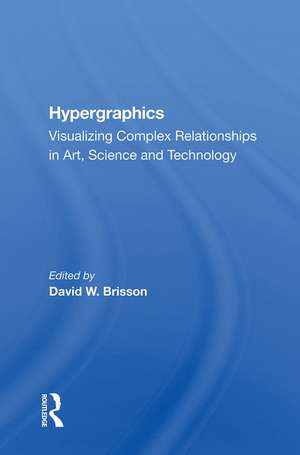
Hypergraphics: Visualizing Complex Relationships In Arts, Science, And Technololgy
Autor David Brissonen Limba Engleză Hardback – 17 iun 2019
Preț: 1095.18 lei
Preț vechi: 1463.46 lei
-25%
Puncte Express: 1643
Carte indisponibilă temporar
Doresc să fiu notificat când acest titlu va fi disponibil:
Se trimite...
Specificații
ISBN-13: 9780367018207
ISBN-10: 0367018209
Pagini: 253
Dimensiuni: 152 x 229 mm
Greutate: 0.63 kg
Ediția:1
Editura: Taylor & Francis
Colecția Routledge
Locul publicării:Oxford, United Kingdom
ISBN-10: 0367018209
Pagini: 253
Dimensiuni: 152 x 229 mm
Greutate: 0.63 kg
Ediția:1
Editura: Taylor & Francis
Colecția Routledge
Locul publicării:Oxford, United Kingdom
V-ar putea interesa
-
 BlueprintsMarcus Du SautoyPreț: 123.84 lei
 -
 -15%Preț: 121.88 lei143.37 lei
 -
 Graph VisionTheodora Vardouli-14%Preț: 416.11 lei483.85 lei
 -
 Functional Art, TheAlberto CairoPreț: 326.65 lei
 -
 Art + Science NowStephen Wilson-21%Preț: 155.99 lei196.91 lei
 -
 Notes on the Synthesis of FormChristopher AlexanderPreț: 235.55 lei
 -
 Preț: 384.83 leiRecomandat
 -
 Preț: 267.25 lei
 -
 Drawing Analogies: Diagrams in Art, Theory and PracticeDavid Burrows-33%Preț: 549.59 lei821.20 lei
 -
 Preț: 290.11 lei
 -
 Canva For DummiesJesse StayPreț: 138.85 lei
 -
 Writing Graphic Novels For DummiesKensuke OkabayashiPreț: 115.21 lei
 -
 Visual Methods for Digital Research - An IntroductionGabriele ColomboPreț: 139.67 lei
 -
 Visual GrammarChristian Leborg-14%Preț: 102.91 lei119.26 lei
 -
 The Book of TreesManuel Lima-8%Preț: 132.55 lei143.66 lei
 -
 Pattern and Chaos in Art, Science and Everyday LifeSarah HortonPreț: 377.18 lei
 -
 Preț: 97.06 lei
 -
 Information GraphicsSandra RendgenPreț: 206.48 lei
 -
 Spacetimes MatterJamie-Scott BaxterPreț: 298.72 lei
 -
 Shaping Visual Structures: The Art of Composition, Movement, and Space in Graphic DesignCarla Viviana Cordova-15%Preț: 120.66 lei142.06 lei
Cuprins
0. Introduction 1. Geometry in Applied Science and Engineering 2. Speculations on Dimensionality, Valence and Aggregation 3. Algorithms, Structures and Models 4. Complex Relations in Urban and Regional Planning: An Application of Hypergraphics 5. Seeing Order: Systems and Symbol 6. Visual Comprehension of n-Dimensions 7. Displaying n-Dimensional Hyperobjects by Computer 8. Real-Time Computer Graphics Analysis of Figures in Four-Space 9. Randomness and Order in Sculptural Form 10. Ambiguous Structures 11. An Impossible Four-Dimensional Illusion
Notă biografică
Edited by David W. Brisson associate professor of design at the Rhode Island School of Design, is a painter and sculptor, and for the past 15 years has been working in the area of geometry[1]ry and perception. He invented the three-dimensional anaglyph and the hypersecretion and devised a method of making three[1]dimensional lenticular drawings, hyperstereograms, and other forms. His art has been exhibited throughout the United States, and he has organized a number of symposia and exhibit[1]tions on hypergraphias. Among his books are Curved 4-Space (1976), and A New Reality: A Theory of Dimensionality (1976).
Descriere
This book reviews developments in hypergraphics from the perspectives of a variety of fields in art and science. It is concerned with visual models and visual thought and discusses the role of art in the discovery of technologically useful materials and techniques.