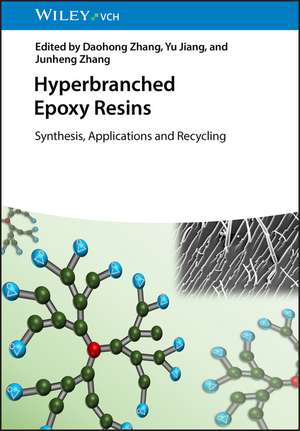
Hyperbranched Epoxy Resins
Editat de Daohong Zhang, Yu Jiang, Junheng Zhangen Limba Engleză Hardback – 23 sep 2026
Hyperbranched epoxy resins attract growing attention in academia and industry for their high crosslinking ability and unique hole-containing topological structure, yet no single reference has covered their complete lifecycle. Hyperbranched Epoxy Resins: Synthesis, Applications, and Recycling, authored by a team of polymer scientists with collectively over 200 publications and 85 patents, delivers that unified treatment from fundamental chemistry through degradation and recycling mechanisms.
The book details synthesis methods, characterization of chemical and topological structure, and homogeneously reinforcing and toughening mechanisms for common epoxy resins. Application coverage spans electrical and electronic materials, pouring filling and sealing materials, and flame-resistant materials. Chapters on high-performance carbon fiber composites address interfacial interaction improvement between matrix and fibers, while dedicated sections treat degradation pathways and recycling strategies.
Readers will also find:
- Thorough background on thermoset resin properties including adhesion, corrosion resistance, chemical stability, and dielectric behavior in industrial contexts
- Detailed characterization protocols for both chemical structure and topological architecture of hyperbranched epoxy resins using current analytical methods
- Coverage of reinforcing and toughening mechanisms that improve mechanical performance when hyperbranched resins are blended with conventional epoxy systems
- Discussion of interfacial interaction improvement mechanisms between polymer matrices and carbon fibers in high-performance composite fabrication
- Analysis of degradation pathways and recycling strategies addressing the full end-of-life cycle for hyperbranched epoxy resin systems
Preț: 832.12 lei
Preț vechi: 914.42 lei
-9% Nou
Puncte Express: 1248
Carte tipărită la comandă
Livrare economică 30 noiembrie-14 decembrie
Livrare express 24-30 octombrie pentru 68.59 lei
Livrare prin curier în România Termenul estimat este afișat lângă disponibilitate.
Transport gratuit pentru acest produs Plată online sau ramburs, în funcție de opțiunile comenzii.
Retur gratuit în 14 zile Comandă securizată și suport în română.
Specificații
ISBN-13: 9783527354801
ISBN-10: 3527354808
Pagini: 320
Dimensiuni: 173 x 248 x 22 mm
Greutate: 0.76 kg
Editura: Wiley-VCH GmbH
ISBN-10: 3527354808
Pagini: 320
Dimensiuni: 173 x 248 x 22 mm
Greutate: 0.76 kg
Editura: Wiley-VCH GmbH
V-ar putea interesa
-
 The Elements of Polymer Science and EngineeringAlfred Rudin-29%Preț: 761.98 lei1069.93 lei
 -
 Chemical and Engineering Thermodynamics, 5eStanley I. Sandler-19%Preț: 581.45 lei717.84 lei
 -
 Furan Polymers and Their ReactionsAlessandro Gandini-23%Preț: 756.43 lei982.37 lei
 -
 March's Advanced Organic ChemistryMichael B. Smith-23%Preț: 1366.29 lei1774.40 lei
 -
 Training in Plastics TechnologyChristian Hopmann-15%Preț: 589.53 lei693.57 lei
 -
 Polymer ExtrusionAnthony Chi-Ying Wong-23%Preț: 780.31 lei1013.39 lei
 -
 -20%Preț: 335.34 lei419.18 lei
 -
 -26%Preț: 1803.18 lei2453.24 lei
 -
 -30%Preț: 97.81 lei139.80 lei
 -
 FermentTim Spector-5%Preț: 116.95 lei123.10 lei
 -
 Hyperbranched PolymersAlbena Lederer-14%Preț: 1198.06 lei1393.08 lei
 -
 Preț: 332.23 lei
 -
 A Concise Introduction to Polymer PhysicsReinhard Hentschke-11%Preț: 428.27 lei481.21 lei
 -
 Functional Polymer FoamsHaoyang Mi-14%Preț: 869.31 lei1010.82 lei
 -
 Functional Polyimide DielectricsJun-Wei Zha-23%Preț: 817.12 lei1061.18 lei
 -
 Handbook of Epoxy/Fiber CompositesSanjay Mavinkere Rangappa-18%Preț: 4598.72 lei5608.20 lei
 -
 Advancements in Polymer TechnologyMrutyunjay Suar-18%Preț: 1146.27 lei1397.89 lei
Notă biografică
Daohong Zhang, PhD, is Dean of the School of Chemistry and Materials Science at South-Central Minzu University in Wuhan, China, and a Fellow of the Royal Society of Chemistry. He has published over 150 scientific publications and 70 patents focused on hyperbranched polymers.
Yu Jiang, PhD, is an Associate Professor at South-Central Minzu University specializing in hyperbranched polymer synthesis and application. A former postdoctoral fellow at KAUST, he has authored over 40 scientific publications and 5 patents on the subject.
Junheng Zhang, PhD, is an Associate Professor and leader of the polymer science department at South-Central Minzu University. He has published over 10 SCI publications and 10 patents and served as principal investigator for more than 10 national foundation projects of China.
Yu Jiang, PhD, is an Associate Professor at South-Central Minzu University specializing in hyperbranched polymer synthesis and application. A former postdoctoral fellow at KAUST, he has authored over 40 scientific publications and 5 patents on the subject.
Junheng Zhang, PhD, is an Associate Professor and leader of the polymer science department at South-Central Minzu University. He has published over 10 SCI publications and 10 patents and served as principal investigator for more than 10 national foundation projects of China.
Cuprins
Preface xi
1 Background and Basic Knowledge of Hyperbranched Epoxy Resins 1
Junheng Zhang and Daohong Zhang
1.1 Chemistry, Synthesis, Manufacture, and Characterization of Epoxy Resins 1
1.1.1 Introduction 1
1.1.2 The Synthesis of Epoxy Resins 2
1.1.3 Properties of Epoxy Resins 3
1.1.3.1 Epoxy Content 3
1.1.3.2 Determination of Hydroxyl Groups 3
1.1.3.3 Chlorine Content 4
1.1.3.4 Molecular Structure 4
1.1.3.5 Physical Properties 4
1.1.3.6 Epoxy Resin Market 6
1.2 Chemistry, Synthesis, Manufacture, and Characterization of Hyperbranched Epoxy Resins 6
2 Properties and Characterization Methods of Hyperbranched Epoxy Resins 13
Kai Cheng and Xian Wang
2.1 Introduction 13
2.2 Properties and Characterization Methods of Hyperbranched Epoxy Resin 15
2.2.1 Degree of Branching 16
2.2.1.1 NMR Spectroscopy 17
2.2.1.2 The Degradable Method and Indirect Viscometry Method 19
2.2.2 Molecular Weight and Molecular Weight Distribution 21
2.2.2.1 GPC and Light Scattering Techniques 21
2.2.2.2 MALDI-TOF MS 22
2.2.2.3 Diffusion-ordered Spectroscopy and NMR Spectroscopy 23
2.2.3 Topology 25
2.2.3.1 Dynamic Light Scattering 26
2.2.3.2 Diffusion-ordered Spectroscopy 26
2.2.4 Rheological Properties 29
2.2.4.1 Rheometer and DMA 30
2.3 Conclusion and Prospect 32
3 Synthesis Methods of Hyperbranched Epoxy Resins 39
Yu Jiang, Aolin Wang, Yufei Zhang, Mengting Du, and Sufang Chen
3.1 Introduction 39
3.2 One-step Polymerization of Epoxy Monomers 40
3.2.1 Proton Transfer Polymerization 40
3.2.2 Step-growth Polycondensation 48
3.2.3 Step-growth Polyaddition 56
3.3 Post-polymerization of Hyperbranched Polymers 62
3.3.1 Etherification 62
3.3.2 Esterification 70
3.3.3 Addition Reaction 76
3.3.4 Click Reaction 81
3.4 Conclusions and Perspectives 92
3.4.1 Challenges 93
3.4.1.1 Challenges in Synthesis and Precise Structural Control 93
3.4.1.2 Challenges in Functionalization and Sustainability 94
3.4.2 Perspectives 94
3.4.2.1 Innovation of Synthesis Methods 94
3.4.2.2 Toward Sustainable Development and a Circular Economy 95
3.4.3 Conclusion 96
4 Applications of Hyperbranched Epoxy Resins 103
Zejun Xu, Zi Wang, and Xingping Zhou
4.1 Introduction 103
4.2 Adhesive Materials 106
4.3 Coating 115
4.4 Matrix for Composites 119
4.4.1 Glass Fiber Composites 120
4.4.2 Carbon Fiber Composites 124
4.4.3 Other Composites 131
4.5 Modifiers for Composite Materials 133
4.5.1 Temperature-Resistant Materials 134
4.5.2 Flame-Resistant Materials 137Contents vii
4.5.3 Antimicrobial Materials 145
4.5.4 Other Materials 147
4.6 Conclusions and Perspectives 149
5 Reinforcing and Toughening and Mechanism of Hyperbranched Epoxy Resins 159
Junheng Zhang and Daohong Zhang
5.1 Introduction 159
5.2 Heterogeneous Mechanism 161
5.2.1 Nano-inorganic and Carbon-Based Nanofillers 161
5.2.2 Reactive Rubbers and Thermoplastics 172
5.2.3 Fiber Materials 176
5.3 Homogeneous Mechanism 180
5.4 Topological Phase Mechanism 195
5.5 Challenges and Perspectives 196
5.5.1 Raman Spectroscopy 197
5.5.2 Positron Annihilation Lifetime Spectroscopy 198
5.5.3 Confocal Microscopy Visualizes 201
5.5.4 Nanoindentation 202
5.5.5 Green Approaches for Epoxy Toughening 203
6 Degradation and Recycling of Epoxy Resins and Their Composites 213
Minghui Cui, Mengqiu Quan, Genzheng Sha, and Jing Chen
6.1 Introduction 213
6.2 Degradation and Recycling of Common Epoxy Resins 214
6.2.1 Method of Degradation 214
6.2.1.1 Thermal Degradation 214
6.2.1.2 Chemical Degradation 215
6.2.1.3 Biodegradation 219
6.2.2 Recycling Method 221
6.2.2.1 Recycling of Epoxy Resins 221
6.2.2.2 Recycling Methods for Epoxy Resins 222
6.2.2.3 Chemical Recycling of Epoxy Resins 225
6.2.2.4 Biological Recycling Technologies and Applications 230
6.2.2.5 Composite Recycling Technologies 232
6.2.2.6 Recycling and Reuse of Epoxy Resin 233
6.3 Degradation and Recycling of HERs 235
6.3.1 Method of Degradation 235
6.3.1.1 Physical Degradation 235
6.3.1.2 Chemical Solution Degradation 236
6.3.1.3 Synergistic Degradation 237
6.3.1.4 Biodegradation 239viii Contents
6.3.2 Recycling Method 240
6.3.2.1 Recovery by Physical Method 240
6.3.2.2 Recycling by Chemical Method 240
6.3.2.3 Multiple Conditions Collaborative Recovery 242
6.3.2.4 Recovery of Composite Components 242
6.4 Economic Feasibility of Epoxy Resin Recycling 243
6.4.1 Cost-effectiveness of Recycling Methods 243
6.4.2 Environmental and Economic Benefits 243
6.4.3 Challenges and Opportunities 244
6.4.4 Future Prospects 244
6.5 Achievements and Challenges 244
6.5.1 Achievements 244
6.5.2 Challenges 245
6.5.3 Outlook 245
7 Hyperbranched Epoxy Resins-Vitrimers 253
Xicheng Yuan and Zhihuan Weng
7.1 Introduction 253
7.2 Chemical Structures of Epoxy Resin Vitrimers 254
7.2.1 Dynamic Transesterification Reaction 255
7.2.2 Dynamic Disulfide Exchange 257
7.2.3 Dynamic Imine Bonds 261
7.2.4 Other Dynamic Cross-Linking Structures 263
7.3 Hyperbranched Epoxy Resin Vitrimer Matrices 264
7.3.1 Hyperbranched Epoxy Vitrimers Based on Transesterification Reaction 264
7.3.2 Hyperbranched Epoxy Vitrimers Based on Disulfide Exchange 268
7.3.3 Hyperbranched Epoxy Vitrimers Based on Imine Bonds 270
7.4 Hyperbranched Epoxy Resin Vitrimer Composites 270
7.5 Conclusions and Perspectives 274
Acknowledgments 276
References 276
8 Perspectives 281
Yu Jiang, Kai Cheng, Xiongjie Li, and Daohong Zhang
8.1 Innovation in Synthesis and Precision Structural Control 281
8.1.1 Novel Controlled Polymerizations and Click Chemistries 282
8.1.2 AI-assisted Molecular Design and Big Data 282
8.1.3 Green and Energy-efficient Synthesis 283
8.2 Structural Parameter Control and Design for Performance Optimization 283
8.2.1 Precision Control of the Degree of Branching (DB) 284
8.2.2 Precision Control of Molecular Weight Distributions 284
8.2.3 Strategic Design of End-group Functionality and Topology 284Contents ix
8.2.4 Establishing Topological Structure-mechanical Property Relationship 285
8.3 Functional Integration and Application Expansion 285
8.3.1 Multifunctional Integrated Design 285
8.3.2 Dynamic Covalent Chemistry and Reconfigurable Networks 285
8.3.3 Expansion of Application Scenarios 286
8.4 Sustainable Development and Circular Economy 286
8.4.1 Expansion of Bio-based Monomer Resources and Performance Enhancement 286
8.4.2 Optimization of Degradation and Recycling Strategies 287
8.5 Industrialization Pathways and Standardization 287
8.5.1 Overcoming Scale-up Challenges 287
8.5.2 Lack of Specialized Processing Techniques and Equipment 287
8.6 Concluding Remarks 288
Index 289
1 Background and Basic Knowledge of Hyperbranched Epoxy Resins 1
Junheng Zhang and Daohong Zhang
1.1 Chemistry, Synthesis, Manufacture, and Characterization of Epoxy Resins 1
1.1.1 Introduction 1
1.1.2 The Synthesis of Epoxy Resins 2
1.1.3 Properties of Epoxy Resins 3
1.1.3.1 Epoxy Content 3
1.1.3.2 Determination of Hydroxyl Groups 3
1.1.3.3 Chlorine Content 4
1.1.3.4 Molecular Structure 4
1.1.3.5 Physical Properties 4
1.1.3.6 Epoxy Resin Market 6
1.2 Chemistry, Synthesis, Manufacture, and Characterization of Hyperbranched Epoxy Resins 6
2 Properties and Characterization Methods of Hyperbranched Epoxy Resins 13
Kai Cheng and Xian Wang
2.1 Introduction 13
2.2 Properties and Characterization Methods of Hyperbranched Epoxy Resin 15
2.2.1 Degree of Branching 16
2.2.1.1 NMR Spectroscopy 17
2.2.1.2 The Degradable Method and Indirect Viscometry Method 19
2.2.2 Molecular Weight and Molecular Weight Distribution 21
2.2.2.1 GPC and Light Scattering Techniques 21
2.2.2.2 MALDI-TOF MS 22
2.2.2.3 Diffusion-ordered Spectroscopy and NMR Spectroscopy 23
2.2.3 Topology 25
2.2.3.1 Dynamic Light Scattering 26
2.2.3.2 Diffusion-ordered Spectroscopy 26
2.2.4 Rheological Properties 29
2.2.4.1 Rheometer and DMA 30
2.3 Conclusion and Prospect 32
3 Synthesis Methods of Hyperbranched Epoxy Resins 39
Yu Jiang, Aolin Wang, Yufei Zhang, Mengting Du, and Sufang Chen
3.1 Introduction 39
3.2 One-step Polymerization of Epoxy Monomers 40
3.2.1 Proton Transfer Polymerization 40
3.2.2 Step-growth Polycondensation 48
3.2.3 Step-growth Polyaddition 56
3.3 Post-polymerization of Hyperbranched Polymers 62
3.3.1 Etherification 62
3.3.2 Esterification 70
3.3.3 Addition Reaction 76
3.3.4 Click Reaction 81
3.4 Conclusions and Perspectives 92
3.4.1 Challenges 93
3.4.1.1 Challenges in Synthesis and Precise Structural Control 93
3.4.1.2 Challenges in Functionalization and Sustainability 94
3.4.2 Perspectives 94
3.4.2.1 Innovation of Synthesis Methods 94
3.4.2.2 Toward Sustainable Development and a Circular Economy 95
3.4.3 Conclusion 96
4 Applications of Hyperbranched Epoxy Resins 103
Zejun Xu, Zi Wang, and Xingping Zhou
4.1 Introduction 103
4.2 Adhesive Materials 106
4.3 Coating 115
4.4 Matrix for Composites 119
4.4.1 Glass Fiber Composites 120
4.4.2 Carbon Fiber Composites 124
4.4.3 Other Composites 131
4.5 Modifiers for Composite Materials 133
4.5.1 Temperature-Resistant Materials 134
4.5.2 Flame-Resistant Materials 137Contents vii
4.5.3 Antimicrobial Materials 145
4.5.4 Other Materials 147
4.6 Conclusions and Perspectives 149
5 Reinforcing and Toughening and Mechanism of Hyperbranched Epoxy Resins 159
Junheng Zhang and Daohong Zhang
5.1 Introduction 159
5.2 Heterogeneous Mechanism 161
5.2.1 Nano-inorganic and Carbon-Based Nanofillers 161
5.2.2 Reactive Rubbers and Thermoplastics 172
5.2.3 Fiber Materials 176
5.3 Homogeneous Mechanism 180
5.4 Topological Phase Mechanism 195
5.5 Challenges and Perspectives 196
5.5.1 Raman Spectroscopy 197
5.5.2 Positron Annihilation Lifetime Spectroscopy 198
5.5.3 Confocal Microscopy Visualizes 201
5.5.4 Nanoindentation 202
5.5.5 Green Approaches for Epoxy Toughening 203
6 Degradation and Recycling of Epoxy Resins and Their Composites 213
Minghui Cui, Mengqiu Quan, Genzheng Sha, and Jing Chen
6.1 Introduction 213
6.2 Degradation and Recycling of Common Epoxy Resins 214
6.2.1 Method of Degradation 214
6.2.1.1 Thermal Degradation 214
6.2.1.2 Chemical Degradation 215
6.2.1.3 Biodegradation 219
6.2.2 Recycling Method 221
6.2.2.1 Recycling of Epoxy Resins 221
6.2.2.2 Recycling Methods for Epoxy Resins 222
6.2.2.3 Chemical Recycling of Epoxy Resins 225
6.2.2.4 Biological Recycling Technologies and Applications 230
6.2.2.5 Composite Recycling Technologies 232
6.2.2.6 Recycling and Reuse of Epoxy Resin 233
6.3 Degradation and Recycling of HERs 235
6.3.1 Method of Degradation 235
6.3.1.1 Physical Degradation 235
6.3.1.2 Chemical Solution Degradation 236
6.3.1.3 Synergistic Degradation 237
6.3.1.4 Biodegradation 239viii Contents
6.3.2 Recycling Method 240
6.3.2.1 Recovery by Physical Method 240
6.3.2.2 Recycling by Chemical Method 240
6.3.2.3 Multiple Conditions Collaborative Recovery 242
6.3.2.4 Recovery of Composite Components 242
6.4 Economic Feasibility of Epoxy Resin Recycling 243
6.4.1 Cost-effectiveness of Recycling Methods 243
6.4.2 Environmental and Economic Benefits 243
6.4.3 Challenges and Opportunities 244
6.4.4 Future Prospects 244
6.5 Achievements and Challenges 244
6.5.1 Achievements 244
6.5.2 Challenges 245
6.5.3 Outlook 245
7 Hyperbranched Epoxy Resins-Vitrimers 253
Xicheng Yuan and Zhihuan Weng
7.1 Introduction 253
7.2 Chemical Structures of Epoxy Resin Vitrimers 254
7.2.1 Dynamic Transesterification Reaction 255
7.2.2 Dynamic Disulfide Exchange 257
7.2.3 Dynamic Imine Bonds 261
7.2.4 Other Dynamic Cross-Linking Structures 263
7.3 Hyperbranched Epoxy Resin Vitrimer Matrices 264
7.3.1 Hyperbranched Epoxy Vitrimers Based on Transesterification Reaction 264
7.3.2 Hyperbranched Epoxy Vitrimers Based on Disulfide Exchange 268
7.3.3 Hyperbranched Epoxy Vitrimers Based on Imine Bonds 270
7.4 Hyperbranched Epoxy Resin Vitrimer Composites 270
7.5 Conclusions and Perspectives 274
Acknowledgments 276
References 276
8 Perspectives 281
Yu Jiang, Kai Cheng, Xiongjie Li, and Daohong Zhang
8.1 Innovation in Synthesis and Precision Structural Control 281
8.1.1 Novel Controlled Polymerizations and Click Chemistries 282
8.1.2 AI-assisted Molecular Design and Big Data 282
8.1.3 Green and Energy-efficient Synthesis 283
8.2 Structural Parameter Control and Design for Performance Optimization 283
8.2.1 Precision Control of the Degree of Branching (DB) 284
8.2.2 Precision Control of Molecular Weight Distributions 284
8.2.3 Strategic Design of End-group Functionality and Topology 284Contents ix
8.2.4 Establishing Topological Structure-mechanical Property Relationship 285
8.3 Functional Integration and Application Expansion 285
8.3.1 Multifunctional Integrated Design 285
8.3.2 Dynamic Covalent Chemistry and Reconfigurable Networks 285
8.3.3 Expansion of Application Scenarios 286
8.4 Sustainable Development and Circular Economy 286
8.4.1 Expansion of Bio-based Monomer Resources and Performance Enhancement 286
8.4.2 Optimization of Degradation and Recycling Strategies 287
8.5 Industrialization Pathways and Standardization 287
8.5.1 Overcoming Scale-up Challenges 287
8.5.2 Lack of Specialized Processing Techniques and Equipment 287
8.6 Concluding Remarks 288
Index 289