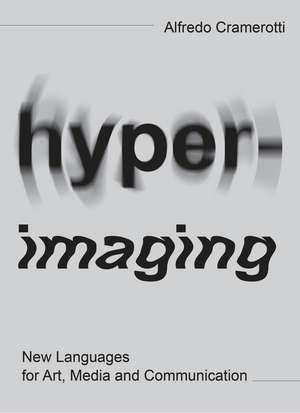
Hyper-imaging: New Languages for Art, Media and Communication
Autor Alfredo Cramerottien Limba Engleză Paperback – 16 noi 2026
Hyper-Imaging: New Languages for Art, Media and Communication describes a condition in which images are processes and no longer end points—relays of action instead of representations. This, in turn, redefines curating as a form of active mediation between human attention and the invisible systems shaping it. Throughout the book, Alfredo Cramerotti weaves theoretical perspectives with case studies drawn from his curatorial experience and deeply engages with artists and thinkers whose work interrogates these shifting dynamics.
This is a book about how images function: how they move, mutate, and coauthor meaning with machines, publics, and institutions. The goal is to equip curators, artists, scholars, and readers to better navigate this terrain: to engage critically, act creatively, and think infrastructurally. In the age of hyper-imaging, what is seeing is not the point; it is the system of seeing that must be curated.
Preț: 276.50 lei
Precomandă
Puncte Express: 415
Carte nepublicată încă
Livrare prin curier în România Precomanda se expediază când titlul devine disponibil.
Transport gratuit de la 400.00 lei Plată online sau ramburs, în funcție de opțiunile comenzii.
Retur gratuit în 14 zile Comandă securizată și suport în română.
Doresc să fiu notificat când acest titlu va fi disponibil:
Se trimite...
Specificații
ISBN-13: 9781835953693
ISBN-10: 1835953697
Pagini: 170
Dimensiuni: 170 x 244 mm
Greutate: 0.45 kg
Editura: Intellect Ltd
Colecția Intellect Ltd
ISBN-10: 1835953697
Pagini: 170
Dimensiuni: 170 x 244 mm
Greutate: 0.45 kg
Editura: Intellect Ltd
Colecția Intellect Ltd
Notă biografică
Alfredo Cramerotti is a scholar, curator, and cultural entrepreneur whose research examines the intersection of contemporary art, media, and digital culture. As Director of the Media Majlis Museum (mm:museum) at Northwestern University in Qatar, he leads research-driven exhibitions and curatorial initiatives that explore the role of media in shaping contemporary cultural narratives, including for major art biennials and cultural institutions worldwide. His academic inquiry focuses on the evolving nature of curatorial practice in relation to technological advancements, globalization, and digital transformation in the cultural sector.
Cuprins
Author’s statement
Foreword by S. Venus Jin
1. The Image: What It Is and What It Does
Rethinking Representation and the Performativity of the Image
Framing the Contemporary Image
Rethinking the Visual Vocabulary
A Living Glossary
2. Seeing Through: From Perception to Operation
From Cognitive Image Formation to Infrastructural Aesthetics
Image as Agent
Visual Content and Machinic Operation
The Contemporary Regime of Visuality
Images After Representation
3. Early Trajectories: Transformative Perspectives on Photography and Mass-Media
McLuhan, Flusser, Vaccari: Historical Legacies and Theoretical Inflections
Precedents and Frameworks
Marshall McLuhan: Pattern and Intuition
Vilém Flusser: Code and Apparatus
Franco Vaccari: The Technological Unconscious
4. Encoding the Visible
Compression, Circulation, and Modulation in Image Behavior
The Image as Modus Operandi
Circulationism: The Structure of Imaging
Operational Aesthetics
5. Visualizing Futures: Approaches Across Disciplines
Journalism, Sociology, Technology, and Art: Reframing Visual Paradigms
Looking, Seeing, Imaging as Thinking Practice
Journalism after the Evidentiary Image
Sociology and the Media Machine
Technology as Mechanism and Milieu
Image Systems and Artistic Production
Segue: From Disciplines to Practices
6. Practices of Hyper-imaging
Case Studies: Steyerl, Goudal, Syms, Bridle, Quayola
The Next Field: Hyper-imaging in Action
Hito Steyerl: Image as Disappearance / Weapon / Echo
Noémie Goudal: Layering the Visual
Martine Syms: Horizontality and Images
James Bridle: The Network and the Image
Quayola: Computation and Images
Working the Image
7. Curating the Image-World
Exhibition-making as Knowledge Device: On Expansion and Pristina Case Studies
The Evolution of Cultural Interactions
On Expansion and Hyperimaging!
The Aesthetic Experience: Non-Linear, Uncertain, and Unfinished
Erica Scourti: Reauthoring the Algorithm
Thomas Galler: The Aesthetics of Accumulation
Margo Wolowiec: Context and Images
Brilant Pireva: Distributed Subjectivity
From Visual Intimacy to Navigational Method
8. The Possibility of an Image
The Intermediacy of Appearance, Code, and Experience
In-between Object, System, and Experience
Systems Thinking: From Object to Instruction
Collapsing the Frame
Image-Making as Aggregation
Triangulating Appearance, Code, and Experience
9. The Transparent Layer
Final Propositions: Toward a Politics of Perceptual Mediation
The Invisibility of the Image
Curating in the Age of Hyper-imaging
From Visual Life to Curatorial Attitude
Toward an Ethics of Hyper-visual Mediation
Afterword by Melanie Lenz
Author’s postscript: A Future Layer
Bibliography and Sources
Projects and Works Referenced
Index
Foreword by S. Venus Jin
1. The Image: What It Is and What It Does
Rethinking Representation and the Performativity of the Image
Framing the Contemporary Image
Rethinking the Visual Vocabulary
A Living Glossary
2. Seeing Through: From Perception to Operation
From Cognitive Image Formation to Infrastructural Aesthetics
Image as Agent
Visual Content and Machinic Operation
The Contemporary Regime of Visuality
Images After Representation
3. Early Trajectories: Transformative Perspectives on Photography and Mass-Media
McLuhan, Flusser, Vaccari: Historical Legacies and Theoretical Inflections
Precedents and Frameworks
Marshall McLuhan: Pattern and Intuition
Vilém Flusser: Code and Apparatus
Franco Vaccari: The Technological Unconscious
4. Encoding the Visible
Compression, Circulation, and Modulation in Image Behavior
The Image as Modus Operandi
Circulationism: The Structure of Imaging
Operational Aesthetics
5. Visualizing Futures: Approaches Across Disciplines
Journalism, Sociology, Technology, and Art: Reframing Visual Paradigms
Looking, Seeing, Imaging as Thinking Practice
Journalism after the Evidentiary Image
Sociology and the Media Machine
Technology as Mechanism and Milieu
Image Systems and Artistic Production
Segue: From Disciplines to Practices
6. Practices of Hyper-imaging
Case Studies: Steyerl, Goudal, Syms, Bridle, Quayola
The Next Field: Hyper-imaging in Action
Hito Steyerl: Image as Disappearance / Weapon / Echo
Noémie Goudal: Layering the Visual
Martine Syms: Horizontality and Images
James Bridle: The Network and the Image
Quayola: Computation and Images
Working the Image
7. Curating the Image-World
Exhibition-making as Knowledge Device: On Expansion and Pristina Case Studies
The Evolution of Cultural Interactions
On Expansion and Hyperimaging!
The Aesthetic Experience: Non-Linear, Uncertain, and Unfinished
Erica Scourti: Reauthoring the Algorithm
Thomas Galler: The Aesthetics of Accumulation
Margo Wolowiec: Context and Images
Brilant Pireva: Distributed Subjectivity
From Visual Intimacy to Navigational Method
8. The Possibility of an Image
The Intermediacy of Appearance, Code, and Experience
In-between Object, System, and Experience
Systems Thinking: From Object to Instruction
Collapsing the Frame
Image-Making as Aggregation
Triangulating Appearance, Code, and Experience
9. The Transparent Layer
Final Propositions: Toward a Politics of Perceptual Mediation
The Invisibility of the Image
Curating in the Age of Hyper-imaging
From Visual Life to Curatorial Attitude
Toward an Ethics of Hyper-visual Mediation
Afterword by Melanie Lenz
Author’s postscript: A Future Layer
Bibliography and Sources
Projects and Works Referenced
Index