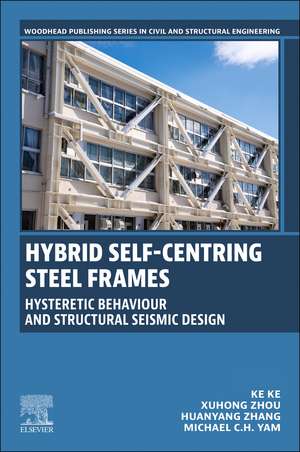
Hybrid Self-Centring Steel Frames: Hysteretic Behaviour and Structural Seismic Design: Woodhead Publishing Series in Civil and Structural Engineering
Autor Ke Ke, Xuhong Zhou, Huanyang Zhang, Michael C.H. Yamen Limba Engleză Paperback – 26 iun 2026
- Presents HSF-SCEDBs: an innovative structural system integrating seismic resilience principles, high-performance materials and optimised structural arrangements.
- Investigates the hysteretic behaviour of SMA components and self-centring connections/braces in HSF-SCEDBs through quasi-static tests, numerical analyses and theoretical analyses, providing diverse solutions for engineering practice.
- Demonstrates the potential of HSF-SCEDBs to mitigate post-earthquake residual deformation, thereby reducing costs associated with repair, demolition and reconstruction, as well as related social impact.
- Describes performance-based design and evaluation frameworks for HSF-SCEDBs with practical examples and illustrates the application of this technology in enhancing seismic resilience through the integration of the latest research developments, theoretical concepts, and case studies.
Din seria Woodhead Publishing Series in Civil and Structural Engineering
- 14%
 Preț: 1471.76 lei
 - 14%
 Preț: 1105.83 lei
 - 30%
 Preț: 1062.35 lei
 - 9%
 Preț: 1066.95 lei
 - 9%
 Preț: 1221.64 lei
 - 25%
 Preț: 1097.37 lei
 - 30%
 Preț: 896.41 lei
 - 30%
 Preț: 1480.63 lei
 - 30%
 Preț: 1648.35 lei
 - 33%
 Preț: 1121.83 lei
 - 9%
 Preț: 1036.80 lei
 - 9%
 Preț: 1517.05 lei
 - 31%
 Preț: 1476.29 lei
 - 30%
 Preț: 1191.64 lei
 - 30%
 Preț: 1446.83 lei
 - 30%
 Preț: 1261.26 lei
 - 40%
 Preț: 703.38 lei
 - 9%
 Preț: 950.30 lei
 - 26%
 Preț: 996.76 lei
 - 30%
 Preț: 872.74 lei
 - 9%
 Preț: 1002.45 lei
 - 25%
 Preț: 1325.65 lei
 - 40%
 Preț: 1003.10 lei
 - 25%
 Preț: 1695.34 lei
 - 30%
 Preț: 1115.75 lei
 - 40%
 Preț: 955.06 lei
 - 26%
 Preț: 1160.75 lei
 - 31%
 Preț: 1196.55 lei
 - 9%
 Preț: 1321.17 lei
 - 30%
 Preț: 1322.55 lei
 - 9%
 Preț: 1440.91 lei
 - 31%
 Preț: 1417.87 lei
 - 30%
 Preț: 1484.48 lei
 - 26%
 Preț: 1005.08 lei
 - 40%
 Preț: 703.28 lei
 - 31%
 Preț: 806.00 lei
 - 31%
 Preț: 1435.70 lei
 - 25%
 Preț: 1325.30 lei
 - 25%
 Preț: 1262.23 lei
 - 9%
 Preț: 904.23 lei
 - 30%
 Preț: 1331.92 lei
 - 23%
 Preț: 1221.23 lei
 - 40%
 Preț: 1649.35 lei
 - 9%
 Preț: 937.83 lei
 - 25%
 Preț: 1210.55 lei
 - 31%
 Preț: 1246.44 lei
 - 26%
 Preț: 945.07 lei
 - 23%
 Preț: 1531.99 lei
 - 32%
 Preț: 1316.63 lei
Preț: 1158.42 lei
Preț vechi: 1507.38 lei
-23%
Puncte Express: 1738
Carte tipărită la comandă
Livrare economică 01-15 decembrie
Livrare prin curier în România Termenul estimat este afișat lângă disponibilitate.
Transport gratuit pentru acest produs Plată online sau ramburs, în funcție de opțiunile comenzii.
Retur gratuit în 14 zile Comandă securizată și suport în română.
Specificații
ISBN-13: 9780443274671
ISBN-10: 0443274673
Pagini: 364
Dimensiuni: 152 x 229 mm
Greutate: 0.6 kg
Editura: ELSEVIER SCIENCE
Seria Woodhead Publishing Series in Civil and Structural Engineering
ISBN-10: 0443274673
Pagini: 364
Dimensiuni: 152 x 229 mm
Greutate: 0.6 kg
Editura: ELSEVIER SCIENCE
Seria Woodhead Publishing Series in Civil and Structural Engineering
V-ar putea interesa
-
 -17%Preț: 36.47 lei43.96 lei
 -
 Structural Design for Fire SafetyAndrew H. Buchanan-19%Preț: 407.96 lei503.65 lei
 -
 Funicular Structures: The Art of Building EfficientlyDamon BolhassaniPreț: 384.80 leiRecomandat
 -
 -31%Preț: 619.84 lei904.13 lei
 -
 Ductile Design of Steel Structures, Third EditionMichel Bruneau-25%Preț: 517.80 lei690.35 lei
 -
 Masonry Structural Design, Third Edition: TMS 402/602-22 and ASCE 7-22Jennifer Eisenhauer Tanner-33%Preț: 934.92 lei1385.29 lei
 -
 Seismic Isolation, Energy Dissipation and Active Vibration Control of StructuresGian Paolo Cimellaro-18%Preț: 2621.48 lei3196.92 lei
 -
 -18%Preț: 1768.09 lei2156.21 lei
 -
 -18%Preț: 1627.35 lei1984.57 lei
 -
 Anti-Seismic DevicesAgostino Marioni-15%Preț: 730.16 lei859.01 lei
 -
 -24%Preț: 1966.54 lei2587.55 lei
 -
 -14%Preț: 905.37 lei1052.76 lei
 -
 Preț: 404.58 lei
 -
 Recent Advances in Structural Engineering, Volume 1A. Rama Mohan Rao-24%Preț: 1289.68 lei1696.95 lei
 -
 -24%Preț: 1203.20 lei1583.15 lei
 -
 Preț: 363.26 lei
 -
 Preț: 469.54 lei
 -
 Recent Developments in Structural Engineering, Volume 4Manmohan Dass Goel-18%Preț: 1457.90 lei1777.92 lei
 -
 Emerging Trends in Composite StructuresMd. Abdul Mannan-18%Preț: 1632.82 lei1991.25 lei
Cuprins
1. Introduction
2. Connections for self-centring energy dissipation bays
3. Braces for self-centring energy dissipation bays
4. Inelastic structural seismic responses
5. Inelastic spectral seismic demands
6. Prediction models of inelastic seismic demands based on regression analysis
7. Prediction models of inelastic seismic demands based on machine-learning techniques
8. Performance-based design methodologies
9. Conclusions
2. Connections for self-centring energy dissipation bays
3. Braces for self-centring energy dissipation bays
4. Inelastic structural seismic responses
5. Inelastic spectral seismic demands
6. Prediction models of inelastic seismic demands based on regression analysis
7. Prediction models of inelastic seismic demands based on machine-learning techniques
8. Performance-based design methodologies
9. Conclusions