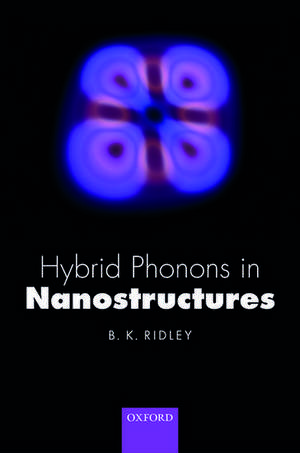
Hybrid Phonons in Nanostructures: Series on Semiconductor Science and Technology, cartea 20
Autor Brian K. Ridleyen Limba Engleză Hardback – 2 feb 2017
În analiza arhitecturii hardware moderne, înțelegerea proceselor fundamentale la nivel de nanostructură devine imperativă. Metodologia abordată în Hybrid Phonons in Nanostructures se concentrează pe fizica stării solide aplicată, explorând modul în care izolarea spațială (confinement) modifică vibrațiile rețelei cristaline. Remarcăm faptul că, deși izolarea modurilor acustice este documentată încă din secolul al XIX-lea, această lucrare vine să completeze un gol teoretic esențial, oferind o relatare cuprinzătoare asupra proprietăților elastice ale modurilor optice, fundamentată pe cercetări recente.
Structura volumului ghidează cititorul prin modele matematice riguroase, de la dinamica rețelei de tip diamant până la regulile de conectare specifice interfețelor. Putem afirma că rigoarea tehnică este punctul forte al autorului, în special în descrierea modurilor polare-optice și a interacțiunii acestora cu electronii. Pe linia practică a lucrării Phonons in Semiconductor Nanostructures de J.P. Leburton, acest volum se distinge printr-un focus specific pe hibridizarea modurilor polarizate longitudinal și transversal, incluzând modurile electromagnetice în materialele polare.
Poziționată ca o continuare a explorărilor din Quantum Processes in Semiconductors, lucrarea de față rafinează conceptele de împrăștiere și interacțiune anharmonică în puncte cuantice. Dacă în lucrările anterioare Brian K. Ridley punea bazele proceselor cuantice, aici livrează o analiză aplicată asupra fononilor fierbinți și a ecranării dinamice, elemente critice pentru ingineria electronică de înaltă performanță. Este o resursă tehnică ce echilibrează modelarea teoretică cu specificațiile necesare dezvoltării de noi materiale semiconductoare.
Din seria Series on Semiconductor Science and Technology
- 24%
 Preț: 594.52 lei
 - 37%
 Preț: 612.88 lei
 - 34%
 Preț: 983.56 lei
 - 37%
 Preț: 1279.67 lei
 - 22%
 Preț: 833.09 lei
 - 34%
 Preț: 1267.26 lei
 - 34%
 Preț: 1163.15 lei
 - 27%
 Preț: 710.21 lei
 - 22%
 Preț: 421.97 lei
 - 33%
 Preț: 699.58 lei
 - 5%
 Preț: 890.05 lei
 - 15%
 Preț: 262.28 lei
 - 25%
 Preț: 597.16 lei
 - 7%
 Preț: 790.51 lei
 - 33%
 Preț: 634.18 lei
 - 33%
 Preț: 691.51 lei
 - 24%
 Preț: 540.44 lei
 - 37%
 Preț: 724.03 lei
 - 34%
 Preț: 733.94 lei
 - 37%
 Preț: 905.58 lei
 - 37%
 Preț: 1207.61 lei
 - 34%
 Preț: 1235.63 lei
 - 37%
 Preț: 1192.31 lei
Preț: 505.59 lei
Preț vechi: 735.47 lei
-31%
Carte tipărită la comandă
Livrare economică 09-14 iulie
Specificații
ISBN-10: 0198788363
Pagini: 206
Dimensiuni: 160 x 239 x 16 mm
Greutate: 0.48 kg
Editura: OUP OXFORD
Colecția OUP Oxford
Seria Series on Semiconductor Science and Technology
Locul publicării:Oxford, United Kingdom
V-ar putea interesa
-
 Semiconductor Physics: Principles, Theory and NanoscaleSandip Tiwari-24%Preț: 607.74 lei794.98 lei
 -
 Semiconductor NanophotonicsPrasanta Kumar Basu-24%Preț: 540.44 lei712.16 lei
 -
 -21%Preț: 358.12 lei455.09 lei
 -
 Introduction to NanophotonicsHenri Benisty-10%Preț: 350.22 lei387.75 lei
 -
 Optical Properties of SolidsMark Fox-11%Preț: 322.89 lei361.95 lei
 -
 -15%Preț: 676.79 lei796.23 lei
 -
 Quantum & Nano Technologies for PhotovoltaicsLoucas Tsakalakos-9%Preț: 660.59 lei725.93 lei
 -
 -9%Preț: 1191.03 lei1308.82 lei
 -
 Applied NanophotonicsSergey V Gaponenko-11%Preț: 628.17 lei705.80 lei
 -
 -23%Preț: 1219.68 lei1583.99 lei
 -
 -9%Preț: 1066.04 lei1171.48 lei
 -
 Advances in Applied Physics ResearchGabriel Waters-26%Preț: 1008.26 lei1359.17 lei
 -
 -18%Preț: 1078.81 lei1315.62 lei
 -
 Preț: 390.23 lei
 -
 Chemical Principles of NanoengineeringAndrea R. Tao-19%Preț: 487.50 lei601.85 lei
 -
 -18%Preț: 1078.13 lei1314.80 lei
 -
 Introduction to Solid State Physics and Crystalline NanostructuresGiuseppe IadonisiPreț: 416.11 lei
De ce să citești această carte
Recomandăm această carte fizicienilor și inginerilor electroniști care proiectează componente hardware de ultimă generație. Cititorul câștigă o înțelegere profundă a hibridizării fononilor în puțuri și fire cuantice, esențială pentru controlul disipării energiei și optimizarea ratelor de împrăștiere în dispozitivele semiconductoare nanometrice. Este un instrument de lucru indispensabil pentru cercetarea avansată în nanotehnologie.
Despre autor
Brian K. Ridley este un distins specialist în fizica semiconductorilor, recunoscut pentru contribuțiile sale teoretice asupra proceselor cuantice. Opera sa se concentrează pe interacțiunile fundamentale dintre purtătorii de sarcină și vibrațiile rețelei în structuri cu dimensiuni reduse. Prin lucrări precum Quantum Processes in Semiconductors, Ridley a stabilit standarde academice în domeniu, îmbinând rigoarea formală cu aplicabilitatea în tehnologia semiconductorilor. Activitatea sa de cercetare este strâns legată de dezvoltarea modelelor matematice care descriu comportamentul electronilor și fononilor în nanostructuri complexe.