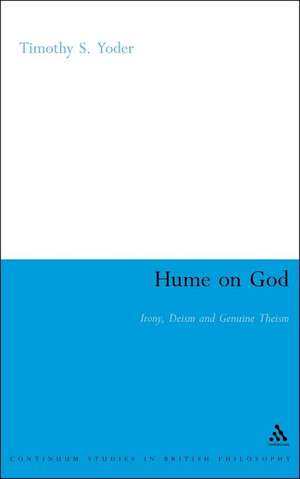
Hume on God: Irony, Deism and Genuine Theism: Continuum Studies in British Philosophy
Autor Dr Timothy S. Yoderen Limba Engleză Paperback – 27 oct 2011
David Hume, one of the most influential philosophers to have written in the English language, is widely known as a skeptic and an empiricist. He is famous for raising questions about the existence of things for which there is insufficient empirical evidence, such as souls, the self, miracles, and, perhaps most importantly, God.
Despite this reputation, however, Hume's works contain frequent references to a deity, and one searches in vain to find a positive assertion of atheism. This book proposes a different reading of Hume on God, in which Hume is seen as proposing a 'genuine theism'. Yoder investigates Hume's use of irony and his relationship with the Deists of his era and offers a thorough re-examination of Hume's writings on religion. Yoder concludes that, despite Hume's criticisms of the church, religiously-based ethics and the belief in miracles, he stops well short of a rejection of the existence of God. Always a creative thinker, Hume carves out a unique conception of the divine being.Din seria Continuum Studies in British Philosophy
- 26%
 Preț: 266.17 lei
 -
 Preț: 263.65 lei
 -
 Preț: 262.81 lei
 - 17%
 Preț: 265.47 lei
 -
 Preț: 263.94 lei
 - 14%
 Preț: 1034.60 lei
 - 26%
 Preț: 262.90 lei
 - 26%
 Preț: 263.28 lei
 - 26%
 Preț: 1034.26 lei
 - 26%
 Preț: 1035.94 lei
 -
 Preț: 264.09 lei
 - 14%
 Preț: 523.98 lei
 - 26%
 Preț: 264.31 lei
 - 26%
 Preț: 1121.01 lei
 -
 Preț: 262.24 lei
 - 26%
 Preț: 1034.34 lei
 - 11%
 Preț: 383.43 lei
 -
 Preț: 263.19 lei
 - 26%
 Preț: 973.91 lei
 - 26%
 Preț: 1035.03 lei
 - 26%
 Preț: 1034.69 lei
 - 26%
 Preț: 1187.20 lei
 - 26%
 Preț: 1033.54 lei
 -
 Preț: 262.34 lei
 - 14%
 Preț: 979.71 lei
 -
 Preț: 264.50 lei
 - 26%
 Preț: 1033.07 lei
 - 26%
 Preț: 913.94 lei
 - 26%
 Preț: 1072.93 lei
 - 26%
 Preț: 1187.72 lei
 - 14%
 Preț: 1035.05 lei
 - 26%
 Preț: 1034.52 lei
 - 26%
 Preț: 975.18 lei
 - 26%
 Preț: 1095.54 lei
 - 26%
 Preț: 914.22 lei
 - 34%
 Preț: 1033.93 lei
Preț: 263.09 lei
Puncte Express: 395
Carte tipărită la comandă
Livrare economică 17-31 august
Livrare prin curier în România Termenul estimat este afișat lângă disponibilitate.
Transport gratuit de la 400.00 lei Plată online sau ramburs, în funcție de opțiunile comenzii.
Retur gratuit în 14 zile Comandă securizată și suport în română.
Specificații
ISBN-13: 9781441122834
ISBN-10: 1441122834
Pagini: 186
Dimensiuni: 156 x 234 x 10 mm
Greutate: 0.27 kg
Editura: Bloomsbury Publishing
Colecția Continuum
Seria Continuum Studies in British Philosophy
Locul publicării:London, United Kingdom
ISBN-10: 1441122834
Pagini: 186
Dimensiuni: 156 x 234 x 10 mm
Greutate: 0.27 kg
Editura: Bloomsbury Publishing
Colecția Continuum
Seria Continuum Studies in British Philosophy
Locul publicării:London, United Kingdom
V-ar putea interesa
-
 Agnosticism: A Very Short IntroductionRobin Le Poidevin-21%Preț: 54.90 lei69.90 lei
 -
 -15%Preț: 109.22 lei128.97 lei
 -
 Morality Without God?Walter Sinnott-ArmstrongPreț: 166.34 lei
 -
 How to Be an AgnosticMark VernonPreț: 178.42 lei
 -
 Why God Won't Go AwayAlister McgrathPreț: 77.31 lei
 -
 The Book of Atheist SpiritualityAndre Comte-SponvillePreț: 108.99 lei
 -
 Gunning for GodJohn LennoxPreț: 84.13 lei
 -
 The New AtheismMichael PoolePreț: 35.19 lei
 -
 Ray Ed D, D: Sex & GodDarrel Ray Ed D.Preț: 90.85 lei
 -
 God: All That MattersMark VernonPreț: 134.80 lei
 -
 Preț: 111.99 lei
 -
 Christian Atheist - Belonging without BelievingBrian MountfordPreț: 75.66 lei
Cuprins
1. The Conventional Story of Hume on God
2. Hume and Irony
3. Hume and Deism
4. Hume on the Existence of God
5. Hume on the Nature of God
6. Conclusion
Recenzii
"Yoder argues that Hume is not a complete skeptic regarding religion, but instead affirms a "true religion" of "genuine theism" in continuity with his defense of mitigated skepticism. Yoder's study is especially valuable for his response to the tendency to dismiss certain passages in Hume's writings as ironic. Instead, Yoder develops a set of hermeneutical principles for deciding when Hume is using irony, and concludes that Hume's positive statements concerning the existence of a deity are not ironic. Yoder's interpretation of Hume's writings on religion will remain an important contribution to the literature." - Dr Claudia Schmidt, Marquette University, USA