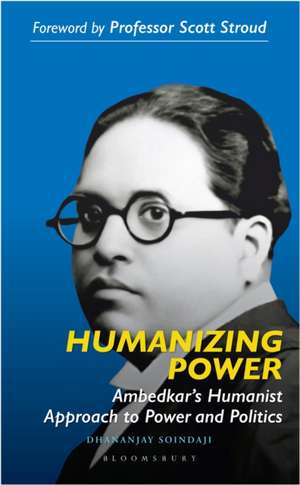
Humanizing Power: Ambedkar’s Humanist Approach to Power and Politics: Bloomsbury Academic India
Autor Dhananjay Soindajien Limba Engleză Hardback – 30 sep 2024
În literatura academică dedicată democrației indiene, analiza puterii se limitează adesea la mecanismele juridice și instituționale, lăsând un gol teoretic în ceea ce privește dimensiunea umanistă și socială a exercitării autorității. Descoperim în volumul Humanizing Power o intervenție filosofică esențială care completează această lacună, recuperându-l pe B. R. Ambedkar nu doar ca arhitect constituțional, ci ca teoretician al puterii puse în serviciul demnității umane. Autorul Dhananjay Soindaji propune o lectură riguroasă a modului în care echilibrul politic rămâne fragil fără o transformare profundă a conștiinței sociale.
Subliniem structura bicefală a lucrării, care ghidează cititorul de la diagnoza „problemei puterii” către „scopul său umanist”. Prima parte investighează subtilitățile relațiilor sociale și ordinea istorică văzută ca o luptă între revoluție și contrarevoluție. Cea de-a doua parte se concentrează pe soluții: moralitatea constituțională, reprezentarea minorităților și conceptul de fraternitate. Cartea completează perspectiva oferită de Ambedkar's Political Philosophy de Valerian Rodrigues, adăugând o analiză aplicată asupra modului în care puterea de stat trebuie să devină un vehicul pentru transformarea socială, nu doar un arbitru al procedurilor electorale. Față de abordările biografice, Soindaji se axează pe deconstrucția teoretică a „puterii poporului” și pe imperativul umanizării politicii într-un context marcat de inegalități sistemice.
Recomandăm acest studiu pentru rigoarea cu care tratează relația dintre religie, moralitate și autoritate. Este o resursă fundamentală care explică de ce, în viziunea lui Ambedkar, democrația politică este nesustenabilă fără o democrație socială consolidată, oferind un cadru conceptual necesar pentru înțelegerea provocărilor contemporane ale statului de drept.
Din seria Bloomsbury Academic India
- 31%
 Preț: 569.40 lei
 - 32%
 Preț: 567.80 lei
 - 33%
 Preț: 551.25 lei
 - 32%
 Preț: 564.82 lei
 - 33%
 Preț: 548.03 lei
 - 32%
 Preț: 563.09 lei
 - 32%
 Preț: 566.10 lei
 - 32%
 Preț: 551.86 lei
 - 33%
 Preț: 551.53 lei
 - 33%
 Preț: 551.65 lei
 - 32%
 Preț: 562.86 lei
 - 32%
 Preț: 552.03 lei
 - 32%
 Preț: 551.25 lei
 - 32%
 Preț: 563.90 lei
 - 33%
 Preț: 548.91 lei
 - 32%
 Preț: 565.03 lei
 - 31%
 Preț: 574.34 lei
 - 33%
 Preț: 548.91 lei
 - 33%
 Preț: 551.34 lei
 - 32%
 Preț: 552.38 lei
 - 33%
 Preț: 551.02 lei
 - 31%
 Preț: 569.73 lei
 - 33%
 Preț: 549.68 lei
 - 31%
 Preț: 574.23 lei
 - 33%
 Preț: 550.47 lei
 - 32%
 Preț: 565.06 lei
 - 33%
 Preț: 548.52 lei
 - 32%
 Preț: 561.50 lei
 - 32%
 Preț: 565.18 lei
 - 33%
 Preț: 549.74 lei
 - 31%
 Preț: 569.00 lei
 - 31%
 Preț: 568.95 lei
 - 31%
 Preț: 568.45 lei
 - 32%
 Preț: 564.39 lei
 - 32%
 Preț: 561.43 lei
 - 31%
 Preț: 569.83 lei
 - 31%
 Preț: 571.92 lei
 - 32%
 Preț: 567.39 lei
 - 33%
 Preț: 550.68 lei
 - 32%
 Preț: 568.34 lei
 - 30%
 Preț: 97.52 lei
 - nou
 Preț: 547.03 lei
 - nou
 Preț: 135.86 lei
 - nou
 Preț: 548.80 lei
 - nou
 Preț: 551.50 lei
Preț: 563.55 lei
Preț vechi: 829.39 lei
-32%
Carte disponibilă
Livrare economică 16-30 noiembrie
Specificații
ISBN-10: 9356408181
Pagini: 296
Dimensiuni: 140 x 222 x 18 mm
Greutate: 0.45 kg
Editura: Bloomsbury Publishing
Colecția Bloomsbury Academic India
Seria Bloomsbury Academic India
Locul publicării:New Delhi, India
De ce să citești această carte
Recomandăm această lucrare cercetătorilor în științe politice și sociologie care doresc să înțeleagă fundamentele umaniste ale gândirii lui B. R. Ambedkar. Cititorul câștigă o perspectivă rară asupra modului în care puterea poate fi reglementată pentru a servi incluziunii sociale și demnității umane. Este un volum esențial pentru a înțelege de ce simpla existență a unei constituții nu garantează echitatea socială fără o reformă morală a societății.
Descriere
Dr B R Ambedkar proposed a rational-legal approach to usher in a balance of power among political institutions under the framework of political democracy through checks and balances - constitutionalising the state structure. However, he was not satisfied with this formal mechanism for ensuring a check on the excesses of power. What he believed in was to usher in the balance of power among the social groups at the societal level to the formal distribution of power under political democracy. For him, this formal balance of power under political democracy would not be effective without the balance of power in the society - constitutionalising the social framework. The book explores the conceptual and philosophical moorings of the relationship between the consolidation of social democracy as propounded by Dr Ambedkar and the democratisation of political power and its deployment for human progress.
Cuprins
Foreword by Professor Scott Stroud
Introduction: Reclaiming Power Track -The Ambedkar Way
PART I: POWER AND ITS PROBLEM
1. The Problem of Power - A Humanist Investigation
2. History as Struggle for Power - Revolution and Counter-Revolution
3. Social Order and Power - Beyond Visible Decisions
4. Subtlety of Power - Social Conscience and Power Relations
PART II: POWER AND ITS HUMANIST PURPOSE
5. Constitutionalising Power - Humanist Interventions To The Constitutional Reforms in India
6. Reclamation of Human Dignity - Reason, Religion, Morality and Power
7. Necessity of State Power - Democratic State, Constitutional Morality and Social Transformation
8. Democratising Power - Fraternity, Political Representation and the Minorities
9. Who Should Rule - People`s Power and Democratic Politics
Conclusion: Humanist Approach to Power - Challenges and Imperatives
References
Index
About the author
Recenzii
Humanizing Power brings together Dr Ambedkar's pragmatic reflections on the responsible and humanist harnessing of power for social transformation towards an emancipated and egalitarian society. The relevance of Ambedkar's ideas about social conscience, about constitutional morality and about the democratic means to prevent the capture of institutions and processes by damaging political power
struggles among elites has never been greater than now.
Drawing on the wisdom of the philosophical tradition of pragmatism, this timely work depicts how Dr B. R. Ambedkar offered a powerful humanist vision to highlight how power can be utilized to transform
modern societies and achieve genuine liberty and equality for all. This is critical in our times when some argue that political democracies in the West and East are descending into neo-authoritarian forms of power of the state, which justify violence against minority citizens in the name of national unity. Ambedkar's legacy is indeed alive and well today as exemplified by new works of scholarship such as Humanizing Power.
Dhananjay's book analyses the major dimensions of Ambedkarism which have probably never been more topical in post-Independence India in detail. He shows that in the Indian context, in contrast to what
we observe in many other countries, society oppresses the marginalized classes whereas state power can liberate them. Ambedkar, as this book deftly demonstrates, showed the way decades ago-he may be followed one day too.
Dhananjay's work highlights how Dr B. R. Ambedkar created strong political institutions capable of securing and advancing individual rights. He also stressed the importance of a democratic culture that
would recognize and embody the value of all human beings. Dhananjay does valuable work in elaborating Ambedkar's rejection of pure power politics, and of a system that would rely solely on check and balance mechanisms to contain the pursuit of power. Humanizing Power should advance our understanding of the distinctiveness and significance of Ambedkar's approach.
Humanizing Power does a remarkable job following Dr Ambedkar's intellectual ideas about how to use state power to advance humanistic ends. More than that, this word depicts how Ambedkar maintained that responsible state power needed a social conscience based on fraternity. This book is a valuable resource to understand the meaning and importance of Ambedkar's political philosophy.
Interrogating the pursuit of power for its own sake, this timely book revisits the humanism that lies at the core of Dr Ambedkar's political philosophy. In line with Ambedkar's anti-caste politics, Dhananjay
argues for the reconceptualization of power as the means to free oppressed castes by advancing human dignity and human rights. Democratic conscientization, constitutional morality, and humanizing
social relations are identified as vital principles to confronting and transforming the brutalizations of the present in India, and beyond.
Humanizing Power is an important book for Western readers interested in power, democracy (and its modern decay). It is a pragmatic attempt to make political power more humane. Devoid of classical Western-centric
definitions of power, it introduces a Subaltern perspective. In the words of Dhananjay, the book enquires as to 'how Dr Ambedkar's discourse on power talks with the contemporary scholarship on power and politics'. If this is its main goal, it achieves it with flying colours. But more than this, the book provides an invaluable, and often marginalized, Indian reading of power in politics and social change. Dhananjay's integration of theory and practice is refreshing and much needed to understand Dr Ambedkar's legacy and impact. Humanizing Power is a valuable contribution to both a growing Ambedkar scholarship and to fields like political sociology and conflict studies. Power, a central dynamic in all social conflicts, needs to be humanized and Dhananjay's book helps us all understand how history, theory and practice are crucial to these important and often overlooked socio-political processes.
In India, today, democratic institutions have often been suborned and made into, as Dhananjay notes, 'a platform for the pursuit of power' by traditional elites and new aspirants. Dhananjay however provides a
spirited and wide-ranging analysis of Ambedkar's 'philosophy of power,' and how Ambedkar ensured that democratic institutions did not make power a goal in itself, but focused on making society democratic or
centred around dignity and freedom. What makes Humanizing Power especially impactful is that it embeds its analysis in the broader context of Ambedkar's understanding of South Asian history and society, along with the struggle between Buddhism and Brahmanism, the 'indirect power' of caste, and more.
An in-depth and well-informed discussion of Dr Ambedkar's dilemmas and emphasis on the necessity to promote fraternity in a caste-ridden democracy, Humanizing Power confronts the reader with essential and
disturbing questions regarding the social biases of political power in the world's so-called largest democracy.
With incisive reason and deep research, Dhananjay recovers Dr Ambedkar as a theorist of power, and uses Ambedkar's writings and struggle to redefine the question of power to understand and regulate it as a medium of transforming societies to be inclusive, respect human dignity and build fraternal bonds of association. Original and powerful, Humanizing Power is a necessary work for our times.