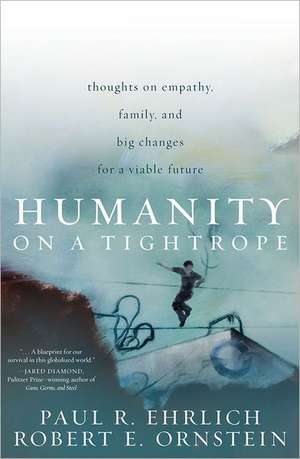
Humanity on a Tightrope: Thoughts on Empathy, Family, and Big Changes for a Viable Future
Autor Paul R. Ehrlich, Robert E. Ornsteinen Limba Engleză Paperback – 16 mar 2012
În peisajul academic actual, unde studiile despre globalizare și ecologie politică se intersectează tot mai des cu psihologia evoluționistă, Humanity on a Tightrope ocupă un loc strategic. Observăm o lucrare care nu se mulțumește doar să diagnosticheze crizele contemporane, ci analizează rădăcinile biologice și sociale ale comportamentului uman. Scrisă de Paul R. Ehrlich și Robert E. Ornstein, cartea propune o trecere de la loialitatea restrânsă a unității familiale tradiționale către o „familie globală” funcțională.
Suntem de părere că forța acestui volum rezidă în abordarea sa interdisciplinară. Autorii folosesc date din neuropsihologie și imagistică cerebrală pentru a explica de ce creierul uman este programat să favorizeze grupul propriu („noi”) în detrimentul străinilor („ei”). Structura este logică și progresivă: prima secțiune explorează evoluția empatiei și a valorilor familiale, în timp ce a doua parte oferă soluții practice pentru „schimbarea minții” și reducerea decalajelor culturale. Acoperă aceeași arie tematică ca One Planet One People de Carl Coon, dar cu o abordare mult mai ancorată în mecanismele neurologice și în biologia conservării.
În contextul operei lui Paul R. Ehrlich, acest titlu reprezintă o evoluție naturală. Dacă în lucrări precum The Dominant Animal autorul se concentra pe impactul umanității asupra mediului, aici, împreună cu Robert E. Ornstein, mută reflectorul pe „software-ul” intern care determină aceste acțiuni: empatia. Recomandăm această lectură ca pe un manual de echilibristică socială, esențial pentru înțelegerea modului în care cooperarea globală poate deveni un mecanism de supraviețuire biologică, nu doar un ideal politic.
Preț: 72.18 lei
Preț vechi: 122.06 lei
-41%
Carte disponibilă
Livrare economică 13-27 noiembrie
Specificații
ISBN-10: 1442206497
Pagini: 184
Dimensiuni: 138 x 220 x 14 mm
Greutate: 0.26 kg
Editura: Bloomsbury Publishing
Colecția Rowman & Littlefield
Locul publicării:New York, United States
De ce să citești această carte
Recomandăm această carte oricărui cititor interesat de sociologie, psihologie sau ecologie care dorește să înțeleagă de ce ne este atât de greu să cooperăm la scară mare. Veți câștiga o perspectivă clară asupra modului în care biologia noastră ne influențează deciziile sociale și veți descoperi argumente științifice solide pentru necesitatea unei empatii extinse. Este o lectură esențială pentru a înțelege „mecanismul” din spatele rasismului și al conflictelor globale, oferind totodată soluții pentru un viitor sustenabil.
Despre autor
Paul R. Ehrlich este profesor de studii ale populației la Universitatea Stanford și președinte al Centrului pentru Biologia Conservării. Autor de renume mondial, acesta a publicat peste 40 de cărți, fiind cunoscut pentru analizele sale privind impactul creșterii populației asupra resurselor planetei. Robert E. Ornstein a fost un psiholog influent, profesor la Stanford și președinte al Institute for the Study of Human Knowledge. Expert în neuropsihologie, Ornstein a publicat lucrări fundamentale despre natura minții umane, traduse în peste 20 de limbi. Împreună, cei doi combină rigoarea biologică cu înțelegerea profundă a conștiinței umane.
Descriere
Cuprins
2 Chapter 1 On a Tightrope
3 Chapter 2 Empathy, And "Us" Family Members versus "Them"
4 Chapter 3 The Seeds Of Family Values And How They Sprouted
5 Chapter 4 The Evolution of "Them"
6 Section 2 Changing Our Mind and Changing the World we Made
7 Chapter 5 The Neuropsychology Of Getting To "Us": The More Alike The More We Like
8 Chapter 6 It's All Us Now: Closing the Culture Gap and Building a Global Family
9 Chapter 7: The Beginnings of a New Stage in History
10 Chapter 8 Getting To "Alike" One Another
11 Chapter 9 Revitalizing Religious Empathy and Staying on the Tightrope
12 Appendix Going Further: Reading, Informing, Acting
13 Bibliography
14 Acknowledgments
Recenzii
Ehrlich, the author of numerous influential environmental books, and award-winning psychologist Ornstein address the need for empathy to maintain the health of civilization. While drawing on a long line of psychological experiments to show the inherent development of family ties and persistent 'us vs. them' mentality in human society, the authors also examine the development of the perfect Leave It To Beaver family stereotype and its enduring impact that has extended far beyond pop culture. A focus on family values that never actually existed, this has created a myth that justifies the concept of a different 'them' that thwarts attempts at transcending differences. With stark examples such as Rwanda to serve as warnings, Ehrlich and Ornstein segue into chapters on 'building the global family.' While political watchers may find it impossible to believe we could ever see beyond the smallest of differences, the authors remain hopeful and offer plenty of evidence that change will come, simply because the twenty-first century requires it. Thoughtful and sincere, this is a solid evidentiary presentation of an all-too-often emotional topic.
A rich book that delves into the root of the world's most pressing problems: the lack of empathy in mankind. The whole book revolves around this central idea of how we human beings as a whole global family should develop more empathy toward each other to ensure a sustainable future....Ehrlich and Ornstein expose readers to some mind-blowing aspects of cultures in the hidden corners of the world....With a smart pun of humanity teetering on the tightrope just as the tightrope performer, Ehrlich and Ornstein showcase their beliefs in the super-power of empathy - that it can save humanity and save the world we live in.
The authors' hearts are in the right place with this earnest plea to all mankind to develop empathy and embrace the interdependency that connects us all. Ehrlich (The Population Bomb) and Ornstein (The Healing Brain) argue that human behavior is the biggest threat to our collective future and strongly suggest we create less "us" vs. "them" binaries. From environmental conservation to ending consumerism to the pervasive ignorance that feeds xenophobia, they approach their focus through the lenses of anthropology, neuropsychology, and history.
With their intriguing analogy of the tightrope walker, authors Ehrlich and Ornstein draw readers into their compelling argument for redefining our notions of family and community. That walker, the authors say, is the human race, the rope the many global crises confronting us, and that perilous journey our own progress towards an uncertain future. And what the world sorely needs to navigate that perilous rope is empathy, specifically that of its more privileged nations.
Humanity on a Tightrope reads like an engaging after-dinner conversation between two old friends. Ehrlich tackles global issues with the ease and sometimes bluster of someone who has been on a soapbox for more than four decades. Ornstein brings insights from psychology.
What the book offers is an "adult conversation" about sustainability..Humanity on a Tightrope leaves no stone unturned, touching on religion, politics, wealth imbalance and the class-driven status quo.
[I]t is the Appendix, Notes and Selected Bibliography which may prolong the thought and then sharpen it for wider, individual effort. This is the evident purpose of the authors. . . .Any such attempt is valuable.
These guys, not for the first time, have cut to the heart of the problem we face. And do not for a moment think it can't be done. Last year at 350.org we organized 5,200 simultaneous rallies in 181 countries to demand scientific action on climate change-we can work globally, but we've got to think through precisely the problems outlined here.
How do we know who is a relative? If you're a rat, it's easy-there's instinctual recognition by smell. But it's hard for humans, because amid us figuring it out rationally, a sludge of emotions helps determine who feels like an Us and who like a Them. In this superb book, Ehrlich and Ornstein explore the evolutionary biology, brain science, anthropology and psychology of how a Them can become an Us, how we can expand our sense of empathy, family and relatedness. But the book is more than merely a masterful and readable review of the subject. It is also a clarion call about what will happen if we don't get better at turning Them's into Us's. This is a deeply important book.
The weighty question of whether a truly unified human family is possible deserves an equally weighty analysis. Thank goodness, then, for this profoundly important book.
In this compact, thought-provoking book, well-known authors Paul Ehrlich and Robert Ornstein have collaborated to lay out a blueprint for our survival in this globalized world. We got away with attitudes of 'us vs. them' in the past; we can no longer get away with those attitudes today.