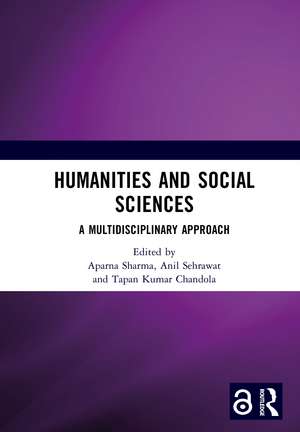
Humanities and Social Sciences: A Multidisciplinary Approach
Editat de Aparna Sharma, Anil Sehrawat, Tapan Kumar Chandolaen Limba Engleză Hardback – 31 mar 2026
The book delves into various themes of Indian Knowledge System, Global Relations, Governance, Policy, and Political Dynamics, Geographical Innovations, Revisiting Indian History and Culture, Contemporary Sociological Imagination, Dialogues in Literature and Literary Discourse, Communication and Language Studies, Contemporary Issues in Mental Health and Well-being, Law, Gender, Human Rights and Teacher Education. With a special emphasis on historical and cultural developments, it provides a comprehensive understanding of society, economy, human behaviour and policy in the modern world through novel academic perspectives.
This volume serves as a valuable resource for academicians, researchers and students in the field of humanities and social sciences. It also addresses concerns of policymakers, educators, civil society members, and professionals working in NGOs, governance, law, business, media, and environmental advocacy.
The Open Access version of this book, available at http://www.taylorfrancis.com, has been made available under a Creative Commons [Attribution-Non Commercial-No Derivatives (CC BY-NC-ND)] 4.0 license.
Preț: 1431.52 lei
Preț vechi: 1904.90 lei
-25% Nou
Puncte Express: 2147
Carte indisponibilă temporar
Doresc să fiu notificat când acest titlu va fi disponibil:
Se trimite...
Specificații
ISBN-13: 9781041299257
ISBN-10: 1041299257
Pagini: 962
Dimensiuni: 174 x 246 mm
Greutate: 1.94 kg
Ediția:1
Editura: CRC Press
Colecția Routledge
ISBN-10: 1041299257
Pagini: 962
Dimensiuni: 174 x 246 mm
Greutate: 1.94 kg
Ediția:1
Editura: CRC Press
Colecția Routledge
Public țintă
Academic and GeneralNotă biografică
Aparna Sharma is Director & Dean, School of Liberal Arts, Noida International University, Gr. Noida. She is an Academic leader and Life Skills coach with more than two decades of classroom teaching and academic administration. She has served reputed organizations in her academic journey. A Doctorate, with four Postgraduate and two Graduate degrees, complement her qualifications. Four Ph.D. have been awarded under her guidance. She has fifty plus presentations, more than forty publications, seven edited books to her credit. She has authored four books including two poetry books (in English and Hindi). Her research revolves around English Literature, Indian History, Management, Gender Studies, Law and Interdisciplinary areas.
Anil Sehrawat is Deputy Director, Amity Institute of Corporate Communications, Amity University Uttar Pradesh, Noida. He is a distinguished academician and researcher with over more than two decades of experience in teaching, academic leadership, and research. Holding dual PhDs in English and Education, along with advanced degrees in English, Education, and Human Resource Management, he specializes in English as a Second Language, Communication Skills, and Emotional Intelligence. To his credit, as an author, there are eight books, over 40 research papers, and 45 presentations at national and international conferences. He is a seasoned trainer, and has conducted workshops on communication, leadership, emotional intelligence etc. for universities and corporate organizations.
Tapan Kumar Chandola is Professor and Dean, Amity Law School, Amity University, Lucknow. He holds LL.B., LL.M., LL.D. degrees, with over twenty-four years of combined experience in academia and industry, he has made significant contributions to legal education and research. He has published more than fifty research papers and articles in reputed national and international journals, including Scopus and Thomson Reuters indexed publications, along with several book chapters. He is the author of four books and has guided Ph.D. and LL.M dissertations. His expertise spans across various fields of law. He is also the editor and advisor of many reputed national and international journals of various national and state universities and publication houses.
Anil Sehrawat is Deputy Director, Amity Institute of Corporate Communications, Amity University Uttar Pradesh, Noida. He is a distinguished academician and researcher with over more than two decades of experience in teaching, academic leadership, and research. Holding dual PhDs in English and Education, along with advanced degrees in English, Education, and Human Resource Management, he specializes in English as a Second Language, Communication Skills, and Emotional Intelligence. To his credit, as an author, there are eight books, over 40 research papers, and 45 presentations at national and international conferences. He is a seasoned trainer, and has conducted workshops on communication, leadership, emotional intelligence etc. for universities and corporate organizations.
Tapan Kumar Chandola is Professor and Dean, Amity Law School, Amity University, Lucknow. He holds LL.B., LL.M., LL.D. degrees, with over twenty-four years of combined experience in academia and industry, he has made significant contributions to legal education and research. He has published more than fifty research papers and articles in reputed national and international journals, including Scopus and Thomson Reuters indexed publications, along with several book chapters. He is the author of four books and has guided Ph.D. and LL.M dissertations. His expertise spans across various fields of law. He is also the editor and advisor of many reputed national and international journals of various national and state universities and publication houses.
Cuprins
Ancient wisdom, modern glow: Rasa Ratnakar and the evolution of Indian beauty practices; Ecological wisdom in Jain Dharma: Ancient environmental ethics for contemporary sustainability challenges; Traditional ecological knowledge and climate adaptation: Quantifying indigenous forest management practices in the Nilgiris biosphere reserve; Indigenous maritime weather prediction: A decolonial analysis of Koli knowledge systems in Mumbai (1800–present); Cultural memory and scientific achievement: The legacy of Mahrauli Iron Pillar in the Indian knowledge traditions; Hatha Yoga in Indian knowledge system; Bodhisattva Avalokiteśvara: Guardian of traders’ paths (with special reference to China); Critically analyzing the studies of William Jones on Indian gods and goddesses; An analysis into the consequences of Hindutva historical revisionism on domain of historical memory in India in the 21st century; From tragedy to tourism: Understanding dark tourism through bibliometrics; Religious tradition in the lost city of Dwarka; Food and Assamese folklore: A study on the folk stories of Lakshminath Bezbarua’s Burhi Aair Sadhu; Terrorism and India-Pakistan relations: An international relations perspective; Democracy of opinions: Analysing the role of narratives in Indian electoral practices; India and BIMSTEC: A foreign policy perspective; Post-pandemic shift in urban mobility patterns in India: Long-term implications for transport planning and infrastructure investment; Decentralisation and local governance; Need for a shift from passive dissent to active dissent: A study of voter apathy in India; Interim government in Bangladesh: A way forward; Homegrown terrorism and the crisis of multiculturalism in Britain: Navigating identity, loyalty, and belonging; Balancing privacy and practicality in the age of technology: A comparative analysis of the EU general data protection regulation and India’s digital personal data protection act; Assimilation vs. pragmatism: Divergent paths of immigration policy in Spain and France; A comparative study of SAARC and the EU on regional cooperation for sustainable development; Regionalism vs globalism: Competing visions of international order; Trade war between US and China: Implications for India; Analyzing the role of the United Nations in preventing conflicts in a globalized world; Food conflict and the limits of global action; India’s economic diplomacy against China’s belt and road initiative; Analysing the role of energy security in the politics of the gulf states; Understanding the dynamics of the policy approaches of Donald Trump and its impact on India; India’s diplomatic hedging in the Bangladesh crisis; Memory, myth, and manuscripts: Literary trauma and the Indian knowledge system in historical perspective; Trauma discourse on Reddit: A linguistic pattern analysis via Voyant tools; Unveiling the unheard voices of Dalit feminist resistance in Sujatha Gidla’s Ants Among Elephants; Moral development and environmental consciousness among young readers: A descriptive study of Ruskin Bond’s children’s fiction; E.M. Forster’s misleading writings on Hinduism: The curious case of Devi; An exploration of unveiling harsh reality in Nayantara Sahgal’s This Time of Morning; Unleashing Gaia’s wrath: Phantasmagorical reckonings in Claire Buss’s The Gaia Project; Locating the influence of physical and psychological spaces in the play The Iceman Cometh by Eugene O’Neill; Assessment of Anita Desai’s Cry, the Peacock and Where Shall We Go This Summer?; Fear as an aesthetic in Manipuri folklore: A cultural and philosophical exploration of folktales and rituals; The forest, the palace, and the sky: A study of emotional cartography in Manipuri folktales; Themes of mental trauma, isolation and abandonment in Chitra Banerjee’s The Palace of Illusions; Invisible wounds, visible scars: The mental and familial breakdown in Shanta Gokhale’s play, Avinash; Literature in harmony with nature: Kalidasa’s environmental consciousness in his Meghadutam and Abhijnanashakuntalam; Inner turmoil: Lugubrious but absolved in Anita Desai’s Fire on the Mountain; Depiction of cultural domination in the marriage system in Vikram Seth’s A Suitable Boy; Haunted by silence: Repressed memory and the shape of narrative; Amalgamation of technical and narrative devices in The Shadow Lines: Glancing into the sanctity of nationalism and postcolonial aftermaths; Unveiling marginalization and marital dynamics: A study of Karna’s plight through the lens of Karna’s Wife: The Outcast’s Queen; The Francophone writers at the crossroads: Between exclusion and recognition in the French literary field; Class-coded nonverbal depiction of the lower-class in Indian visual media: Analysis of selected films and series; Developing writing coherence through iterative feedback: A longitudinal study of upper primary ESL students in Indian multilingual classrooms; Redefining aging through lifelong learning and upskilling: A sociological analysis; Nepali folk songs as the voice of the subaltern: A critical study; Linking household demographics, socio-economic factors, and hygiene behavior to drinking water safety and sanitation in Dhaka slums; The role of autobiographical writing as a means of empowerment and activism for transgender communities; Revisiting woman at the crossroads of partition: A case study; A look into decency and morality issues through a feminist lens: With special reference to stand-up comedy in India; Mutilated breasts and the politics of femininity in Margaret Atwood’s Bodily Harm; Feminine perspective in Odia folklore: The story of Tapoi; Advancing gender equality and women’s empowerment: A study of international norms and frameworks; Perceived discrimination and self-concept in transgenders: Exploring the casual link; Representation of transgender roles in modern Indian cinema: A breakthrough from stereotypes to authenticity; Women in public administration in early India; Rajput pride and Mughal harmony: The evolution of Jodha’s image in Hindi cinema; Gendering culture: The praxis of encoding, decoding the traditional Manipuri theatrical performance Pashakela; Ineffectiveness of anti-witch hunting laws in India: A critical analysis; Bidirectional relationship between societal norms and advertising in shaping gender perceptions in Indian children: A bibliometric analysis; Excusing violence: Rethinking provocation and gender in post-British legal systems; Workplace discrimination against transgender persons in India: Evaluating legal remedies and enforcement; Beyond the alpha: Reimagining Shiva’s masculinity in Amish Tripathi’s Shiva Trilogy; A study on women’s mobility and public harassment in Bangladesh: Barriers on the move; Role of social media in raising awareness and shaping social behavior: To mitigate traditional menstrual practices (Chhaupadi) among women in Far-Western Nepal; Mothers, madness, and memory: A feminist reading of intergenerational trauma in Sue Monk Kidd’s The Mermaid Chair; The politics of representation: Pattachitrakatha, visual culture and nationalism construction of identity of Indian women; Tess of the D’Urbervilles: A tragic symbol of social injustice and gender inequality; Negotiating patriarchy through performance: A gendered analysis of Sohar songs among Magahi women in Bihar; Between voice and silence: Feminist portrayals of modern Indian women in postcolonial literature; Gender and caste connotations of honour killing: A study; Queering the Bildungsroman: A journey from innocence to self-acceptance in Shyam Selvadurai’s Funny Boy; Digitized intimacies: Femtech, data extraction, and reproductive rights in Indian urbanity; Black mirrors of self-esteem: A review of smartphone addiction and its effect on self-esteem among Indian college students; The influence of locus of control on clothing preference indicators among young adults in Delhi-NCR; Mental health discourse on Instagram: A content analysis of Indian origin social media influencers; Restorative benefits of campus landscapes in a semi-arid Indian university; Exploring the relationship between nomophobia and psychological distress in Indian young adults; Sensitivity towards women difficulties: Awareness and effectiveness of women empowerment in India; Balancing innovation and ethics: Generative AI’s role in the future of education; Evolving government initiatives in children protection: Impact of Covid-19 and the road to sustainability; Construction and standardization of parenting style scale; "Role of AI in achieving divergent thinking" among school students: A theoretical perspective; STEM meets STEAM: Training B.Ed. students in arts-integrated pedagogies for transformative learning; Dalit oppression and exclusion on educational campus: A postcolonial study of the story "Shodh Prabandh"; Vocational education and sustainability: NEP 2020 role in shaping environmentally conscious careers; Diversity, equity, and inclusion in educational institutions; The dual burden of inflation and healthcare expenditure: Examining financial strain on families below the poverty line through updated socioeconomic scales in India; Multilingualism: An intercultural competence for a science classroom; Transforming education: The promise and pitfalls of AI-driven personalized learning; Adapting to crisis: Understanding climate vulnerability in Delhi’s informal settlements; Artificial intelligence and electronic waste management in Uttarakhand: An analysis; Urban India’s water supply woes: A review of policies and provisioning; Online gaming and legal challenges in India; Validity of electronic contracts in Indian landscape; Artificial intelligence and criminal justice: Challenges to due process and legal accountability in India; AI and forensics: Challenges in the criminal justice system; Medical malpractice and exigency of codified law in Bangladesh: A study on the attitudes of general people; Constitution of India governing hate speech; Unveiling the margins: Analyzing the social impacts of exclusionary categories in the Surrogacy Act of 2021; Enhancing rehabilitation for prisoners: The effect of mental health interventions on violence reduction and positive outcomes in India; From suppression to expression: Is the sedition era truly over?; Digital justice and the future of family courts: The role of AI in transforming access to justice in India; Justice beyond the courtroom: Rethinking India’s Indigenous paths to social equity; Surveillance, bias, and justice: Ethical implications of predictive policing in India and the United States; Workable solutions for speedy justice, legal reforms and social equity; The role of judicial discretion in bail decisions: Balancing individual rights and public interest; India’s residential property market 2024: A comparative analysis of growth, demand dynamics, and regional disparities; Punishing poverty: The economic disparity of the poor in the criminal justice system; Delegated legislation and doctrine of excessive delegation: A critical analysis with special reference to India and the U.K.; AI-powered judiciary: National and international perspectives on machine learning in court administration; Paradigms of data protection laws in the era of artificial intelligence; AI in personalizing OTT experiences: Its impact on millennials viewing habits and preferences; Influence of social media usage on learning effectiveness and career growth: Study the mediating role of socialization, externalization, combination and internalization; Reconstructing sanity: Multidisciplinary perspectives on mental health policy and practice in India; Social media impact and perception towards religious communication with reference to SAARC countries; Review of false information, deception, and misinformation on social networks; Assessing the role of digital media in promoting collaborative learning among secondary school students in the Noida region; The economics of sexism: How box office success reinforces gender stereotypes in Bollywood filmmaking; Indian green bonds: A qualitative analysis of reporting frameworks, allocation, and impact disclosures; Patentability of AI-generated inventions; From thrift to trend: Exploring thrifting behaviour through the S-O-R framework; The rise of cashless transactions: Evaluating digital payment platform using UTAUT2; Emotion-aware image captioning using BLIP-2 and DeepFace integration; Organisational culture as an instrument of strategic changes implementation; Metadiscourse in law and sciences students’ spontaneous texts; Mapping the research landscape of CSR and sustainable development: Insights from a bibliometric study; Mapping the impact of artificial intelligence on the digital economy: A bibliometric approach
Descriere
This compilation of original, peer-reviewed papers takes a multidisciplinary approach to address a diverse range of topics in the humanities and social sciences. It explores traditional knowledge systems and their relevance to sustainable development, leadership, health, and ethics.