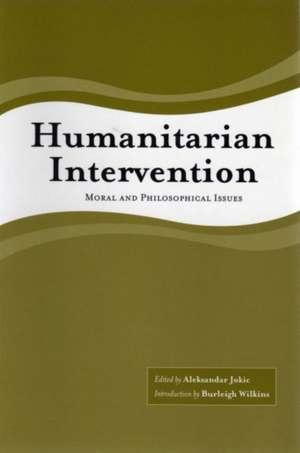
Humanitarian Intervention: Moral and Philosophical Issues
Editat de Aleksandar Jokic Introducere de Burleigh Wilkinsen Limba Engleză Paperback – 21 feb 2003
The focus of the volume is on the abstract principles involved; though reference is sometimes made to specific cases, the essays here consist primarily of philosophical reflection on the abstract issues. (A companion volume on the specific issues surrounding a particular case, Lessons of Kosovo, is being published simultaneously.)
Preț: 332.12 lei
Preț vechi: 408.55 lei
-19%
Puncte Express: 498
Carte disponibilă
Livrare economică 16-30 noiembrie
Livrare express 30 octombrie-05 noiembrie pentru 105.76 lei
Livrare prin curier în România Termenul estimat este afișat lângă disponibilitate.
Transport gratuit de la 400.00 lei Plată online sau ramburs, în funcție de opțiunile comenzii.
Retur gratuit în 14 zile Comandă securizată și suport în română.
Specificații
ISBN-13: 9781551114897
ISBN-10: 1551114895
Pagini: 160
Dimensiuni: 152 x 229 x 10 mm
Greutate: 0.28 kg
Editura: BROADVIEW PR
Colecția Broadview Press
Locul publicării:Peterborough, Canada
ISBN-10: 1551114895
Pagini: 160
Dimensiuni: 152 x 229 x 10 mm
Greutate: 0.28 kg
Editura: BROADVIEW PR
Colecția Broadview Press
Locul publicării:Peterborough, Canada
V-ar putea interesa
-
 The Case for Working with Your HandsMatthew CrawfordPreț: 86.35 lei
 -
 -12%Preț: 271.82 lei308.51 lei
 -
 Consciousness: New Philosophical PerspectivesQuentin Smith-26%Preț: 365.68 lei495.50 lei
 -
 -20%Preț: 315.75 lei393.04 lei
 -
 Oxford Studies in Philosophy of Law: Volume 2Leslie Green-20%Preț: 432.02 lei541.46 lei
 -
 Debating Same-Sex MarriageJohn Corvino-15%Preț: 177.71 lei209.36 lei
 -
 Born Free and Equal?: A Philosophical Inquiry into the Nature of DiscriminationKasper Lippert-Rasmussen-31%Preț: 679.72 lei984.98 lei
 -
 Preț: 445.45 lei
 -
 You Must Change Your LifePeter SloterdijkPreț: 188.70 lei
 -
 The Wellness SyndromeAndre SpicerPreț: 138.07 lei
 -
 States of ShockBernard StieglerPreț: 228.70 lei
 -
 Global Crises and the Crisis of Global LeadershipStephen GillPreț: 289.63 lei
 -
 This Is Political PhilosophyAlex TucknessPreț: 314.72 lei
 -
 Philosophy of Law: Introducing JurisprudenceProfessor Jeffrey Brand-25%Preț: 201.31 lei266.98 lei
 -
 Free WillSam Harris-20%Preț: 51.46 lei64.02 lei
 -
 Lessons of Kosovo: The Dangers of Humanitarian InterventionAleksandar Jokic-11%Preț: 333.03 lei372.26 lei
 -
 Leviathan, Parts I and II - Revised EditionThomas Hobbes-13%Preț: 138.03 lei157.92 lei
 -
 The Second Treatise of Civil GovernmentJohn Locke-17%Preț: 78.22 lei94.21 lei
 -
 The Making of the Indebted ManMaurizio Lazzarato-16%Preț: 80.00 lei95.45 lei
 -
 The Political Discourse of Carl Schmitt: A Mystic of OrderMontserrat Herrero-24%Preț: 367.22 lei483.79 lei
Recenzii
International law makes it explicit that states shall not intervene militarily or otherwise in the affairs of other states; it is a central principle of the charter of the United Nations. But international law also provides an exception; when a conflict within a state poses a threat to international peace, military intervention by the UN may be warranted. (Indeed, the UN Charter provides for an international police force, though nothing has ever come of this provision). The Charter and other UN documents also assert that human rights are to be protected—but in the past the responsibility for the protection of human rights has for the most part been allowed to rest on the government of the state where the violation of rights occurs. Not surprisingly in this context, the question of what protection (if any) should be provided by the UN or otherwise to individuals when their human rights are violated by their governments or with the complicity of their governments remains a contentious issue. Should the principle of respect for state sovereignty trump the principle of respect for human rights? Historically it has been allowed to do so, but recently it has been more and more widely argued that when states fail to respect the human rights of their citizens (or of others who reside within their boundaries), they may be held accountable for their actions. Is military humanitarian intervention justifiable? And if so, under what circumstances? Those are the questions addressed in this collection of essays.
The focus of the volume is on the abstract principles involved; though reference is sometimes made to specific cases, the essays here consist primarily of philosophical reflection on the abstract issues. (A companion volume on the specific issues surrounding a particular case, Lessons of Kosovo, is being published simultaneously.)
The focus of the volume is on the abstract principles involved; though reference is sometimes made to specific cases, the essays here consist primarily of philosophical reflection on the abstract issues. (A companion volume on the specific issues surrounding a particular case, Lessons of Kosovo, is being published simultaneously.)
Cuprins
Preface, Aleksandar Jokic
Introduction, Burleigh Wilkins
1 War, Revolution, and Humanitarian Intervention, Anthony Ellis
2 Humanitarian Intervention: Some Doubts, Burleigh Wilkins
3 Foreign Armed Intervention: Between Justified Aid and Illegal Violence, Jovan Babic
4 Humanitarian Intervention and Moral Theory, Michael Philips
5 Preempting Humanitarian Interventions, Thomas Pogge
6 Humanitarian Intervention and International Law, Alfred P. Rubin
7 From Nuremberg to Kosovo: The Morality of Illegal International Legal Reform, Allen Buchanan
Contributors
Introduction, Burleigh Wilkins
1 War, Revolution, and Humanitarian Intervention, Anthony Ellis
2 Humanitarian Intervention: Some Doubts, Burleigh Wilkins
3 Foreign Armed Intervention: Between Justified Aid and Illegal Violence, Jovan Babic
4 Humanitarian Intervention and Moral Theory, Michael Philips
5 Preempting Humanitarian Interventions, Thomas Pogge
6 Humanitarian Intervention and International Law, Alfred P. Rubin
7 From Nuremberg to Kosovo: The Morality of Illegal International Legal Reform, Allen Buchanan
Contributors