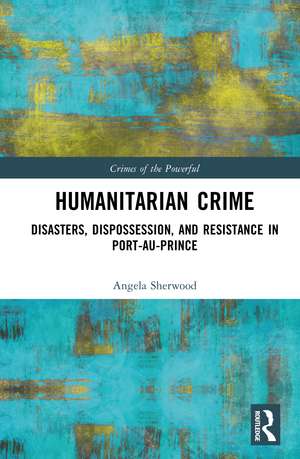
Humanitarian Crime: Disasters, Dispossession, and Resistance in Port-au-Prince: Crimes of the Powerful
Autor Angela Sherwooden Limba Engleză Hardback – 2 iun 2026
Focusing on post‑earthquake Haiti, a setting marked by large‑scale international involvement and deep historical and colonial inequalities, this book examines how humanitarian organisations helped shape the city’s post‑disaster
landscape. It shows how humanitarian actors, working alongside the Haitian state, contributed to the reproduction of homelessness, landlessness, and urban exclusion through their management of displacement camps, their
reliance on property‑based models of assistance, and their role in coercive programmes of camp closure.
Drawing on extensive fieldwork, interviews, and archival research, this book develops the concept of humanitarian crime to illuminate the state processes, institutional arrangements, and material structures that underpin violent
outcomes in humanitarian settings. At the same time, it centres the voices of Haitian civil society and affected communities, highlighting how those subjected to state–humanitarian expulsions interpret, contest, and resist the
harms inflicted through humanitarian governance. It foregrounds land occupations and informal urbanisation as key forms of resistance that expose and challenge the dispossession inscribed within the everyday workings of
humanitarian intervention.
By situating humanitarianism within wider relations of sovereignty, accumulation, and control, this book opens new pathways for studying humanitarian power and its role within contemporary global violence. It
also establishes a research agenda for understanding humanitarian crime and for examining how contemporary crises, not least increasingly frequent climate disasters, are being governed in ways that only deepen precarity and dispossession.
This book is essential reading for all those engaged in work on crimes of the powerful, disaster recovery, state and corporate crime, and Caribbean Studies.
Din seria Crimes of the Powerful
-
 Preț: 395.00 lei
 -
 Preț: 446.30 lei
 -
 Preț: 435.82 lei
 -
 Preț: 469.26 lei
 -
 Preț: 445.02 lei
 -
 Preț: 423.33 lei
 -
 Preț: 438.12 lei
 -
 Preț: 424.32 lei
 -
 Preț: 436.97 lei
 -
 Preț: 418.66 lei
 -
 Preț: 239.65 lei
 -
 Preț: 406.47 lei
 -
 Preț: 438.73 lei
 -
 Preț: 439.05 lei
 -
 Preț: 217.20 lei
 -
 Preț: 401.22 lei
 -
 Preț: 354.63 lei
 -
 Preț: 381.17 lei
 - 18%
 Preț: 1115.87 lei
 - 18%
 Preț: 1311.72 lei
 - nou
 Preț: 439.19 lei
Preț: 1307.48 lei
Preț vechi: 1594.48 lei
-18%
Puncte Express: 1961
Carte tipărită la comandă
Livrare economică 20 noiembrie-04 decembrie
Livrare prin curier în România Termenul estimat este afișat lângă disponibilitate.
Transport gratuit pentru acest produs Plată online sau ramburs, în funcție de opțiunile comenzii.
Retur gratuit în 14 zile Comandă securizată și suport în română.
Specificații
ISBN-13: 9781032750736
ISBN-10: 1032750731
Pagini: 192
Dimensiuni: 156 x 234 mm
Greutate: 0.45 kg
Ediția:1
Editura: Taylor & Francis
Colecția Routledge
Seria Crimes of the Powerful
Locul publicării:Oxford, United Kingdom
ISBN-10: 1032750731
Pagini: 192
Dimensiuni: 156 x 234 mm
Greutate: 0.45 kg
Ediția:1
Editura: Taylor & Francis
Colecția Routledge
Seria Crimes of the Powerful
Locul publicării:Oxford, United Kingdom
Public țintă
Postgraduate and Undergraduate AdvancedNotă biografică
Angela Sherwood is a Lecturer in Climate Justice at Queen Mary University of London (QMUL) and Co-Director of the QMUL Centre for Climate Crime and Climate Justice. She is also an Executive Board Member of the International State Crime Initiative (ISCI).
Cuprins
1. Humanitarian Crime: An Introduction 2. Humanitarianism in Crimes of the Powerful Research 3. Port-au-Prince and The Making of a Violent Urban Order 4. Governing the “Ungovernable” City: Humanitarianism and Managing Urban Crisis 5. Forced Evictions and Campicide as State–Humanitarian Crime 6. Exposing Humanitarian Crimes of Dispossession 7. Camp Afterlives and Humanitarian Denial 8. Concluding Reflections
Recenzii
Humanitarian Crime advances a rigorous theorisation of the structural harms produced by humanitarian interventions. Centring post-earthquake Haiti as the epicentre of imperial governance, Angela Sherwood conceptualises humanitarian crime to elucidate how Global North aid regimes perpetuate colonial plunder, racialised legality, and neoliberal dispossession. These interlocking forces, Sherwood demonstrates, actively produce the very disastrous conditions that subordinate Global South societies to post-disaster humanitarian intervention. This groundbreaking book expands the crimes of the powerful scholarship by revealing the criminogenic entanglements of humanitarianism, state, and colonial power.
Jose Atiles, Associate Professor in the Department of Sociology at the University of Illinois at Urbana- Champaign.
In this brilliant and searing analysis of humanitarian crime in Haiti, Angela Sherwood has effectively developed a new field of criminological enquiry. As humanitarian organisations increasingly assume the corporate form and align themselves with state organisational goals that ultimately conflict with their own, sometimes dubious, ethical protocols, the possibility of engaging in human rights violations against the very populations they exist to protect is heightened. By investigating how both the state and humanitarian organisations treated the landless and displaced after Haiti’s earthquake, Sherwood uncovers, in compelling detail, the structural conditions and institutional practices that both enable organisational deviance and embed humanitarianism within a broader system of criminogenic power.
Penny Green, Professor of Law and Globalisation at Queen Mary University of London, Director of the International State Crime Initiative (ISCI)
This is a powerful book that interrogates the aftermath of the Haitian earthquake in 2010. Angela Sherwood deploys a critical criminological and socio-legal perspective to reveal violent and harmful systems of administration and power relations, orchestrated by the state-humanitarian nexus. Angela conclusively shows how the closure of humanitarian camps as a marker of successful reconstruction, was in fact a violent form of administering further displacement, or of ‘disappearing the earthquake displaced’. But running parallel to dispossession is resistance and power. Angela reveals a counterhegemonic form of reconstruction, where previously displaced communities reclaim land, build a home and reject the norms of private property. This is an urgent book with a unique vantage point, and from which we can interrogate the destruction and reconstruction of other vulnerable geographical landscapes now and in the future.
Victoria Cooper, Senior Lecturer in Criminology and Social Policy at the Open University
Jose Atiles, Associate Professor in the Department of Sociology at the University of Illinois at Urbana- Champaign.
In this brilliant and searing analysis of humanitarian crime in Haiti, Angela Sherwood has effectively developed a new field of criminological enquiry. As humanitarian organisations increasingly assume the corporate form and align themselves with state organisational goals that ultimately conflict with their own, sometimes dubious, ethical protocols, the possibility of engaging in human rights violations against the very populations they exist to protect is heightened. By investigating how both the state and humanitarian organisations treated the landless and displaced after Haiti’s earthquake, Sherwood uncovers, in compelling detail, the structural conditions and institutional practices that both enable organisational deviance and embed humanitarianism within a broader system of criminogenic power.
Penny Green, Professor of Law and Globalisation at Queen Mary University of London, Director of the International State Crime Initiative (ISCI)
This is a powerful book that interrogates the aftermath of the Haitian earthquake in 2010. Angela Sherwood deploys a critical criminological and socio-legal perspective to reveal violent and harmful systems of administration and power relations, orchestrated by the state-humanitarian nexus. Angela conclusively shows how the closure of humanitarian camps as a marker of successful reconstruction, was in fact a violent form of administering further displacement, or of ‘disappearing the earthquake displaced’. But running parallel to dispossession is resistance and power. Angela reveals a counterhegemonic form of reconstruction, where previously displaced communities reclaim land, build a home and reject the norms of private property. This is an urgent book with a unique vantage point, and from which we can interrogate the destruction and reconstruction of other vulnerable geographical landscapes now and in the future.
Victoria Cooper, Senior Lecturer in Criminology and Social Policy at the Open University
Descriere
This is the first book to theorise humanitarian power within the crimes of the powerful tradition, offering a compelling account of the structural forces embedded in humanitarian institutions, and the practices and forms of legitimation through which the violent effects of humanitarian intervention are typically produced and obscured.