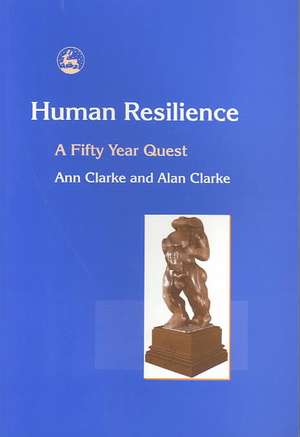
Human Resilience: A Fifty Year Quest
Autor Alan Clarke, Ann Clarke Contribuţii de Barbara Tizarden Limba Engleză Paperback – 18 iun 2003
The emerging importance of resilience as a fundamental human characteristic makes this book of great significance to psychologists, social workers and students. Anyone working with disadvantaged children and those with learning disabilities will be interested in Human Resilience's practical implications: how resilience can be improved both by personal characteristics such as self-esteem, problem-solving ability or sociability, interacting with external support.
Preț: 460.84 lei
Preț vechi: 648.67 lei
-29%
Puncte Express: 691
Carte disponibilă
Livrare economică 12-26 noiembrie
Livrare prin curier în România Termenul estimat este afișat lângă disponibilitate.
Transport gratuit pentru acest produs Plată online sau ramburs, în funcție de opțiunile comenzii.
Retur gratuit în 14 zile Comandă securizată și suport în română.
Specificații
ISBN-13: 9781843101390
ISBN-10: 1843101394
Pagini: 432
Dimensiuni: 150 x 230 x 25 mm
Greutate: 0.66 kg
Editura: JESSICA KINGSLEY PUBLISHERS
Colecția Jessica Kingsley Publishers
Locul publicării:London, United Kingdom
ISBN-10: 1843101394
Pagini: 432
Dimensiuni: 150 x 230 x 25 mm
Greutate: 0.66 kg
Editura: JESSICA KINGSLEY PUBLISHERS
Colecția Jessica Kingsley Publishers
Locul publicării:London, United Kingdom
V-ar putea interesa
-
 Evaluation ResearchAlan Clarke-18%Preț: 693.84 lei846.14 lei
 -
 -24%Preț: 197.68 lei258.81 lei
 -
 -20%Preț: 153.56 lei192.35 lei
 -
![Exploring Depression, and Beating the Blues: A CBT Self-Help Guide to Understanding and Coping with Depression in Asperger's Syndrome [ASD-Level 1]](https://i2.books-express.ro/bt/9781849055024/exploring-depression-and-beating-the-blues.jpg) -23%Preț: 122.00 lei158.19 lei
-23%Preț: 122.00 lei158.19 lei -
 Music Therapy with Families: Therapeutic Approaches and Theoretical PerspectivesStine Lindahl Jacobsen-27%Preț: 239.07 lei329.39 lei
 -
 -28%Preț: 198.27 lei276.07 lei
 -
 -20%Preț: 116.44 lei145.32 lei
 -
 -29%Preț: 207.39 lei290.68 lei
 -
 Mindfulness and the Arts Therapies: Theory and PracticeJared D. Kass-28%Preț: 213.73 lei296.67 lei
 -
 NETTERs GynäkologieFrank H. Netter-5%Preț: 229.63 lei241.71 lei
Recenzii
Few can match the contribution these scientists have made to the field of intellectual disability and to the broader field of the psychology of human development… Human Resilience contains a selection of 18 articles and chapters previously published jointly or individually by the authors over a period spanning the years 1953-2000. These published papers have been complemented by three new chapters and introductory commentaries… This book is an inspiration to those that follow in the footsteps of these two intellectual giants. They have, as Barbara Tizard reports, made the world a better place, especially for people with intellectual disabilities'.
`This book is for the concerned sceptic, for those who see the potential of and question the ability of major interventions in children's lives, such as adoption, and in so doing wonder about the mechanisms by which alteration in life's pathways come about'
`An excellent treatment of methodological concepts such as `the sleeper effect, the `regression to the mean' and the use of correlations help to elucidate issues in the field that are commonly misunderstood or misapplied.'
`Clarke and Clarke have been the pioneers of a systematic study of human resilence since the early1950's, and their work undoubtedly shaped the history of developmental psychology in this country…if you work as a developmental psychologist or you are interested in the nature-nurture debate, I would suggest you read this book.'
`This book is for the concerned sceptic, for those who see the potential of and question the ability of major interventions in children's lives, such as adoption, and in so doing wonder about the mechanisms by which alteration in life's pathways come about'
`An excellent treatment of methodological concepts such as `the sleeper effect, the `regression to the mean' and the use of correlations help to elucidate issues in the field that are commonly misunderstood or misapplied.'
`Clarke and Clarke have been the pioneers of a systematic study of human resilence since the early1950's, and their work undoubtedly shaped the history of developmental psychology in this country…if you work as a developmental psychologist or you are interested in the nature-nurture debate, I would suggest you read this book.'
Cuprins
Personal Profile: Ann & Alan Clarke, Barbara Tizard. Acknowledgements. Preface. 1. Genesis. Part I: Constancy and Change in Human Development. 2. How constant is the IQ? 3. Cognitive and social changes in the feeble-minded: Three further studies. 4. Predicting human development: Problems, evidence, implications. 5. Developmental discontinuities: An approach to assessing their nature. 6. Constancy and change in the growth of human characteristics. 7. The adult outcome of early behavioural abnormalities. 8. Varied destinies: A study of unfulfilled predictions. Part II: Research Problems and Solutions. 9. Regression to the mean: A confused concept. 10. Sleeper effects in development: Fact or artifact? 11. Intervention and sleeper effects: A reply to Victoria Seitz.12. Research problems…and solutions. Part III: Intelligence. 13. Polygenic and environmental interactions. 14.Parent-offspring resemblances in intelligence: Theories and evidence. 15. The Burt affair. 16. Task complexity and transfer in the development of cognitive structures. 17. Editorial: The later cognitive effects of early intervention. Part IV: Early Experience and the Life Path. 18. Learning and human development: The 42nd Maudsley Lecture. 19. How modifiable is the human life path? 20. Contrary evidence? Part V: Epilogue. 21. Human resilience and the course of human development. Subject index.