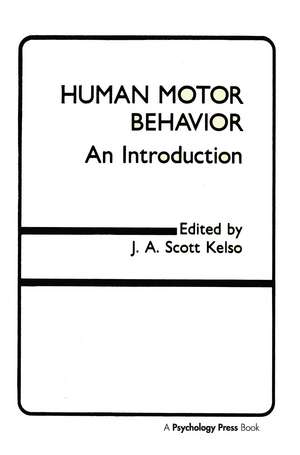
Human Motor Behavior: An Introduction
Autor J.A. Scott Kelsoen Limba Engleză Hardback – aug 1982
Preț: 345.38 lei
Puncte Express: 518
Carte tipărită la comandă
Livrare economică 08-22 decembrie
Livrare prin curier în România Termenul estimat este afișat lângă disponibilitate.
Transport gratuit de la 400.00 lei Plată online sau ramburs, în funcție de opțiunile comenzii.
Retur gratuit în 14 zile Comandă securizată și suport în română.
Specificații
ISBN-13: 9780898591880
ISBN-10: 0898591880
Pagini: 320
Dimensiuni: 152 x 229 x 19 mm
Greutate: 0.48 kg
Ediția:1
Editura: Taylor & Francis
Colecția Psychology Press
Locul publicării:Oxford, United Kingdom
ISBN-10: 0898591880
Pagini: 320
Dimensiuni: 152 x 229 x 19 mm
Greutate: 0.48 kg
Ediția:1
Editura: Taylor & Francis
Colecția Psychology Press
Locul publicării:Oxford, United Kingdom
V-ar putea interesa
-
 -31%Preț: 675.99 lei974.95 lei
 -
 Permanent Present TenseSuzanne Corkin-19%Preț: 76.46 lei93.95 lei
 -
 Brain On Fire: My Month of MadnessSusannah Cahalan-31%Preț: 63.76 lei92.81 lei
 -
 Brain Function and Psychotropic DrugsHeather Ashton-28%Preț: 423.78 lei587.68 lei
 -
 Corticospinal Function and Voluntary MovementRobert Porter-26%Preț: 831.05 lei1129.67 lei
 -
 Calcium Ions in Nerve Cell FunctionPlaton G. Kostyuk-33%Preț: 614.91 lei911.44 lei
 -
 -24%Preț: 547.45 lei718.80 lei
 -
 -20%Preț: 68.81 lei85.66 lei
 -
 The Autisms: Molecules to Model SystemsCraig M. Powell-33%Preț: 1354.41 lei2016.05 lei
 -
 Brain, Mind, and the Structure of RealityPaul L. Nunez-21%Preț: 375.00 lei476.33 lei
 -
 Incomplete NatureTerrence W. DeaconPreț: 298.43 lei
 -
 Language and Action in Cognitive NeuroscienceYann Coello-18%Preț: 1126.68 lei1374.00 lei
Public țintă
ProfessionalRecenzii
"...the book's strengths include a strong emphasis on theory and many examples of the necessity for creative methodology to solve problems related to understanding movement coordination."
—Physical & Occupational Therapy in Pediatrics
—Physical & Occupational Therapy in Pediatrics
Cuprins
Preface, PART I: PERSPECTIVES AND ISSUES IN MOTOR BEHAVIOR I. The Process Approach to Understanding Human Motor Behavior: An Introduction 2. Concepts and Issues in Human Motor Behavior: Coming to Grips with the Jargon PART II: INFORMATION PROCESSING, MOTOR LEARNING, AND MEMORY 3. Information-processing Framework for Understanding Human Motor Behavior 4. Motor Control and Motor Learning: The Closed-loop Perspective 5. Memory for Movement with Emphasis on Short-term Aspects PART III: FROM COMPONENT ANALYSIS TO MOTOR PROGRAMS 6. Component Analysis and Conceptions of Skill 7. Learning and Control of Coordinated Motor Patterns: The Programming Perspective PART IV: GENERALIZED MOTOR PROGRAMS AND SCHEMAS FOR MOVEMENT 8. More on Motor Programs 9. The Schema Concept PART V: DEGREES OF FREEDOM, COORDINATIVE STRUCTURES, AND TUNING 10. The Bernstein Perspective: I. The Problems of Degrees of Freedom and Context-Conditioned Variability I The Bernstein Perspective: II. The Concept of Muscle Linkage or Coordinative Structure 12. The Bernstein Perspective: III. Tuning of Coordinative Structures with Special Reference to Perception. Epilogue: Two Strategies for Investigating Action