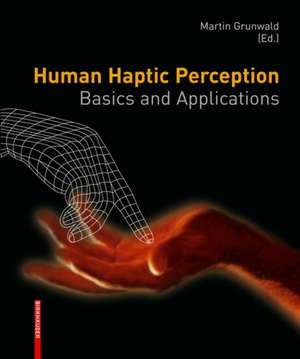
Human Haptic Perception
Editat de Martin Grunwalden Limba Engleză Hardback – 17 oct 2008
În cadrul programelor de studii avansate în neuroștiințe și psihologie experimentală, studiul simțului tactil a ocupat adesea un loc secundar în raport cu cel vizual sau auditiv. Human Haptic Perception, coordonat de Martin Grunwald, vine să corecteze această asimetrie printr-o sinteză monumentală de 600 de pagini, esențială pentru înțelegerea modului în care acțiunile noastre cotidiene sunt ghidate de percepția activă. Ne-a atras atenția rigoarea cu care lucrarea este structurată, pornind de la o bază istorică și epistemologică solidă, care recuperează contribuțiile pionierilor europeni și americani, înainte de a trece la mecanismele neurofiziologice complexe ale receptorilor și plasticității neuronale. Putem afirma că volumul se distinge prin dimensiunea sa enciclopedică, reunind expertiza a 80 de cercetători internaționali. Spre deosebire de The Psychology of Touch de Morton a. Heller, care se concentrează preponderent pe aspecte psihofizice și educaționale, lucrarea de față extinde analiza către frontierele tehnologice moderne. Aceasta reprezintă o alternativă comprehensivă la The Sense of Touch and Its Rendering pentru cursurile de robotică și interfață om-mașină, oferind avantajul unei integrări mai profunde între datele clinice și cele de inginerie haptică. Dincolo de fundamentele teoretice, cuprinsul dezvăluie o progresie logică spre aplicații practice, de la percepția haptică la fetus până la iluziile perceptive și sinestezie. Această abordare este o constantă în opera lui Martin Grunwald, regăsită și în Human Touch in Healthcare sau Lehrbuch Haptik, unde autorul demonstrează relevanța tactilității în profesiile medicale. Ediția publicată de Birkhäuser Basel rămâne un punct de referință pentru cercetătorii care doresc să exploreze nu doar cum simțim, ci și cum putem replica aceste senzații în medii virtuale.
Preț: 643.44 lei
Preț vechi: 794.37 lei
-19%
Carte tipărită la comandă
Livrare economică 24-30 noiembrie
Specificații
ISBN-10: 3764376112
Pagini: 688
Ilustrații: IX, 676 p. 238 illus.
Dimensiuni: 198 x 248 x 43 mm
Greutate: 1.45 kg
Ediția:2008
Editura: birkhäuser
Locul publicării:Basel, Switzerland
V-ar putea interesa
-
 -29%Preț: 66.72 lei94.39 lei
 -
 -10%Preț: 373.73 lei413.20 lei
 -
 The Visual (Un)Conscious and Its (Dis)Contents: A microtemporal approachBruno G. Breitmeyer-31%Preț: 386.86 lei560.43 lei
 -
 Surrounding Free Will: Philosophy, Psychology, NeuroscienceAlfred R. Mele-31%Preț: 628.50 lei910.54 lei
 -
 -34%Preț: 570.52 lei867.38 lei
 -
 -32%Preț: 539.46 lei797.96 lei
 -
 -31%Preț: 792.55 lei1148.53 lei
 -
 Collective EmotionsChristian von Scheve-31%Preț: 813.66 lei1174.88 lei
 -
 Emotion and Decision-making ExplainedEdmund T. Rolls-26%Preț: 503.35 lei683.29 lei
 -
 Aesthetics and the Sciences of MindGreg Currie-31%Preț: 634.50 lei919.61 lei
 -
 The Brain Supremacy: Notes from the frontiers of neuroscienceKathleen TaylorPreț: 223.04 lei
 -
 Transcranial Magnetic StimulationAlexander Rotenberg-18%Preț: 1448.36 lei1766.30 lei
 -
 Biopsy Diagnosis of Peripheral NeuropathyJuan M. Bilbao-5%Preț: 1530.78 lei1611.34 lei
Public țintă
ResearchDe ce să citești această carte
Recomandăm această lucrare cercetătorilor și studenților din neuroștiințe, inginerie și psihologie care au nevoie de un fundament teoretic robust despre simțul tactil. Cititorul câștigă o perspectivă 360 de grade asupra sistemului haptic, de la anatomia receptorilor până la implementări în robotica modernă. Este o resursă rară care unifică istoria științei cu tehnologia de vârf, oferind explicații clare pentru fenomene complexe precum memoria de lucru haptică.
Cuprins
Textul de pe ultima copertă
In this book an international team of 80 authors presents a comprehensive collection of writings on both aspects of research on human haptic perception.
After a theoretical and historical introduction, the chapters are dedicated to neurophysiological basics as well as the psychological, clinical and neuropsychological aspects of haptic perception. Results of studies into human haptic perception in the fields of virtual haptics and robotics are also included. In the final section, contributions from the applied and industrial sectors illustrate the practical uses of knowledge about the human sense of touch.
This easily accessible textbook gives not only students,scientists and those with prior knowledge, but also interested laypersons insights into a fascinating area of study that is constantly discovering new challenges and presenting innovative solutions.