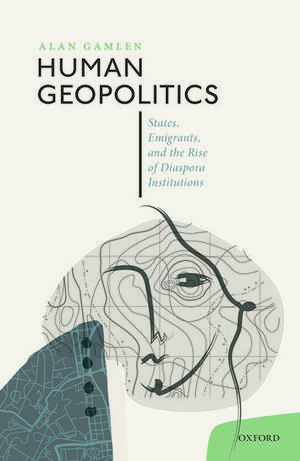
Human Geopolitics: States, Emigrants, and the Rise of Diaspora Institutions
Autor Alan Gamlenen Limba Engleză Hardback – 2 mai 2019
Preț: 712.10 lei
Preț vechi: 1031.82 lei
-31%
Puncte Express: 1068
Carte tipărită la comandă
Livrare economică 27 noiembrie-08 decembrie
Livrare prin curier în România Termenul estimat este afișat lângă disponibilitate.
Transport gratuit pentru acest produs Plată online sau ramburs, în funcție de opțiunile comenzii.
Retur gratuit în 14 zile Comandă securizată și suport în română.
Specificații
ISBN-13: 9780198833499
ISBN-10: 0198833490
Pagini: 352
Dimensiuni: 157 x 241 x 25 mm
Greutate: 0.65 kg
Editura: OUP OXFORD
Colecția OUP Oxford
Locul publicării:Oxford, United Kingdom
ISBN-10: 0198833490
Pagini: 352
Dimensiuni: 157 x 241 x 25 mm
Greutate: 0.65 kg
Editura: OUP OXFORD
Colecția OUP Oxford
Locul publicării:Oxford, United Kingdom
Recenzii
Gamlen has produced an ambitious and compelling work that can, and should, be employed as a catalyst for further research into the complexity of global diaspora and migration policymaking.
With Human Geopolitics, Alan Gamlen crowns more than a decade of work studying diaspora institutions.... Human Geopoliticsdescribes the impressive trend for creating diaspora institutions, provides explanations as to why that trend took hold and, most grippingly, provides a narrative of how it occurred. The book has a remarkable geographic scope, providing short case studies of the creation of diaspora institutions in all regions of the world. ...Because of its coverage, this study seems fundamental to the development of the literature on diasporas.... the book serves as a splendid appetiser for developing many enticing research projects... Intriguing models pepper the book through and through,...
Gamlen's Human Geopolitics makes a convincing argument for the changing nature of diaspora governance based on a comparative mixed-method study with an impressive global and longitudinal scope. The book provides a compelling story about the political drivers of this process and invites scholars to further explore, both qualitatively and quantitatively,geographic and temporal variation in adherence to this new global trend. The original data collected by the author will doubtless be in high demand not just among migration and diaspora scholars, but also within the field of citizenship studies at large.
Alan Gamlen's Human Geopoliticsenters this field as a powerful and especially well-informed critical analysis....This empirical analysis is another key reason why the book will become an essential reference in this field....no one has attempted such an authoritative and wide-ranging review before and this becomes the reference to which all other attempts must improve on.... The central conclusion is a powerful one: the rapid spread of diaspora institutions results from a network of international organisations sponsoring global policy exchanges and is evidence of an evolving migration regime. This is ground-breaking stuff, it demonstrates the value of theoretical analysis of the fantastic new policy database and presents an important response to the 'missing regime' thesis of global migration governance.... The book has provided a framework of very significant and lasting value....
Alan Gamlen has written an ambitious and insightful book on the emergence and spread of diaspora management institutions.....He provides a superb intellectual history of the process and unpacks the mechanisms....There is no doubt that the phenomenon under study inHuman Geopolitics is of critical importance today.... Alan Gamlen has written an important comparative book that will be widely read and debated by political scientists, sociologists, political geographers, and migration studies scholars. His empirical work documenting the spread of diaspora institutions already constitutes a seminal 'academic public good'; while the intellectual history of the emerging global migration regime he has provided us with is a well-timed and much appreciated contribution.
With Human Geopolitics, Alan Gamlen crowns more than a decade of work studying diaspora institutions.... Human Geopoliticsdescribes the impressive trend for creating diaspora institutions, provides explanations as to why that trend took hold and, most grippingly, provides a narrative of how it occurred. The book has a remarkable geographic scope, providing short case studies of the creation of diaspora institutions in all regions of the world. ...Because of its coverage, this study seems fundamental to the development of the literature on diasporas.... the book serves as a splendid appetiser for developing many enticing research projects... Intriguing models pepper the book through and through,...
Gamlen's Human Geopolitics makes a convincing argument for the changing nature of diaspora governance based on a comparative mixed-method study with an impressive global and longitudinal scope. The book provides a compelling story about the political drivers of this process and invites scholars to further explore, both qualitatively and quantitatively,geographic and temporal variation in adherence to this new global trend. The original data collected by the author will doubtless be in high demand not just among migration and diaspora scholars, but also within the field of citizenship studies at large.
Alan Gamlen's Human Geopoliticsenters this field as a powerful and especially well-informed critical analysis....This empirical analysis is another key reason why the book will become an essential reference in this field....no one has attempted such an authoritative and wide-ranging review before and this becomes the reference to which all other attempts must improve on.... The central conclusion is a powerful one: the rapid spread of diaspora institutions results from a network of international organisations sponsoring global policy exchanges and is evidence of an evolving migration regime. This is ground-breaking stuff, it demonstrates the value of theoretical analysis of the fantastic new policy database and presents an important response to the 'missing regime' thesis of global migration governance.... The book has provided a framework of very significant and lasting value....
Alan Gamlen has written an ambitious and insightful book on the emergence and spread of diaspora management institutions.....He provides a superb intellectual history of the process and unpacks the mechanisms....There is no doubt that the phenomenon under study inHuman Geopolitics is of critical importance today.... Alan Gamlen has written an important comparative book that will be widely read and debated by political scientists, sociologists, political geographers, and migration studies scholars. His empirical work documenting the spread of diaspora institutions already constitutes a seminal 'academic public good'; while the intellectual history of the emerging global migration regime he has provided us with is a well-timed and much appreciated contribution.
Notă biografică
Alan Gamlen is a Professor in the School of Regulation and Global Governance at The Australian National University. He is an expert on human migration and mobility. Alan has previously held appointments at Oxford University, Stanford University, the Max Planck Society, the Japan Centre for Area Studies, Monash University and Wellington University in his homeland, New Zealand. He holds a Doctorate from the University of Oxford (St Antony's College), where he studied as a New Zealand Top Achiever Scholar.
Cuprins
- 1: Human Geopolitics
- 2: The Global Rise of Diaspora Institutions
- 3: Exile Ingathering: An Exposition
- 4: Regime Shocks in India, Mexico, and Eritrea
- 5: Labour Export from the Asian Body Shops
- 6: Intercultural Borders in Europe and its Emulators
- 7: Human Geopolitics in the Black Sea and Beyond
- 8: Diaspora Engagement Goes Global
- 9: Orchestrating a Migration Regime
- 10: Following Diaspora Policies
- 11: Conclusion
- pendix 1: Full List of Diaspora Institutions in the Study, with Sources
- Appendix 2: Origin State Interviews and Formal Statements
- Appendix 3: International Organisations and Donor States