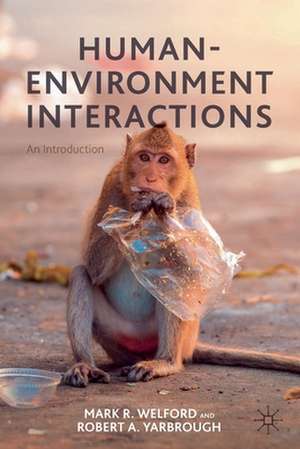
Human-Environment Interactions
Autor Mark R. Welford, Robert A. Yarbroughen Limba Engleză Paperback – 7 oct 2020
This textbook explores the growing area of human-environment interaction. We live in the Anthropocene, an era dominated by humans, but also by the positive yet destructive environmental feedbacks that are poised to completely reset the relationships between nature and society. Modern and historic political, social, and cultural processes and physical landscape responses determine the intensity of these impacts. Yet different cultural groups, political and economic entities view, react to, and impact these human-environmental processes in spatially distinct and divergent ways.
Providing an accessible, up-to-date, approach to human-environment interactions with balanced coverage of both social and natural science approaches to core environmental issues, this textbook is an integrative, multi-disciplinary offering that discusses environmental issues and processes within the context of human societies. The book begins by addressing the three most pressing issues of our time: climate change, threshold exceedance, and the 6th mass extinction. From there the authors identify within chapters on resources, population, agriculture and urbanization what precipitated and continues to sustain these three issues. They end with a chapter outlining some practical solutions to our human-environment crises.
The book will be a valuable resource for interdisciplinary environment related courses bridging the gap between the social and natural sciences, human geographies and physical geographies.
Preț: 453.95 lei
Puncte Express: 681
Carte tipărită la comandă
Livrare economică 24 noiembrie-08 decembrie
Livrare prin curier în România Termenul estimat este afișat lângă disponibilitate.
Transport gratuit pentru acest produs Plată online sau ramburs, în funcție de opțiunile comenzii.
Retur gratuit în 14 zile Comandă securizată și suport în română.
Specificații
ISBN-13: 9783030560317
ISBN-10: 3030560317
Pagini: 260
Ilustrații: IX, 249 p. 23 illus., 21 illus. in color.
Dimensiuni: 155 x 235 x 15 mm
Greutate: 0.37 kg
Ediția:1st edition 2021
Editura: Springer
Locul publicării:Cham, Switzerland
ISBN-10: 3030560317
Pagini: 260
Ilustrații: IX, 249 p. 23 illus., 21 illus. in color.
Dimensiuni: 155 x 235 x 15 mm
Greutate: 0.37 kg
Ediția:1st edition 2021
Editura: Springer
Locul publicării:Cham, Switzerland
Cuprins
Chapter 1: Introduction.- Chapter 2: Climate Change.- Chapter 3: Extinctions.- Chapter 4: Thresholds.- Chapter 5: Resources.- Chapter 6: Population.- Chapter 7: Agriculture.- Chapter 8: Urbanization.- Chapter 9: Practical Solutions.
Textul de pe ultima copertă
This textbook explores the growing area of human-environment interaction. We live in the Anthropocene, an era dominated by humans, but also by the positive yet destructive environmental feedbacks that are poised to completely reset the relationships between nature and society. Modern and historic political, social, and cultural processes and physical landscape responses determine the intensity of these impacts. Yet different cultural groups, political and economic entities view, react to, and impact these human-environmental processes in spatially distinct and divergent ways.
Providing an accessible, up-to-date, approach to human-environment interactions with balanced coverage of both social and natural science approaches to core environmental issues, this textbook is an integrative, multi-disciplinary offering that discusses environmental issues and processes within the context of human societies. The book begins by addressing the three most pressing issues of our time: climate change, threshold exceedance, and the 6th mass extinction. From there the authors identify within chapters on resources, population, agriculture and urbanization what precipitated and continues to sustain these three issues. They end with a chapter outlining some practical solutions to our human-environment crises.
The book will be a valuable resource for interdisciplinary environment related courses bridging the gap between the social and natural sciences, human geographies and physical geographies.
Mark R. Welford is Head and Professor of Geography at the University of Northern Iowa, USA. He is the author of Geographies of Plague Pandemics: The Spatial-Temporal Behavior of Plague to the Modern Day. He is also a co-Principal Investigator on a National Science Foundation RAPID grant entitled “Tracking and Understanding Spatiotemporal Dynamics of the COVID-19 Pandemic in the Arctic.”
Robert A. Yarbrough is Associate Professor of Geography in the Department of Geology and Geography at Georgia Southern University, USA. His research areas include nature-society geographies, critical cultural geographies, and immigration.
Caracteristici
Written in an accessible and engaging style to appeal to undergraduate students looking for an engaging overview of this important field Provides an accessible, up-to-date, integrative approach to human-environment interactions Brings together both social and natural science approaches to core environmental issues Includes numerous illustrative case studies throughout the text