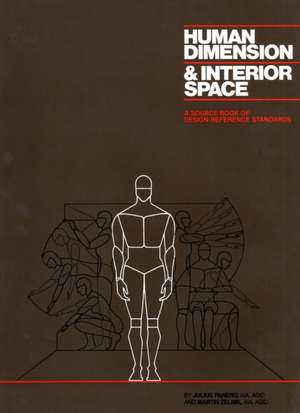
Human Dimension and Interior Space
Autor Julius Panero, Martin Zelniken Limba Engleză Hardback – noi 1979
Deschizând paginile acestui album fundamental, Human Dimension and Interior Space, suntem întâmpinați de o rigoare vizuală care transformă anatomia umană în geometrie aplicată. Experiența este una a clarității absolute: peste 300 de ilustrații alb-negru și diagrame tehnice ne ghidează privirea de la detaliul unei articulații până la complexitatea unui spațiu de birouri sau a unei locuințe. Observăm cum Julius Panero și Martin Zelnik reușesc să vizualizeze invizibilul — interfața fizică dintre corp și obiectele care îl înconjoară. Găsim în această carte o structură tripartită care echilibrează teoria cu pragmatismul. Prima parte ne familiarizează cu fundamentele antropometriei, oferind o perspectivă empatică prin includerea standardelor pentru persoanele în vârstă sau cu dizabilități. Partea a doua ne prezintă tabele de date organizate pe percentile, în timp ce a treia secțiune, cea mai spectaculoasă vizual, oferă sute de desene în plan și secțiune. Complementar volumului Anthropometry de Beata Mrugalska, care se concentrează pe ergonomia la locul de muncă, lucrarea de față extinde analiza asupra tuturor tipurilor de medii interioare, de la rezidențial la instituțional. De asemenea, spre deosebire de Metric Handbook, care este un ghid general de planificare, Human Dimension and Interior Space plasează utilizatorul uman, cu toate variațiile sale de dimensiune, în centrul absolut al procesului de proiectare. În contextul operei autorului, această lucrare rafinează viziunea tehnică începută în Time-Saver Standards for Housing and Residential Development, însă aici accentul cade pe detaliul fin al interacțiunii umane. Apreciem în mod deosebit curajul autorilor de a demonta mitul „omului mediu”, oferind în schimb instrumente precise pentru a crea spații adaptabile. Este un volum care nu doar informează, ci educă ochiul proiectantului să vadă dincolo de estetică, către funcționalitatea biologică a spațiului.
Preț: 284.94 lei
Carte disponibilă
Livrare economică 07-21 noiembrie
Livrare express 24-30 octombrie pentru 90.61 lei
Specificații
ISBN-10: 0823072711
Pagini: 320
Ilustrații: 300 b&w illustrations, bibliography, index
Dimensiuni: 237 x 309 x 30 mm
Greutate: 1.5 kg
Ediția:Revised
Editura: Clarkson Potter/Ten Speed
V-ar putea interesa
-
 Preț: 416.81 lei
 -
 Metric Handbook: Planning and Design DataPamela Buxton-8%Preț: 459.21 lei499.13 lei
 -
 The Measure of Man and WomanAlvin R Tilley-19%Preț: 504.53 lei622.88 lei
 -
 ManualsAdrian Shaughnessy-17%Preț: 644.27 lei773.63 lei
 -
 The Interior Design CourseTomris TangazPreț: 126.15 lei
 -
 New Nordic DesignDorothea Gundtoft-16%Preț: 124.70 lei147.99 lei
 -
 AdaptableHerman PontzerPreț: 193.37 lei
 -
 The Pocket Universal Principles of Interior DesignKelly Harris Smith-19%Preț: 81.02 lei100.20 lei
 -
 Design Master Class 100 RoomsCarl DellatorePreț: 384.18 lei
 -
 -19%Preț: 432.56 lei534.02 lei
 -
 Architects' DataErnst Neufert-19%Preț: 595.38 lei735.04 lei
 -
 The MaximalistDani DazeyPreț: 283.75 lei
 -
 The EssentialsCaitlin FlemmingPreț: 286.30 lei
 -
 Interior Design CourseTomris TangazPreț: 143.13 lei
 -
 -16%Preț: 79.53 lei95.03 lei
 -
 Evidence-Based Design for Interior DesignersLinda L. Nussbaumer-36%Preț: 592.93 lei921.17 lei
 -
 -18%Preț: 120.39 lei146.22 lei
 -
 The Scandinavian Home: Interiors inspired by lightNiki Brantmark-21%Preț: 156.62 lei198.37 lei
 -
 The Incomplete (Updated Edition)GestaltenPreț: 365.90 lei
 -
 Human Factors in the Built Environment: Studio Instant AccessLinda L. Nussbaumer-22%Preț: 510.52 lei652.82 lei
De ce să citești această carte
Recomandăm această carte oricărui profesionist sau student din domeniul designului de interior și arhitecturii care dorește să fundamenteze estetica pe date ergonomice solide. Veți câștiga acces la un sistem de standarde esențiale, ilustrate clar, care elimină presupunerile din procesul de proiectare. Este resursa definitivă pentru a înțelege cum dimensiunile corpului uman dictează confortul și eficiența într-un spațiu construit, asigurând o abordare incluzivă și precisă.
Despre autor
Julius Panero este un arhitect și designer de interior recunoscut, activând în New York ca partener în cadrul firmei Panero Zelnik Associates. Expertiza sa vastă în planificarea spațiului și standarde de proiectare l-a consacrat ca o autoritate în domeniul antropometriei aplicate. Alături de partenerul său, Martin Zelnik, a contribuit semnificativ la literatura de specialitate, oferind resurse care au devenit referințe standard în facultățile de arhitectură și design din întreaga lume. Opera sa se concentrează pe optimizarea relației dintre mediul construit și nevoile fizice ale utilizatorilor.
Notă biografică
Descriere scurtă
Human Dimension and Interior Space is the first major anthropometrically based reference book of design standards for use by all those involved with the physical planning and detailing of interiors, including interior designers, architects, furniture designers, builders, industrial designers, and students of design. The use of anthropometric data, although no substitute for good design or sound professional judgment should be viewed as one of the many tools required in the design process. This comprehensive overview of anthropometrics consists of three parts.
The first part deals with the theory and application of anthropometrics and includes a special section dealing with physically disabled and elderly people. It provides the designer with the fundamentals of anthropometrics and a basic understanding of how interior design standards are established. The second part contains easy-to-read, illustrated anthropometric tables, which provide the most current data available on human body size, organized by age and percentile groupings. Also included is data relative to the range of joint motion and body sizes of children. The third part contains hundreds of dimensioned drawings, illustrating in plan and section the proper anthropometrically based relationship between user and space. The types of spaces range from residential and commercial to recreational and institutional, and all dimensions include metric conversions.
In the Epilogue, the authors challenge the interior design profession, the building industry, and the furniture manufacturer to seriously explore the problem of adjustability in design. They expose the fallacy of designing to accommodate the so-called average man, who, in fact, does not exist. Using government data, including studies prepared by Dr. Howard Stoudt, Dr. Albert Damon, and Dr. Ross McFarland, formerly of the Harvard School of Public Health, and Jean Roberts of the U.S. Public Health Service, Panero and Zelnik have devised a system of interior design reference standards, easily understood through a series of charts and situation drawings. With Human Dimension and Interior Space, these standards are now accessible to all designers of interior environments.